
Google’s Top 50 Ranking Factors for 2026: Confirmed, Likely and Myth

You have probably seen the number 200.
It turns up on every list of Google ranking factors ever published. Nobody has sourced it.
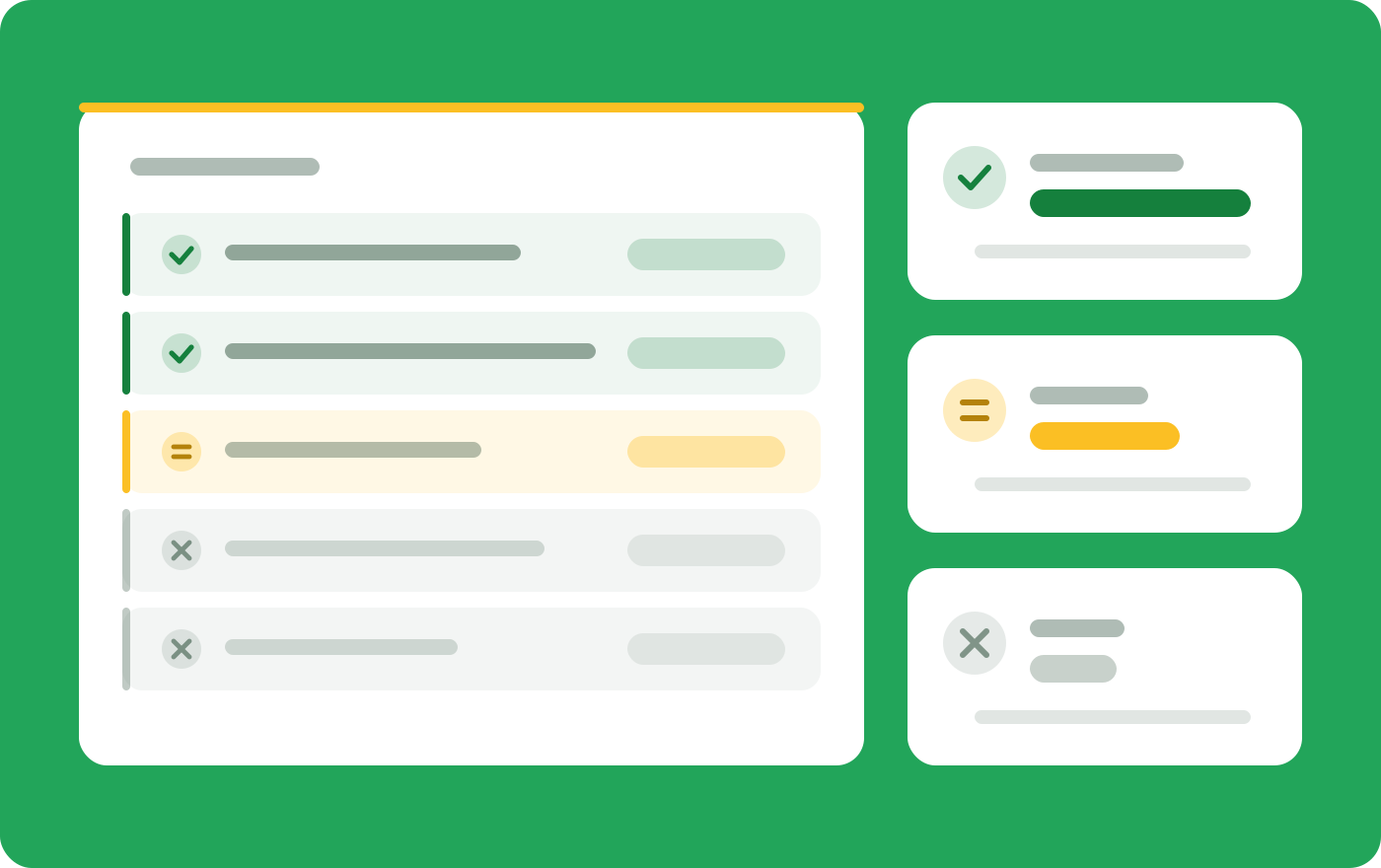
Google has confirmed about two dozen.
This page marks fifty claims Confirmed, Likely or Myth. Each one shows you the evidence.
Confirmed means Google said so, with a date you can check. Likely means the 2024 API leak or repeated observation supports it, and Google has stayed quiet. Myth means Google’s own statements contradict it.
Here is how to tell the difference.
What is a Google ranking factor?
A ranking factor is an input Google’s systems use to order results.
Google uses a slightly different word, and the difference matters. Google publishes a guide to its ranking systems. Not its factors.
A signal is an input. HTTPS is a signal. Your page either serves over HTTPS or it does not.
A ranking system weighs signals and produces an order. RankBrain is a system. You cannot optimise for it, because it is not something your page has.
A ranking factor, as the industry uses the term, covers both.
That looseness is where the long lists go wrong. It lets a system, a signal, a search feature and a recovery tool sit in one numbered sequence as if they were the same kind of thing.
Google’s November 2022 guide is the closest thing to an official list. It names seventeen systems, plus four retired ones.
It is not a list of 200 anything.
How many Google ranking factors are there?
Nobody outside Google knows.
Google has never published the number. The figure you keep seeing traces back to one remark.
In 2009, Matt Cutts, then head of Google’s webspam team, referred to the algorithm using “over 200 variables.”
That became “over 200 ranking factors.” It has been repeated for seventeen years by pages citing each other instead of him.
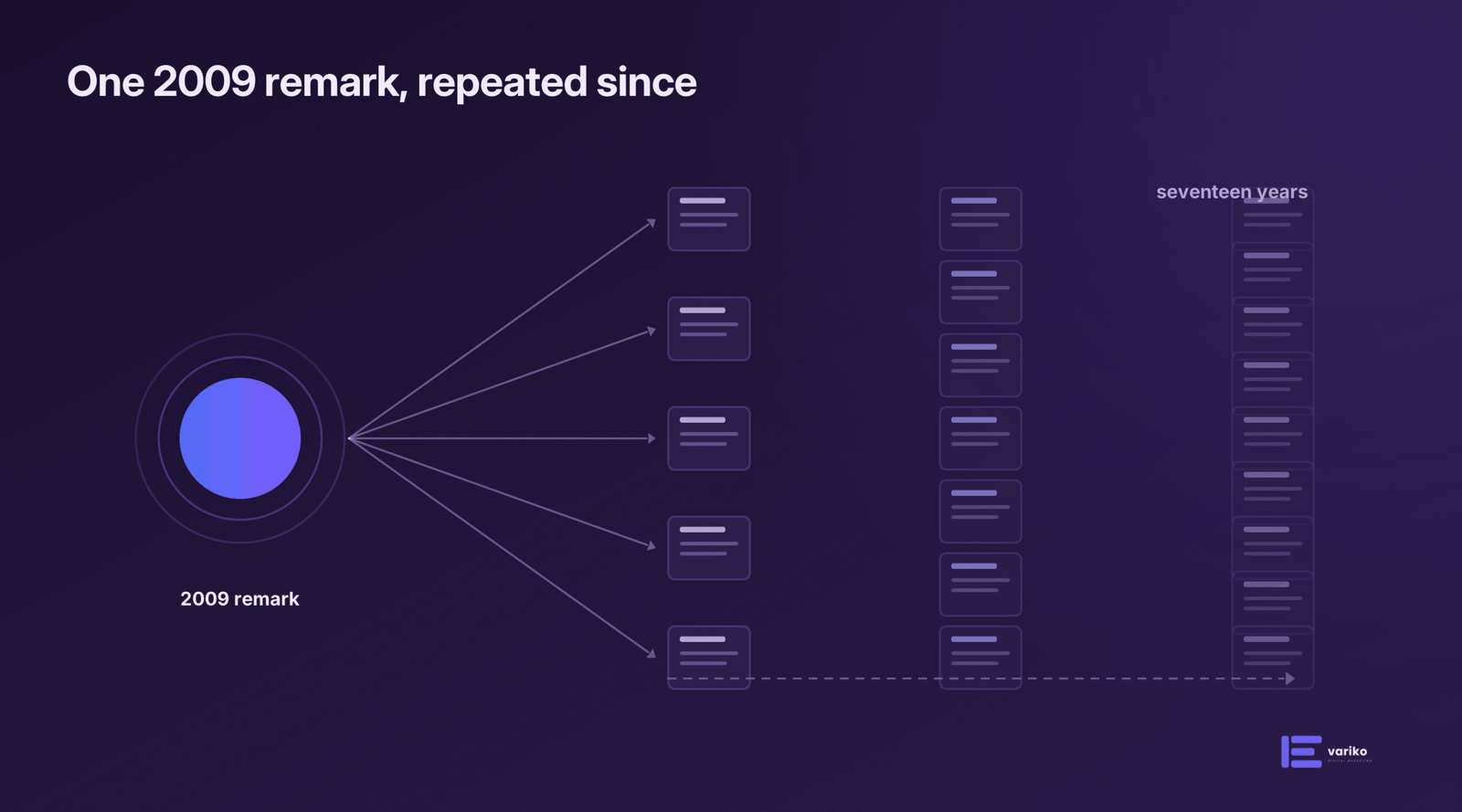
All five of the top-ranking pages for this query repeat it. None of them sources it.
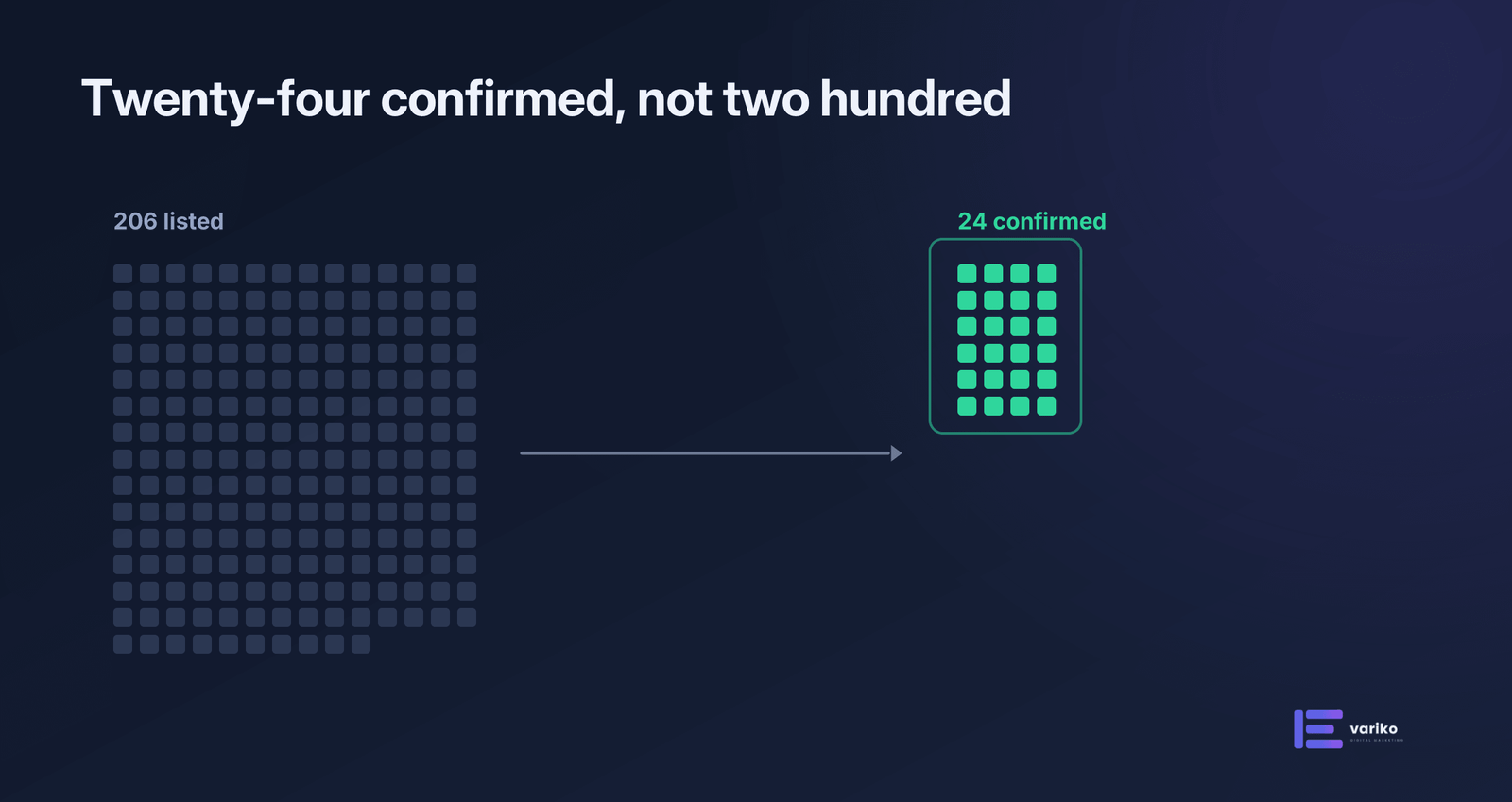
The page ranking first asserts it in the opening paragraph. Then it lists 206 items. About twenty of those are old algorithm updates, search features or recovery tools.
Eight more are factors that same page says Google has denied. The denial is printed inside the entry. The entry stays in the list.
The number is not even useful. Google runs many systems, several of them machine-learned, and those do not break down into a list. A count tells you nothing about weighting.
This page adjudicates fifty claims. Twenty-four are Confirmed.
That is the number I can defend. It is an order of magnitude below the one in circulation.
How do you tell a real ranking factor from a repeated claim?
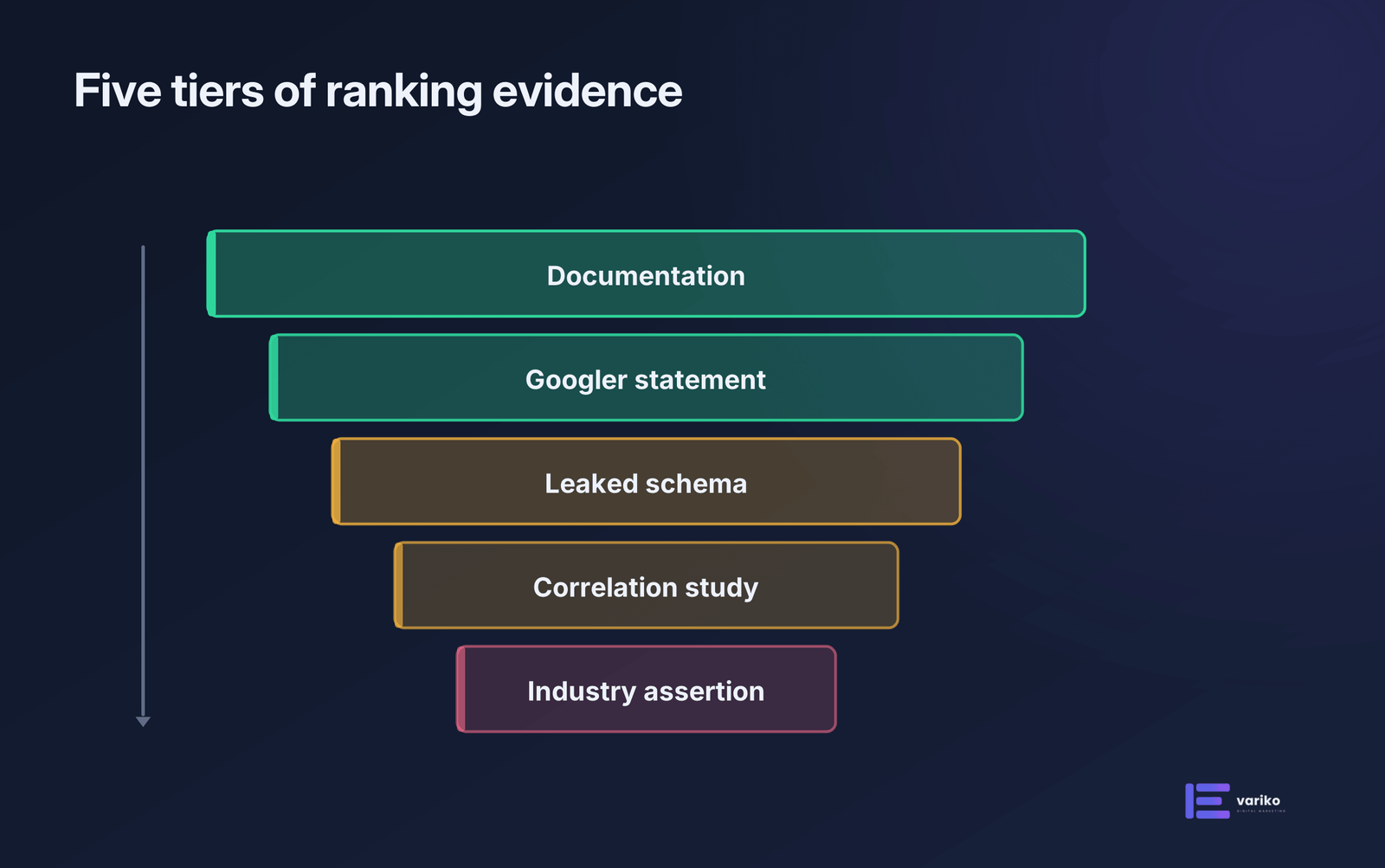
Evidence about ranking comes in five kinds. They are not equal.
Rank them once and you have a test you can use on any claim. Including mine.
- Google’s own documentation. Published and maintained. The strongest thing available.
- An on-record statement from a named Googler. Weaker, because nobody maintains it. A 2014 blog post stays up. A 2017 remark in a hangout never gets corrected.
- The leaked internal schema. The May 2024 documents name thousands of fields. Naming a field is not the same as showing it is live.
- A correlation study. Tells you what ranking pages have in common. Says nothing about cause. Section eleven explains why.
- An industry assertion. A blog post, a vendor metric, a conference slide. Worth reading. Worth nothing as evidence.
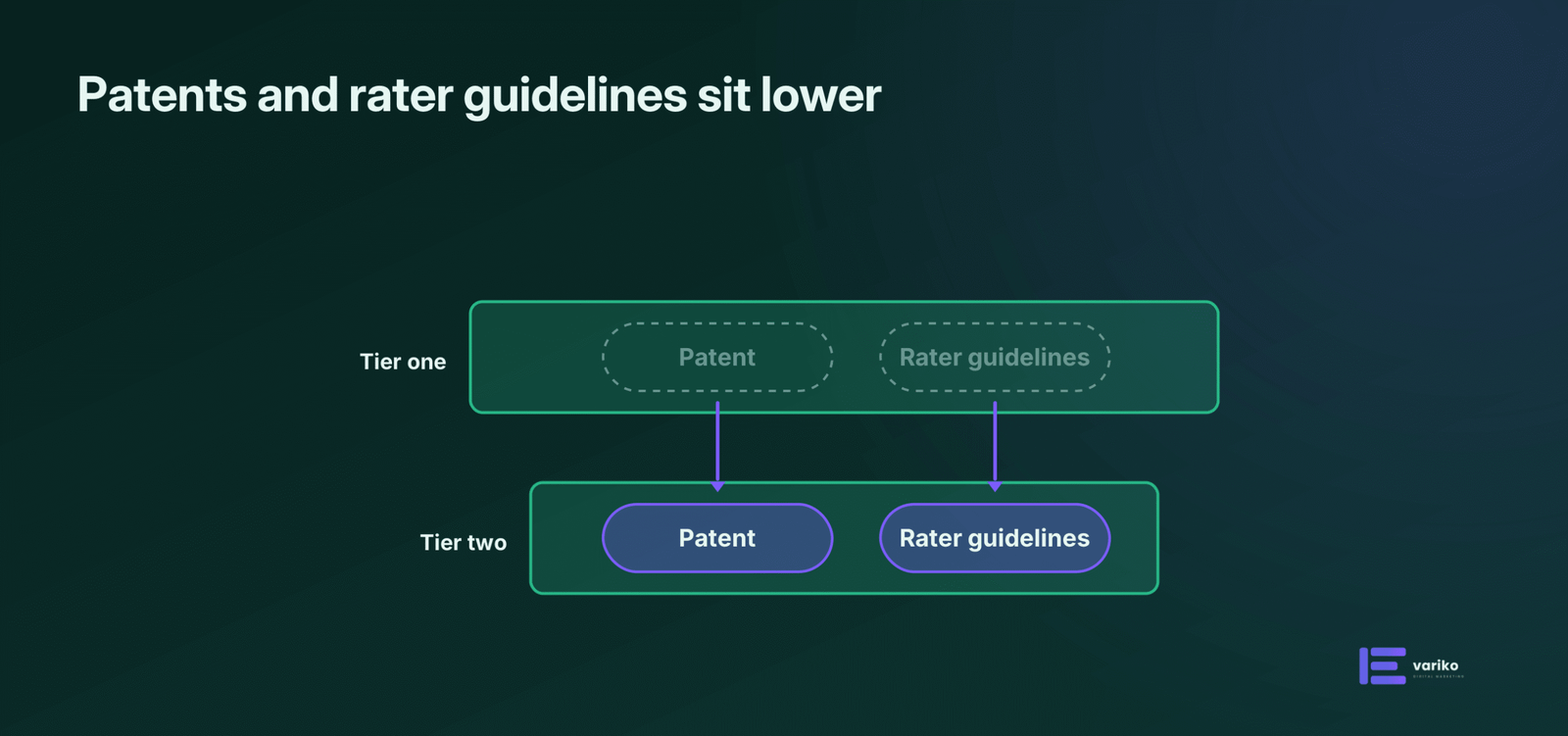
Two things get mistaken for tier one. Neither belongs there.
A Google patent shows what Google thought worth patenting. It does not show what ships, or when. The page ranking first for this query cites one filed in 2013.
The Quality Rater Guidelines tell human raters how to score sample results. They do not describe the algorithm. That same page cites them as factor evidence four separate times.
Both sit at tier two at best. Treat them as a signal of Google’s thinking, not as a statement about ranking.
The three verdicts come straight out of that order.
Confirmed needs tier one or two. Google said it. You can point at where and when.
Likely rests on tier three or four. The evidence leans one way and Google has not spoken.
Myth means Google contradicts the claim, or it traces to tier five and stops there.
One thing the standard does not tell you is how much a factor matters.
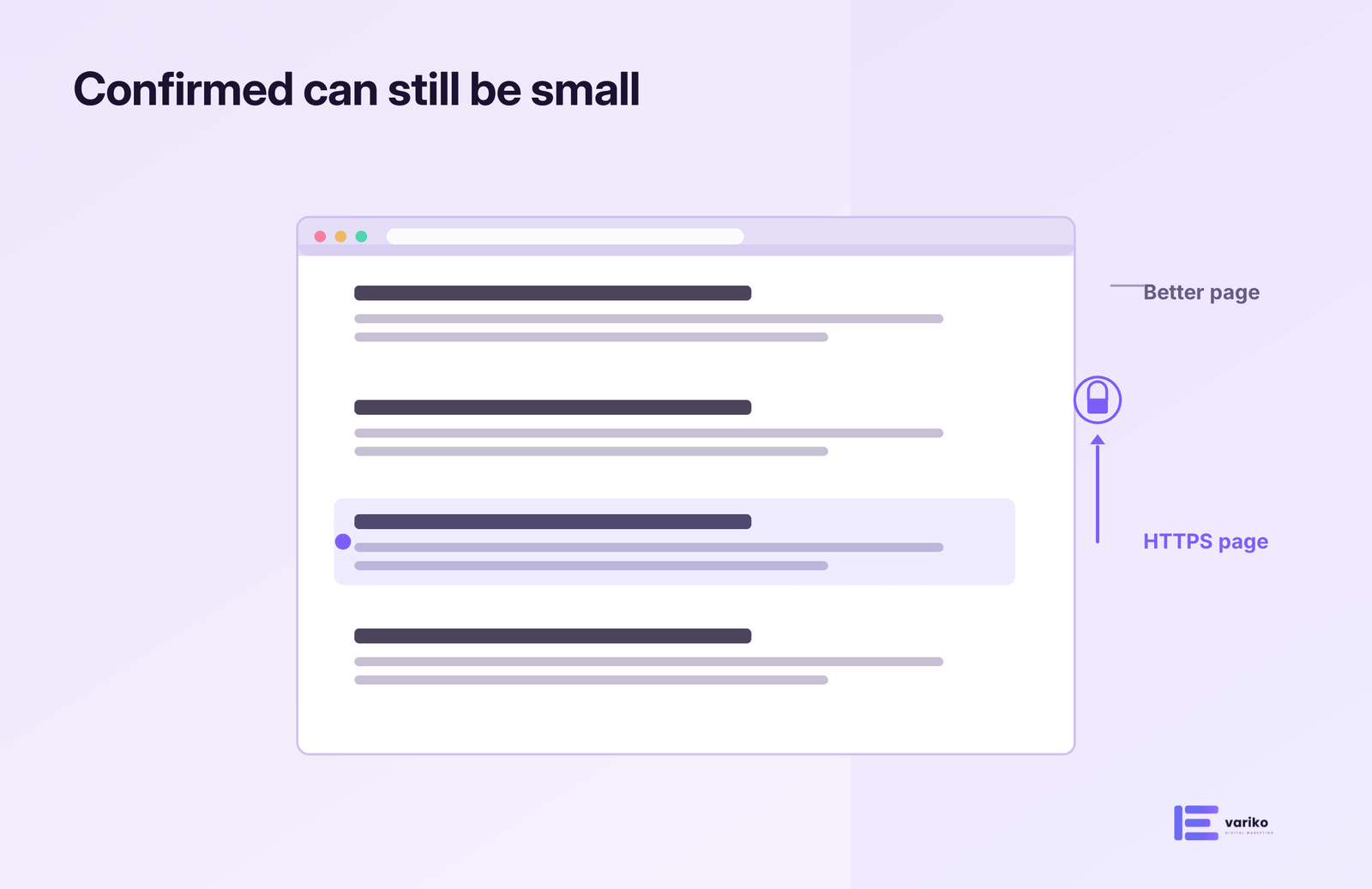
A factor can be Confirmed and still barely move anything.
HTTPS is the clearest case. Google announced it in August 2014 and called it lightweight. A certificate has never lifted a page past a better one.
Confirmed and small are not in conflict.
A verdict column that pretended otherwise would mislead you in a new direction.
The fifty factors, adjudicated
The table carries all fifty.
Factor names the claim. Verdict is one of the three words above, used the same way every time.
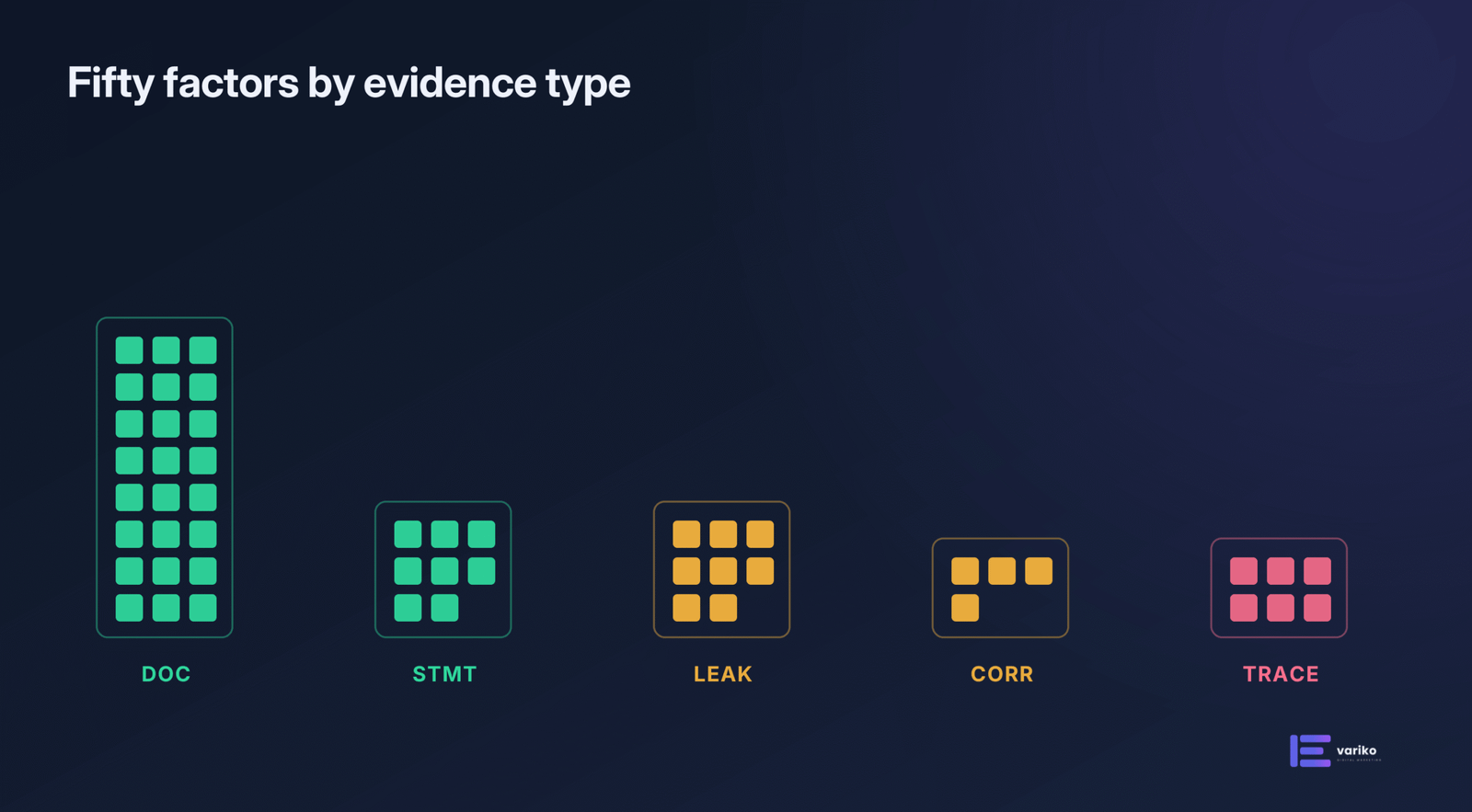
Evidence says which tier the verdict rests on. DOC for Google documentation. STMT for an on-record Google statement. LEAK for the May 2024 documents. CORR for a correlation study. TRACE for a claim followed back to its origin.
Source and date is what you can check. What to do is one line. The mechanism belongs on the page that owns it.
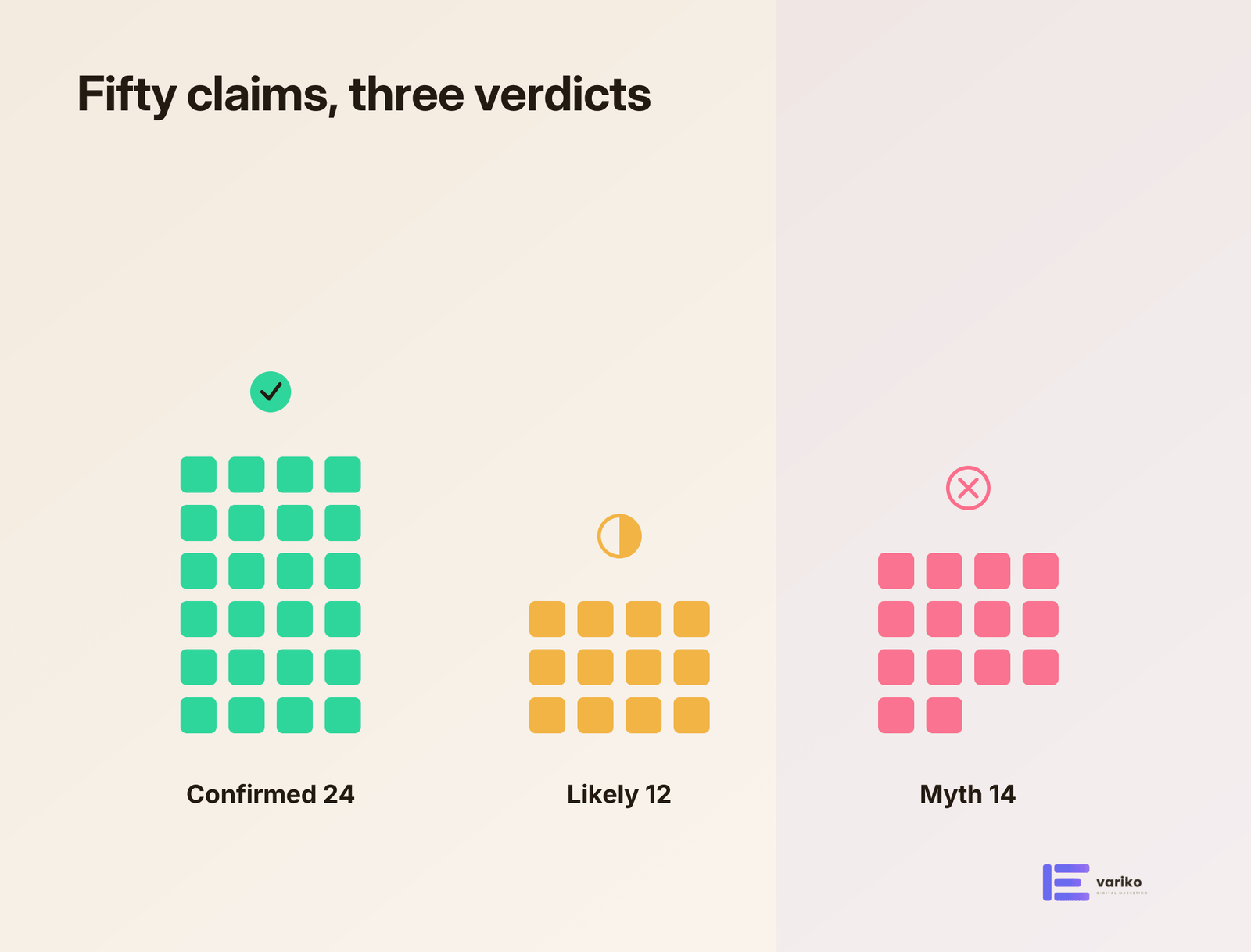
Confirmed … 24
| # | Factor | Evidence | Source and date | What to do |
|---|---|---|---|---|
| 1 | Relevance to the query | DOC | Google, How Search Works, and the ranking systems guide | Answer the query the page targets, in the words readers use for it |
| 2 | Content quality, through the core ranking systems | DOC | Ranking systems guide: the helpful content system “became part of our core ranking systems” in March 2024 | Treat quality as systemic rather than as one more box |
| 3 | Link analysis and PageRank | DOC | Named as a ranking system, 21 November 2022 | Earn links that carry topical relevance |
| 4 | Anchor text as link context | DOC | Google’s link best-practice documentation | Describe the destination, vary the wording |
| 5 | Core Web Vitals | DOC | Page experience documentation: “Core Web Vitals are used by our ranking systems” | Get all three inside threshold, then stop |
| 6 | Interaction to Next Paint | DOC | web.dev: INP replaced FID on 12 March 2024 | Measure INP, not FID |
| 7 | Largest Contentful Paint | DOC | Page experience documentation | Fix the largest above-fold element first |
| 8 | Cumulative Layout Shift | DOC | Page experience documentation | Reserve space for images, ads and late fonts |
| 9 | HTTPS | DOC | Google Webmaster Central, August 2014, described as lightweight | Get a certificate, redirect properly, expect nothing more |
| 10 | Mobile-friendly rendering | DOC | Google Search Central, 21 April 2015 | Pass on real devices, then read row 11 |
| 11 | No single page-experience signal | DOC | Page experience documentation: “There is no single signal” | Fix Core Web Vitals for ranking, the rest for readers |
| 12 | Intrusive interstitials | DOC | Page experience documentation, after the January 2017 rollout | Remove anything that covers the content on arrival |
| 13 | Freshness systems, query-dependent | DOC | Named as a ranking system, November 2022 | Update where the query wants recency, leave the rest alone |
| 14 | Original content systems | DOC | Named as a ranking system, November 2022 | Publish the source, not a summary of one |
| 15 | Deduplication systems | DOC | Named as a ranking system, November 2022 | Consolidate near-duplicates before they compete |
| 16 | Passage ranking | DOC | Named as a ranking system, November 2022 | Make individual sections answer individual questions |
| 17 | Neural matching | DOC | Named as a ranking system, November 2022 | Write about the concept rather than around a phrase |
| 18 | RankBrain | DOC | Named as a ranking system, November 2022 | Nothing direct. It is why exact phrasing stopped mattering |
| 19 | BERT | DOC | Named as a ranking system, November 2022 | Keep sentence structure clean. Prepositions carry meaning |
| 20 | MUM | DOC | Named as a ranking system, November 2022 | Nothing direct |
| 21 | Site diversity system | DOC | Named as a ranking system, November 2022 | Expect about two results per domain on most queries |
| 22 | Spam detection, including SpamBrain | DOC | Named as a ranking system, plus Google’s spam policies | Read the spam policies once and stay inside them |
| 23 | Site reputation, scaled content and expired domain abuse | DOC | Google Search Central, March 2024 spam policies | Do not rent subfolders, mass-generate pages, or buy expired domains for their history |
| 24 | Local pack: relevance, distance, prominence | DOC | Google Business Profile Help, local ranking documentation | Complete the profile, pick the right primary category, earn real reviews |
Likely … 12
| # | Factor | Evidence | Source and date | What to do |
|---|---|---|---|---|
| 25 | Click and engagement signals through NavBoost | LEAK + STMT | Content Warehouse documents name NavBoost with goodClicks, badClicks and lastLongestClicks, May 2024; NavBoost and Glue named in Pandu Nayak’s 2023 DOJ testimony | Earn the click by matching the query, then satisfy it |
| 26 | Site-level quality scoring | LEAK | A site-wide quality attribute in the May 2024 documents | Raise the floor. Thin sections pull the whole domain down |
| 27 | Chrome usage data in page quality | LEAK | Chrome-derived attributes in the May 2024 documents | Nothing direct. A reason not to dismiss real behaviour |
| 28 | Brand strength and unlinked mentions | LEAK + CORR | Brand-entity attributes in the May 2024 documents, plus independent correlation work | Get named in places Google already trusts |
| 29 | Link tiering by quality | LEAK | Tiered link attributes in the May 2024 documents | Fewer placements, better ones |
| 30 | Stored page version history | LEAK | Version-history attributes in the May 2024 documents | Make substantive changes rather than cosmetic ones |
| 31 | Rater feedback entering quality systems | LEAK | Rater-related attributes in the May 2024 documents | Write to the rater guidelines’ standard, not their vocabulary |
| 32 | Topical coverage and topical authority | CORR | No Google statement exists. Repeated independent observation only | Cover one subject completely before opening the next |
| 33 | Internal link distribution | DOC-adjacent | PageRank is documented. How internal links distribute it is inference | Link deliberately, toward the pages that must rank |
| 34 | Content depth and comprehensiveness | CORR | Correlation with pages that happen to rank | Be complete on the question. Length follows |
| 35 | Author and entity identity signals | LEAK | Entity-reference attributes in the May 2024 documents | Real authors, real bios, one consistent name |
| 36 | What decides selection in AI Overviews and AI Mode | DOC-partial | Google documents eligibility and says no special optimisation is needed. Selection logic is unpublished | Write extractable, attributable answers. Read section twelve before acting |
Myth … 14
| # | Claim | Evidence | Where it came from | What is true instead |
|---|---|---|---|---|
| 37 | Google uses over 200 ranking factors | TRACE | A 2009 Matt Cutts remark about “over 200 variables” | The figure has never been confirmed. Twenty-four are |
| 38 | Domain Authority is a Google ranking factor | DOC + TRACE | A Moz metric adopted as shorthand, then promoted to factor status by list articles | Google does not use any vendor’s authority score |
| 39 | E-E-A-T is a direct ranking factor | STMT | The quality rater guidelines read as algorithm documentation | Google has said repeatedly that it is not a direct factor. The fourth letter, Experience, was added in December 2022 |
| 40 | Social signals rank your pages | STMT | Correlation between shares and rankings, read backwards | Not a direct factor. Social gets content in front of people who link to it |
| 41 | Word count and minimum content length | STMT + CORR | Studies reporting the average length of ranking pages | Google has said word count is not a ranking factor. There is no threshold to clear |
| 42 | Keyword density targets | STMT | Pre-2010 on-page tools that measured it because they could | No target has value. Write the terms the subject needs |
| 43 | LSI keywords | STMT | Latent semantic indexing, a real 1980s retrieval technique, misapplied to Google | Google has stated it does not use LSI. Related terms matter; the named technique is not why |
| 44 | Domain age | STMT | Correlation between old domains and strong rankings | John Mueller: “No, domain age helps nothing.” Age is not the asset |
| 45 | Bounce rate as the mechanism | STMT | Google Analytics exposing the metric, plus a plausible story | Google does not read your Analytics. Click behaviour inside the results page is a separate claim, at row 25 |
| 46 | Dwell time as a Google metric | TRACE | SEO commentary, never Google’s vocabulary | No published metric by that name. The underlying idea overlaps row 25 |
| 47 | Schema markup raises rankings | DOC | Rich results appearing above plain ones, read as a lift | Structured data makes a page eligible for rich results. It does not raise position |
| 48 | Meta descriptions rank pages | DOC | Their place in on-page checklists since the 1990s | Not a ranking factor, and Google rewrites them often. They affect clicks |
| 49 | Installing Analytics or Search Console helps | STMT | The inference that Google must use data it can see | Google has denied it. Install both, and expect no ranking effect |
| 50 | AI Overviews need special optimisation | DOC | Vendors selling AI-search optimisation as a distinct discipline | Google’s AI features documentation states there are no additional requirements, no special optimisations, and no special schema |
The Confirmed column is short. Almost all of it comes from two Google pages.
That is not a gap in my research. That is the finding. It is also why every long list has to pad.
That is not a gap in my research. That is the finding. It is also why every long list has to pad.
What has Google actually confirmed?
About two dozen things.
Nearly all of them sit in two documents: Google’s ranking systems guide and its page experience documentation.
Put those two pages next to any 200-item list.
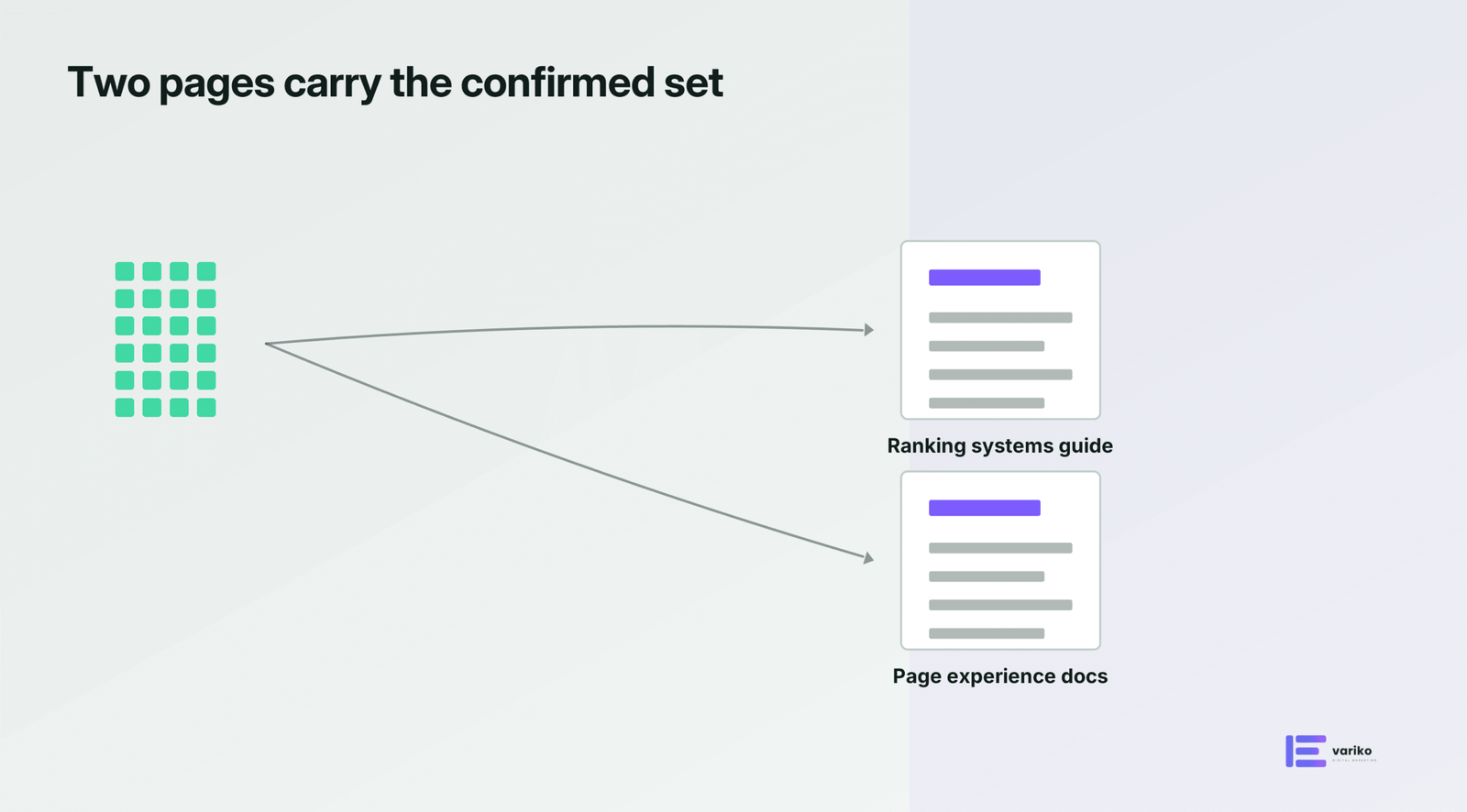
The gap is the list’s own invention.
The confirmed set splits three ways. What Google ranks on. What it ranks with. What it demotes for.
The sections below take them in that order.
Relevance and content quality
Relevance is the one factor nobody argues about.
Google’s documentation describes matching your page to the meaning of a query as the first thing its systems do. Everything else operates on pages that already cleared that bar.
It also comes with the least useful advice attached. Answer the question you set out to answer.
Content quality is confirmed, but not as one signal. It runs through everything.
In March 2024, Google’s helpful content system stopped existing separately. The ranking systems guide now lists it under retired systems:
In March 2024, it evolved and became part of our core ranking systems.
So it did not go away. It got absorbed.

Four more systems decide which relevant, decent page actually shows.
Original content systems prefer the source over the summary.
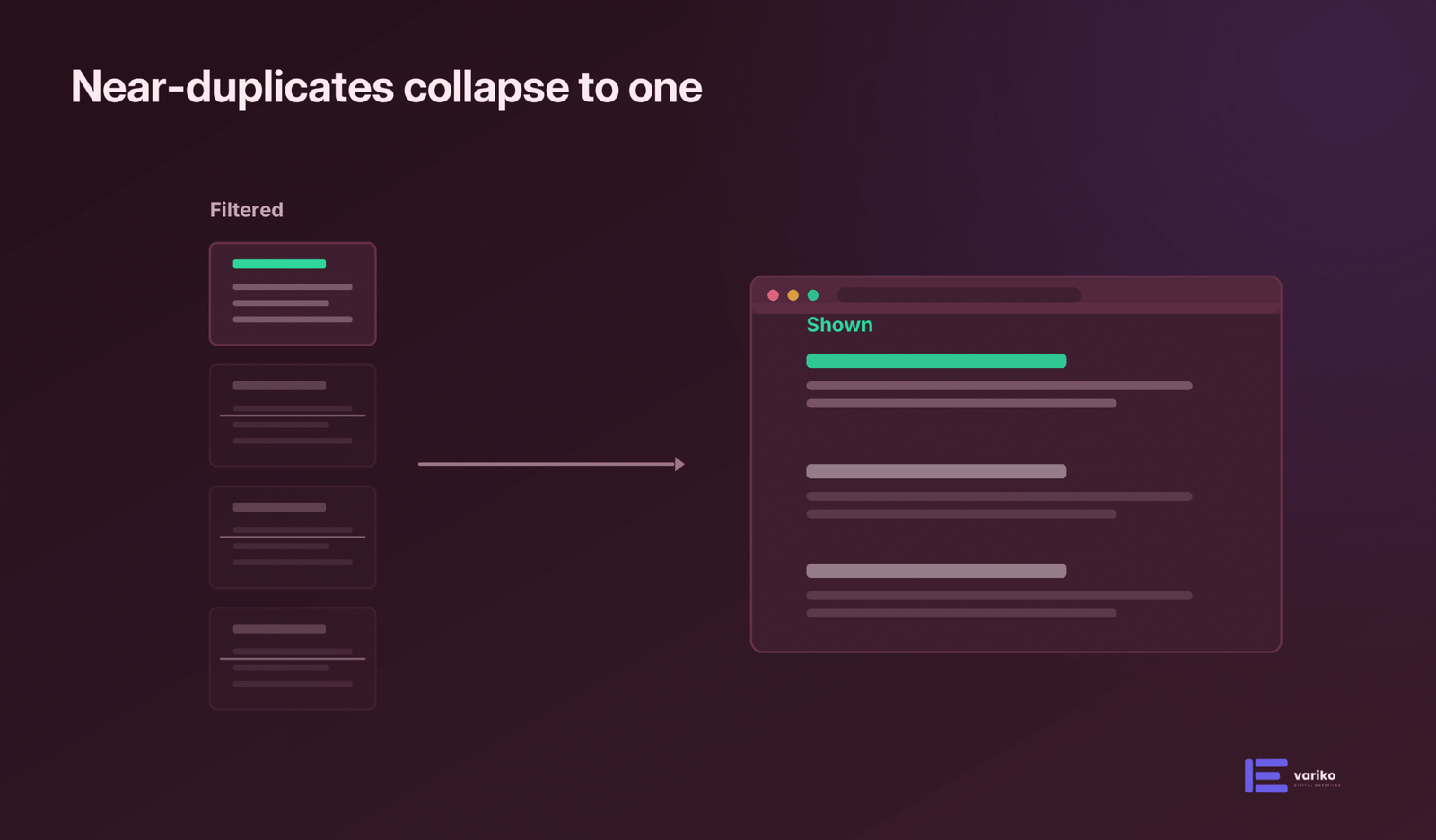
Deduplication systems collapse near-identical pages so one of them shows.
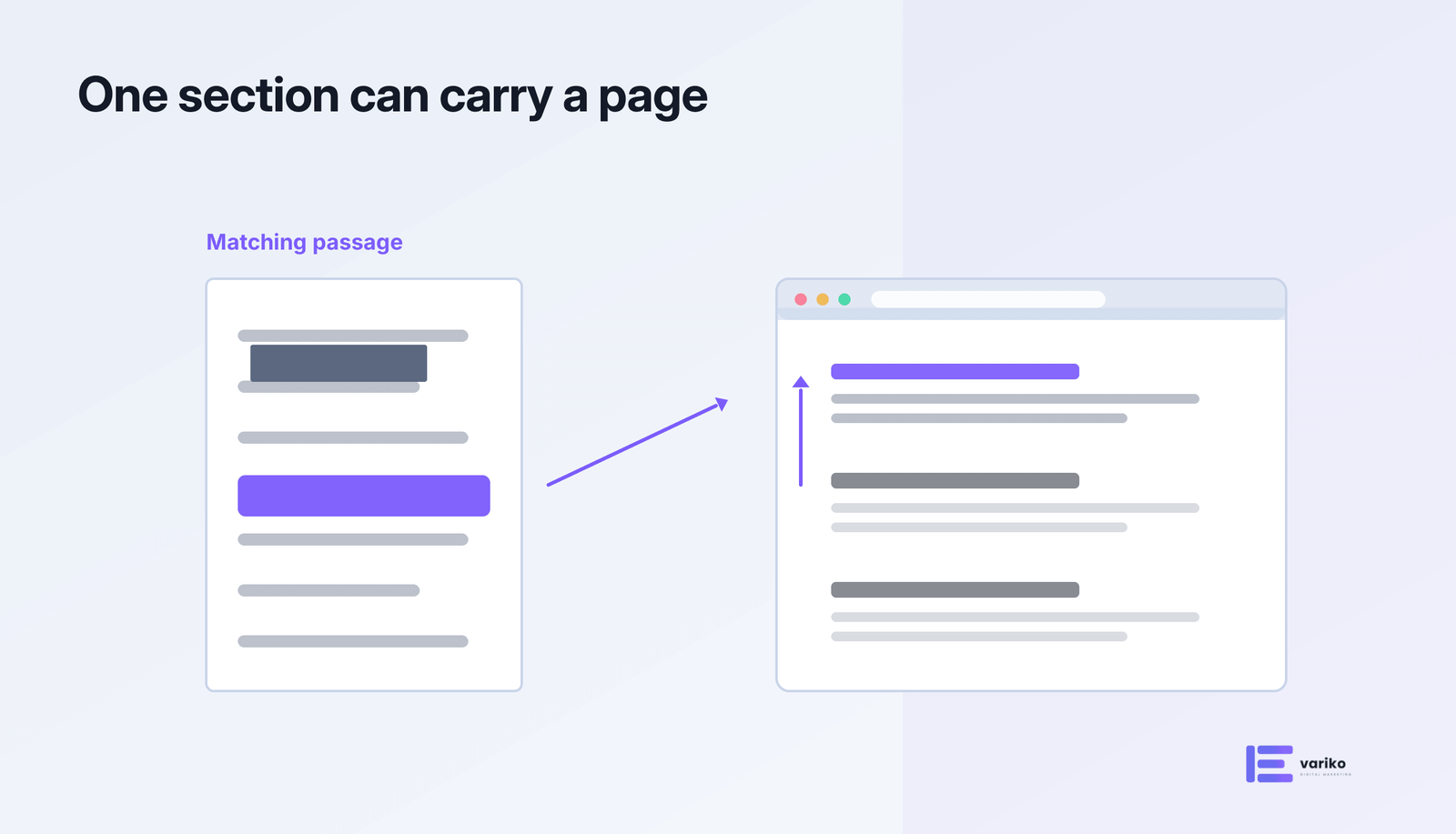
Passage ranking lets one strong section carry a page on a narrow query.
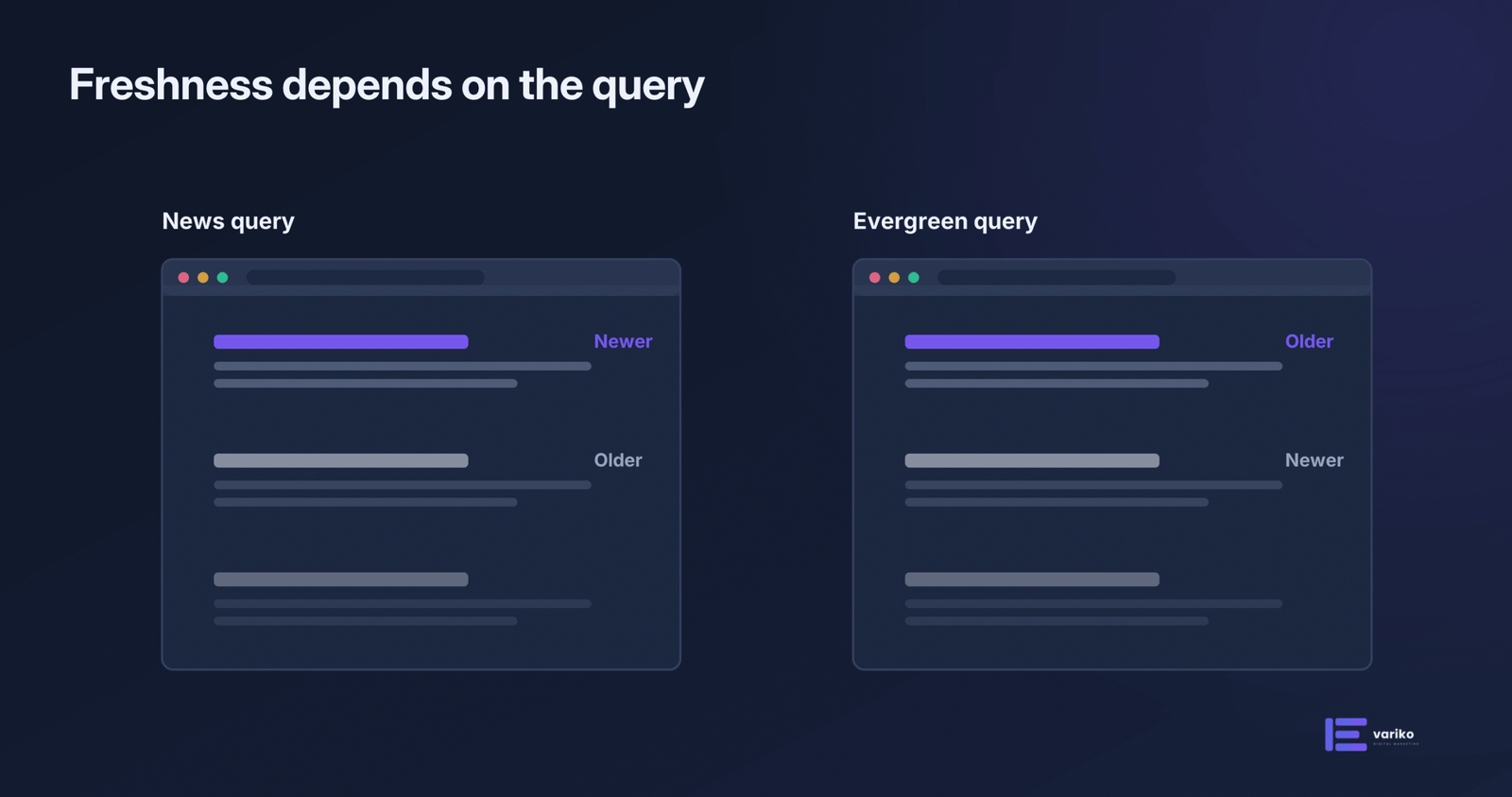
Freshness systems apply only where the query wants recency. That is why updating an evergreen page does nothing and updating a news page does everything.
Then come the four machine-learned systems nobody can act on. Every list includes them anyway.
RankBrain, neural matching, BERT and MUM are all named in Google’s guide. They are why matching a phrase exactly stopped helping. There is no setting to change.
The practical point is narrow. content quality work aimed at these systems one at a time is wasted.
Make your page the best answer to its question. That hits all of them at once.
Links, PageRank and anchor text
Links are confirmed, and the confirmation is old news.
Google’s ranking systems guide names “Link analysis systems and PageRank” outright. Published 21 November 2022 and maintained since.
Nobody should be debating whether links count.
Anchor text is confirmed as context for the link. Google’s documentation tells you to write anchor text that describes the destination, which only makes sense if something reads it.
The limits that follow are inference, and I mark them as such. Vary the wording. Never use the same anchor more than three times in one page.
What is not confirmed is weighting. Nobody outside Google knows how much a link counts against relevance.
No correlation study can tell you either. Section eleven covers why. backlinks get the full verdict in section nine.
Page experience: Core Web Vitals, HTTPS, mobile and interstitials
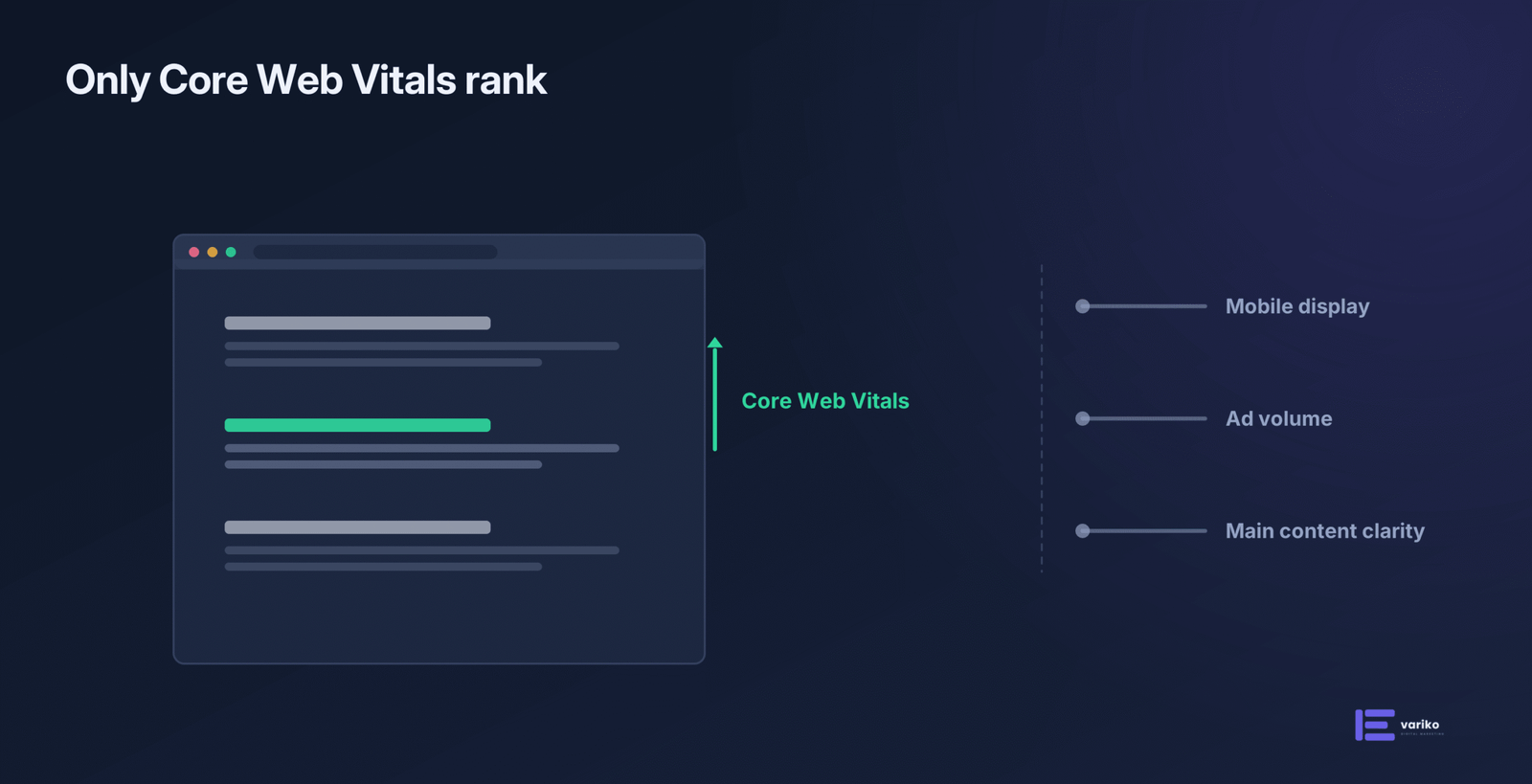
Core Web Vitals are a ranking factor. The other page-experience items are not.
Google’s page experience documentation says both halves, in consecutive paragraphs:
Core Web Vitals are used by our ranking systems.
Beyond Core Web Vitals, other page experience aspects don’t directly help your website rank higher in search results.
The same page kills a claim most lists get wrong. There is no page experience score:
There is no single signal. Our core ranking systems look at a variety of signals that align with overall page experience.
Anything selling you page experience as one number is describing a tool’s invention.
The three Core Web Vitals are Largest Contentful Paint, Interaction to Next Paint and Cumulative Layout Shift.
The middle one is where accuracy on this subject gets tested.
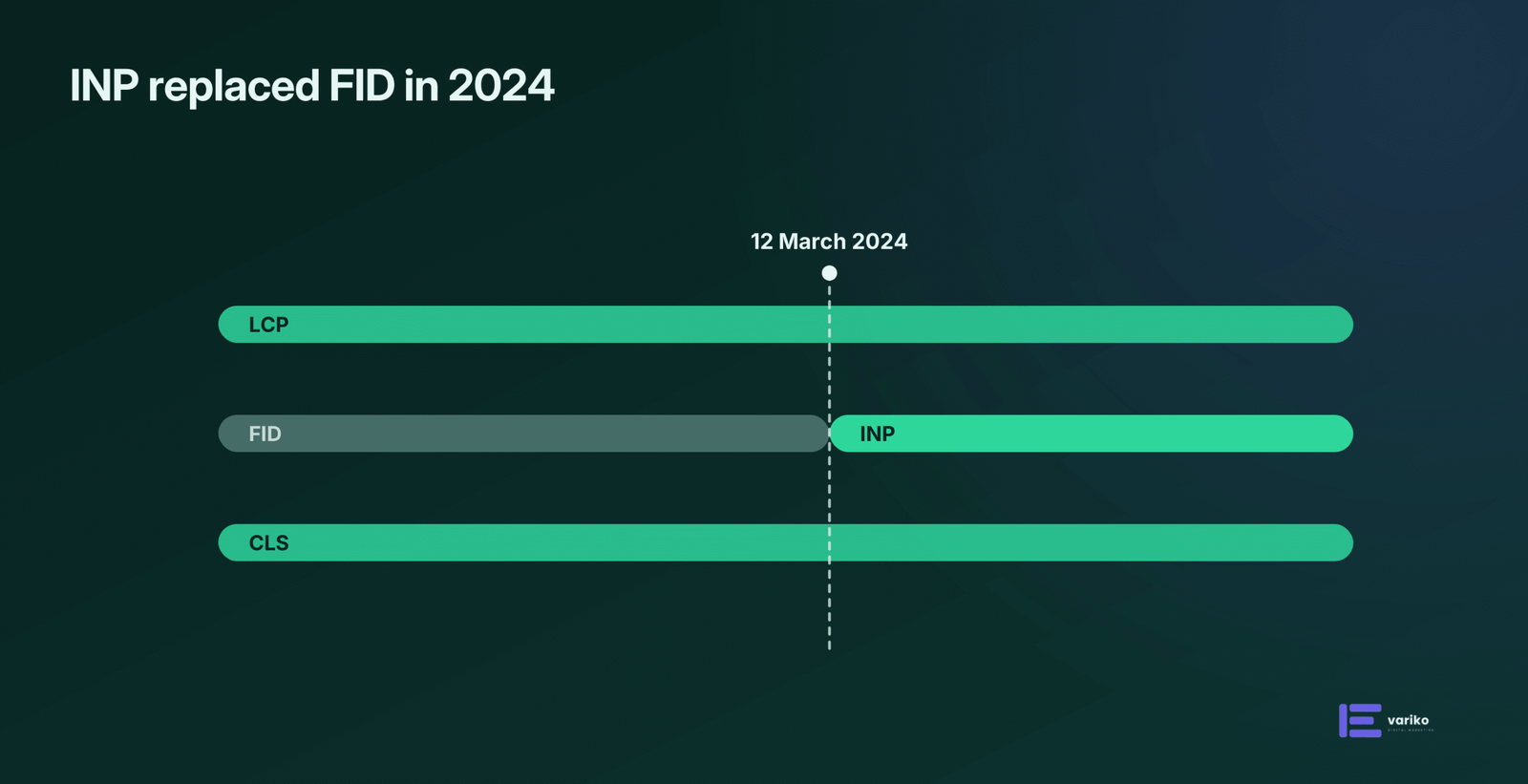
Interaction to Next Paint replaced First Input Delay on 12 March 2024. Google announced it on web.dev. FID left Search Console the same day and survived six more months in other tools before retirement.
Any article, tool output or audit still reporting First Input Delay was written before March 2024.
One of the five pages ranking for this query names FID as a current Core Web Vital. Under a title promising confirmed factors only.
HTTPS is Confirmed and lightweight. Google announced it on the Webmaster Central blog in August 2014 and described it that way at the time.
Get a certificate. Redirect properly. It will not move you past a better page.
Mobile-friendly rendering is Confirmed by the mobile-friendly update of 21 April 2015.
The boundary above now applies to it. Beyond Core Web Vitals, Google’s documentation says mobile display does not directly raise rankings.
Pass on real devices anyway. Most of your readers are on one.
Two tools went away here, which matters if you are following someone’s checklist. The Mobile Usability report in Search Console and the standalone Mobile-Friendly Test were both retired in December 2023.
One of the five competing pages still tells you to open that report. With a screenshot.
Intrusive interstitials are Confirmed through the page experience documentation, after the rollout of January 2017.
A pop-up that covers your content on arrival is the specific target.
Core Web Vitals have their own page for thresholds and fixes. This one stops at the verdict.
The ranking systems Google names and nobody lists
Google names several ranking systems that almost no list mentions.
They explain more SERP behaviour than most of the factors that do get listed.
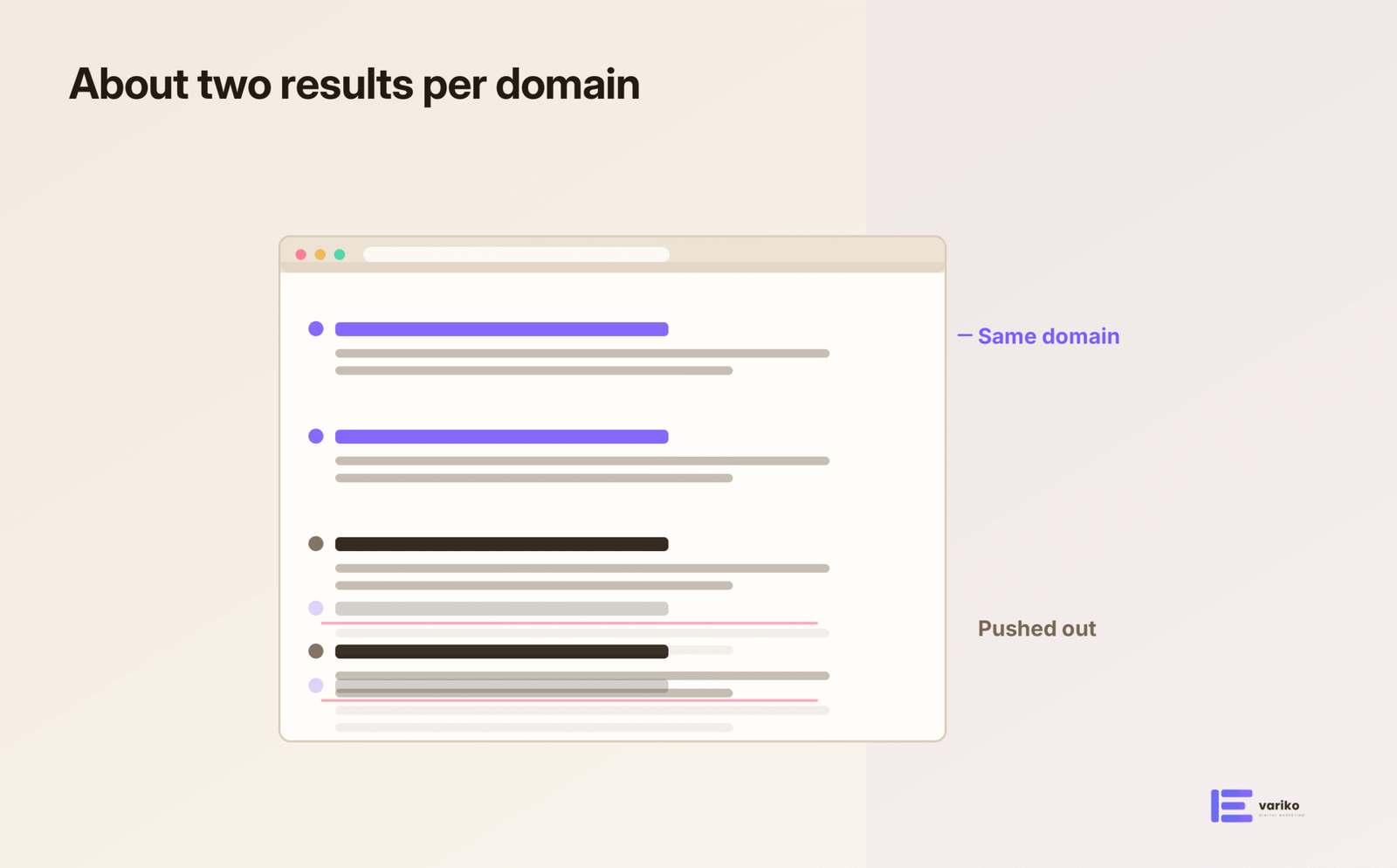
The site diversity system is why you rarely see three results from one domain.
The exact match domain system demotes low-quality sites whose only asset is a keyword in the domain. That is the reverse of how exact-match domains usually get described.
Reliable information systems raise authoritative sources where bad information does real damage.
Crisis information systems and local news systems change results in specific circumstances.
Removal-based demotion systems act on sites with high volumes of valid legal or personal-information removals.
The reviews system rewards independent review content over thin aggregation.
None of those is actionable the way “compress your images” is actionable.
All of them are documented. That puts them above most of what fills a 200-item list.
The spam policies that demote rather than promote
Three spam policies published in March 2024 can move your site down.
That makes them ranking factors in the only direction that matters to the site they hit. Google announced them alongside the March 2024 core update.
Site reputation abuse covers hosting third-party content on your domain to borrow your signals. That is the policy behind the coupon-section and casino-subfolder takedowns of the last two years.
Scaled content abuse covers generating pages at volume with little value. By automation or by hand.
Expired domain abuse covers buying a domain for its accumulated signals and putting unrelated content on it.
SpamBrain, Google’s spam detection system, is named separately in the ranking systems guide.
Read the spam policies once, in full. They are shorter than most of the articles written about them.
What decides the local pack
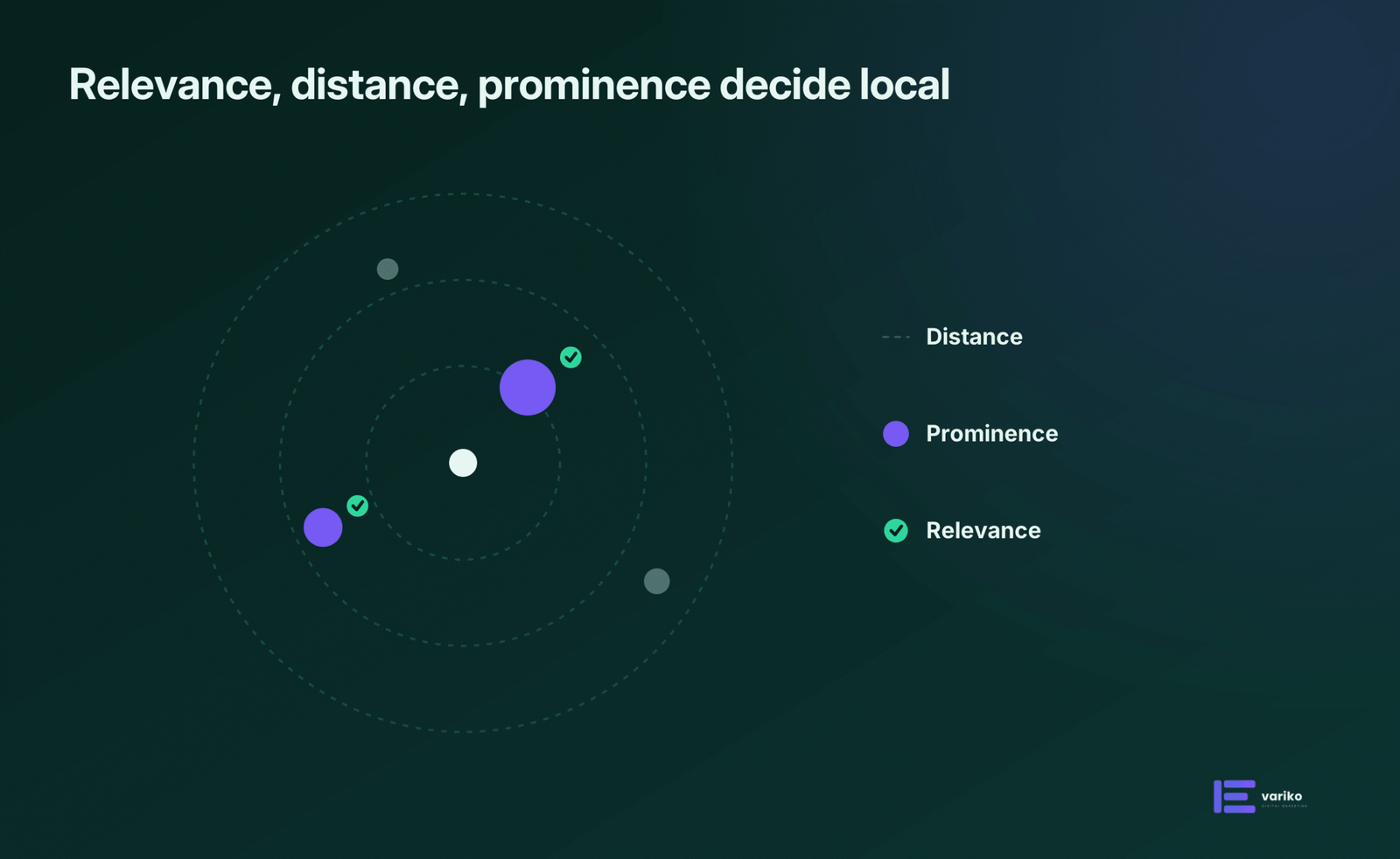
Google documents three things: relevance, distance and prominence.
Relevance is how well the business matches the search.
Distance is how far the business is from the searcher, or from the area searched.
Prominence is how well known the business is. Google describes it as drawing on information from across the web, including links, articles and directories, plus review count and score.
All three come from Google Business Profile’s own help material.
That is a firmer basis than the local sections of most ranking-factor articles.
Three actions follow. Complete the profile. Choose the right primary category. Earn genuine reviews.
local SEO owns the rest.
Crawling and indexing are prerequisites, not ranking factors
A blocked page does not rank badly. It does not rank at all.
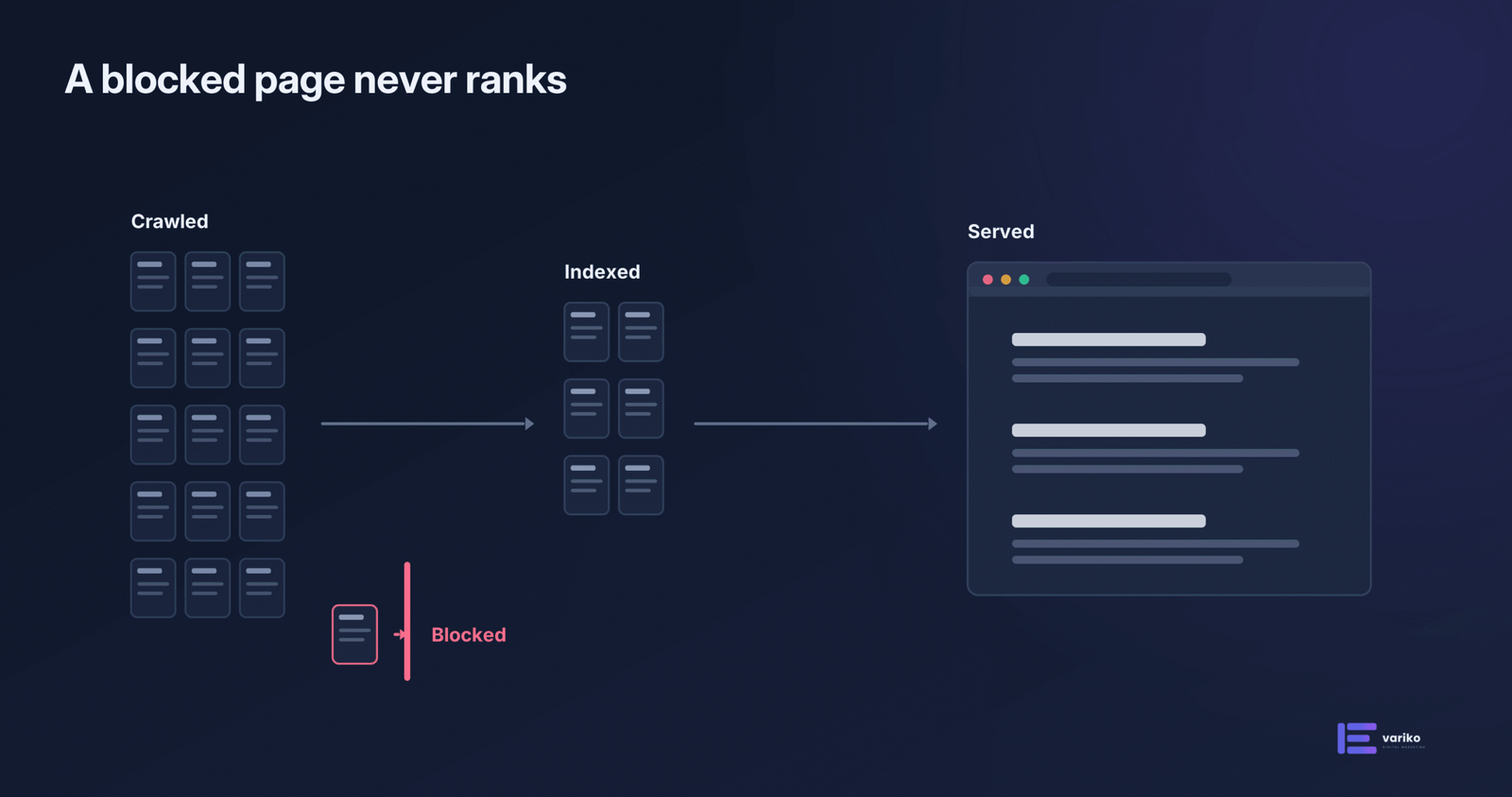
Google’s documentation treats crawling, indexing and serving as sequential stages. Ranking happens inside the last one.
That is why mobile-first indexing is not in the table above.
Mobile-first indexing is how Google fetches and stores your pages, using the mobile version as the basis. It decides what Google has. Not how Google orders it.
Treat it as a ranking factor and you end up optimising something that was never a lever.
The same mistake runs through the competitor set, and it explains the inflated counts.
The page ranking first for this query counts shopping results, image results and an Atari Breakout easter egg among its 206 factors. It also counts the disavow file and the reconsideration request.
Search features are things Google shows you. A disavow file and a reconsideration request are what you reach for after a problem.
Neither category is a factor. About twenty of that page’s items belong to one or the other.
Getting the categories right is most of what separates a usable list from a long one.
crawlability sits upstream of all of this. technical SEO owns the diagnosis. types of SEO owns the taxonomy.
What did the Google API leak reveal about ranking?
It revealed the names of fields in one of Google’s internal schemas.
That is more than nothing and a lot less than proof.
On 27 May 2024, Rand Fishkin published a set of internal Google documents at SparkToro. More than 2,500 pages. 14,014 attributes. Apparently from a Content Warehouse API.
The documents sat on GitHub between 27 March and 7 May 2024. The most recent date inside them is August 2023.
What a schema is matters more here than what was in it.
A schema lists the fields a system can store.

It does not show you that a field is populated, that it feeds the live ranking systems, how much it counts, or that an attribute does what its name suggests.
Fishkin said as much in the post:
It’s not quite proof.
He also noted that some attributes may be retired, used only in testing, or never deployed at all.
That is the standard I hold on this page. The leak supports Likely verdicts. Never Confirmed ones.
One of the five pages ranking for this query writes that the leak “proved” Google uses a site authority score.
A leaked field name called siteAuthority does not prove that. It makes a site-level quality signal far more likely than Google’s public statements suggested. That is a real finding, and it is a different one.
Three things in the documents changed what reasonable people believe.
NavBoost, carrying attributes named goodClicks, badClicks and lastLongestClicks.
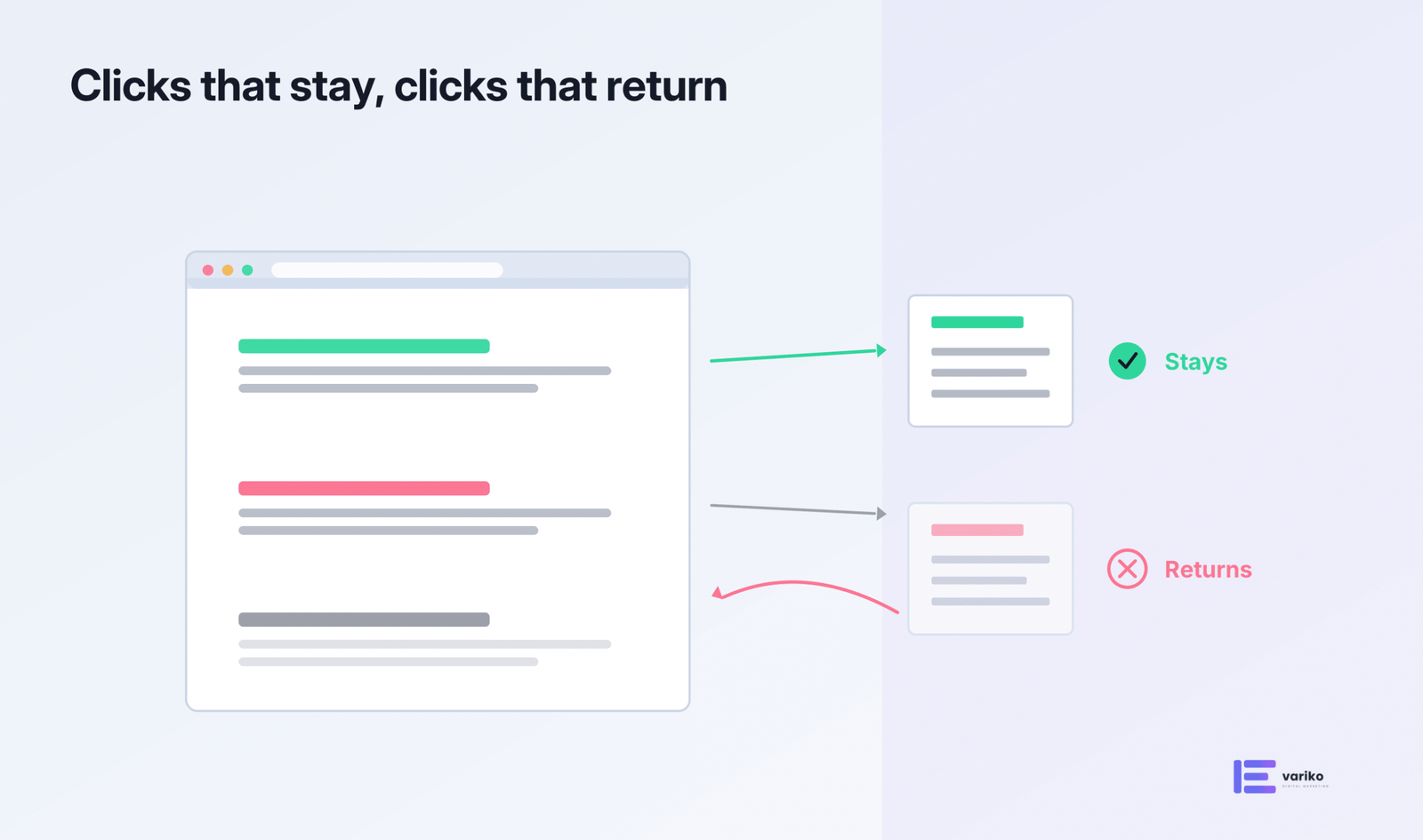
NavBoost was not new. Pandu Nayak, then Google’s VP of Search, named NavBoost and a system called Glue in 2023 testimony for the United States Department of Justice. The leak supplied the field names.
A site-level quality attribute, which sits awkwardly against years of public statements that Google has no site-wide authority score.
Chrome-derived data appearing among page-quality attributes.
So the leak moved several widely held beliefs from guesswork to well-supported inference. It moved nothing to certainty.
the Google API leak deserves its own page for the detail.
Which factors are likely but unconfirmed?
Likely means the evidence leans one way and Google has not spoken.
Twelve entries sit here. Every one names its evidence type, so you can discount it yourself.
None of them should be described to a client as something Google uses.
25. Click and engagement signals through NavBoost: Likely. Google’s systems appear to use aggregated click behaviour from the results page. The evidence is the leaked NavBoost attributes plus Nayak’s 2023 DOJ testimony. Earn the click by matching the query, then satisfy it.
26. Site-level quality scoring: Likely. A site-wide quality attribute appears in the May 2024 documents and Google has not confirmed one. Raise the floor across your site. Thin sections appear to drag everything else down.
27. Chrome usage data in page quality: Likely. Chrome-derived attributes appear in the documents. There is nothing to act on, and it is a reason not to write off real user behaviour as unmeasurable.
28. Brand strength and unlinked mentions: Likely. Brand-entity attributes appear in the documents. Independent correlation work also finds brand mentions tracking AI-answer visibility more closely than backlinks. Get named in places Google already trusts.
29. Link tiering by quality: Likely. The documents include tiered link attributes. Links are not counted equally. Go for fewer and better placements.
30. Stored page version history: Likely. Version-history attributes appear in the documents. A figure of twenty stored versions circulates widely, and it is commentary on the leak, not documentation, so I am not using it. Make substantive changes.
31. Rater feedback entering quality systems: Likely. Attributes referencing Google’s quality rater platform appear in the documents. Write to the standard the rater guidelines describe, not their vocabulary.
32. Topical coverage and topical authority: Likely, and this one needs a warning the others do not. No Google statement supports it. The leak does not name it. The evidence is repeated observation that sites covering a subject completely beat sites covering it partially.
I have built my agency on that observation. It is still the weakest evidence in this column, and I am not going to pretend otherwise because it suits me. topical authority has its own page.
33. Internal link distribution: Likely. PageRank itself is Confirmed. How internal links move it around your site is inference from the documented mechanism. Link deliberately, toward the pages that have to rank. internal linking owns the method.
34. Content depth and comprehensiveness: Likely, on correlation only. Pages covering a question completely tend to outrank pages covering it partially. Whether depth caused that is exactly what section eleven takes apart. Be complete and let length happen.
35. Author and entity identity signals: Likely. Entity-reference attributes appear in the documents. Real authors, real bios, one consistent spelling of the name.
36. What decides selection in AI Overviews and AI Mode: Likely, and partly documented. Google publishes the eligibility rule and says no special optimisation is required. It has not published how a source gets chosen. Section twelve covers it, including the part that cuts against my own service line.
One factor is deliberately missing from this column.
E-E-A-T is not Likely. Google has stated it is not a direct ranking factor, so it goes in the myth table.
Are backlinks still a ranking factor in 2026?
Yes.
Google’s ranking systems guide names “Link analysis systems and PageRank” among its notable systems. That documentation is maintained, not historical.
The question gets asked every year because the answer changed in degree without changing in kind.
What changed is everything around links. Relevance, content quality and the machine-learned matching systems now decide which pages are even in contention.
So links increasingly sort a shortlist. They no longer create one.
A strong link profile on a page that does not answer the query does nothing. A decade ago that was not reliably true.
What did not change is the evidence. Brand mentions appear in the leak. Topical coverage appears in nobody’s documentation. Links appear in Google’s own guide.
Of the things people reach for to improve a competitive page, links still have the firmest evidence behind them.
What nobody outside Google can give you is weighting. Every published figure on links versus content comes from a correlation study.
No correlation study can separate links causing rankings from rankings causing links.
link building and link quality cover method and judgement. The verdict here is that the factor is real and documented.
The myths, and where each one came from
Every row below is false for a traceable reason. The reason matters more than the verdict.
A debunk that says “this is wrong” gets forgotten. A debunk that shows you where the claim came from stops it coming back.
| Myth | Where it came from | What Google has said | What is actually true |
|---|---|---|---|
| Domain Authority is a Google ranking factor | A metric built by Moz as a predictive tool, adopted as industry shorthand, then promoted to factor status by list articles. Two of the five pages ranking for this query list it among their top factors | Google does not use third-party authority metrics | DA is one company’s estimate of how a site might perform. It can be useful as a comparison. It is not a thing Google reads. The leak’s site-level quality attribute is a different claim and stays separate |
| E-E-A-T is a direct ranking factor | The search quality rater guidelines, read as if they documented the algorithm | Google has stated repeatedly that E-E-A-T is not a direct ranking factor | It describes what Google’s systems are built to approximate. The fourth letter, Experience, was added in December 2022, and three of the five competing pages still write E-A-T |
| Social signals rank your pages | Correlation between shares and rankings, read backwards. One competitor places it among its eight most important factors | Google has said repeatedly that social signals are not a direct ranking factor | Social puts content in front of people who then link to it and mention it. The effect is real and the path runs through other factors |
| Word count affects rankings | Studies reporting the average length of pages that rank, most often a figure around 1,400 words | Google has stated that word count is not a ranking factor | Length follows the question. Padding a page to reach a number makes it worse on the factors that are confirmed |
| Keyword density has a target | On-page tools from before 2010 that measured density because it was measurable | Google has described density targets as having no value | Write the terms the subject requires, where it requires them |
| LSI keywords | Latent semantic indexing, a genuine information-retrieval technique from the 1980s, misapplied to Google. One competitor gives it two numbered entries; another recommends it | Google has stated it does not use LSI | Related terms matter a great deal. The named technique is not the reason, and tools selling “LSI keywords” are selling synonyms |
| Domain age helps | Correlation between old domains and strong rankings, which is mostly correlation with everything else an old domain accumulated | John Mueller: “No, domain age helps nothing.” Asked again in December 2023 who benefits from the belief, he answered: “Primarily those who want to sell you aged domains” | Age is not the asset. What the domain gathered during that time is |
| Bounce rate is the mechanism | Google Analytics exposing the metric, plus a plausible story about quick returns to the results page. One competitor states it as mechanism: that Google judges the page irrelevant and drops its rank | Google has repeatedly denied using Analytics bounce rate | Google does not read your Analytics. Click behaviour inside the results page is a separate claim, it is Likely rather than Confirmed, and it lives in section eight |
| Dwell time is a Google metric | SEO commentary. The term has never been Google’s | No metric by that name has been published | The underlying idea overlaps with the NavBoost click attributes. The named metric is not something you can measure or optimise |
| Schema markup raises rankings | Rich results appearing above plain ones, read as a ranking lift | Google documents structured data as making a page eligible for rich results | Mark up what qualifies and expect the appearance of the result to change, not its position. schema markup covers which types earn what |
| Meta descriptions are a ranking factor | Their place on on-page checklists since the 1990s | Google has not used meta description as a ranking factor for many years | It decides whether the result gets clicked, and Google rewrites it often anyway. Write it for the click |
| Installing Analytics or Search Console helps | The inference that Google must use data it can see | Google has denied it. One competing page lists it as a factor and notes the denial inside the same entry | Install both, because you need the data. Neither one ranks you |
| Google uses over 200 ranking factors | A 2009 remark by Matt Cutts about “over 200 variables” | Google has never confirmed the figure or published a list | Twenty-four are confirmed. The rest of any 200-item list is inference, history or error |
| AI Overviews need special optimisation | Vendors selling AI-search optimisation as a separate discipline, ours included | Google’s AI features documentation states there are “no additional requirements to appear in AI Overviews or AI Mode, nor other special optimizations necessary”, and adds that there is no special structured data to add | Section twelve sets out what is actually true here, and it is less convenient for us than for most of the pages you will read on the subject |
Two of those rows need a sentence more from me.
Domain authority is the one where a tool vendor cannot be straight with you. The metric is the product.
I have sat in meetings where the whole report was a DA score going up. The rankings had not moved. The number had.
Evariko sells no metric, so saying this costs me nothing.
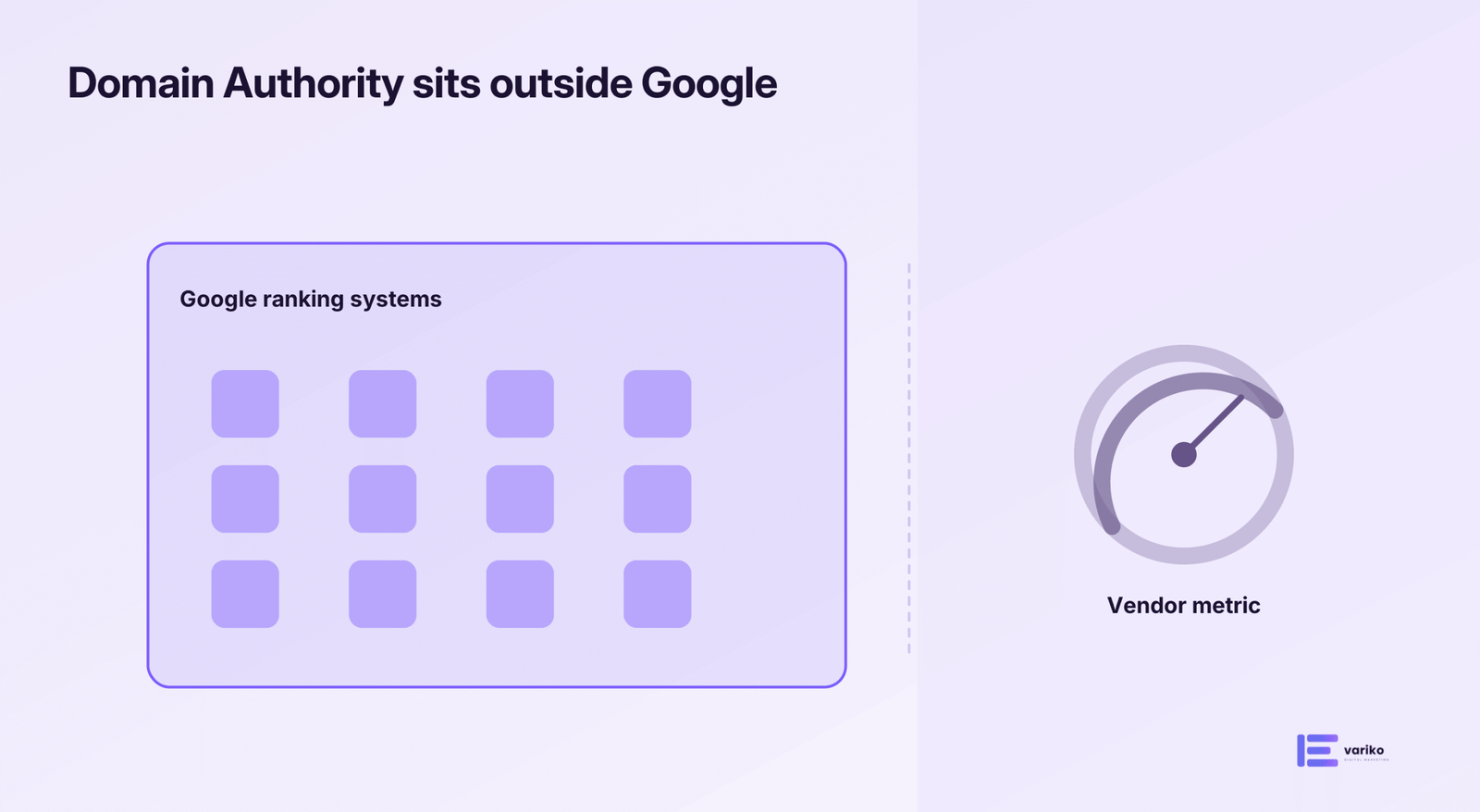
domain authority is a third-party estimate. It has never been a Google signal.
Word count does the most daily damage of anything on the list.
A word target is the easiest brief to write. I have written them, years ago, and they produced worse pages every time.
Google has said word count is not a ranking factor. Write to the question and stop.
What does a ranking correlation study actually measure?
It measures what high-ranking pages have in common. It cannot tell you what put them there.
That one limitation produces more of the myths above than any other cause.
One worked example settles it.
Take the most-cited correlation in the business. Pages that rank well have more referring domains than pages that do not.
The finding is real and has been reproduced many times.
One competing page reports its version as the “12th most influential ranking factor.” That is where the error enters.
The study measured an association. “Influential” is a claim about cause. The study contains no information about cause at all.
Three explanations fit the data equally well.
Links caused the rankings.
The rankings caused the links, because pages that rank get found and pages that get found get cited.
Or something else caused both, such as the page genuinely being the best resource on its subject.
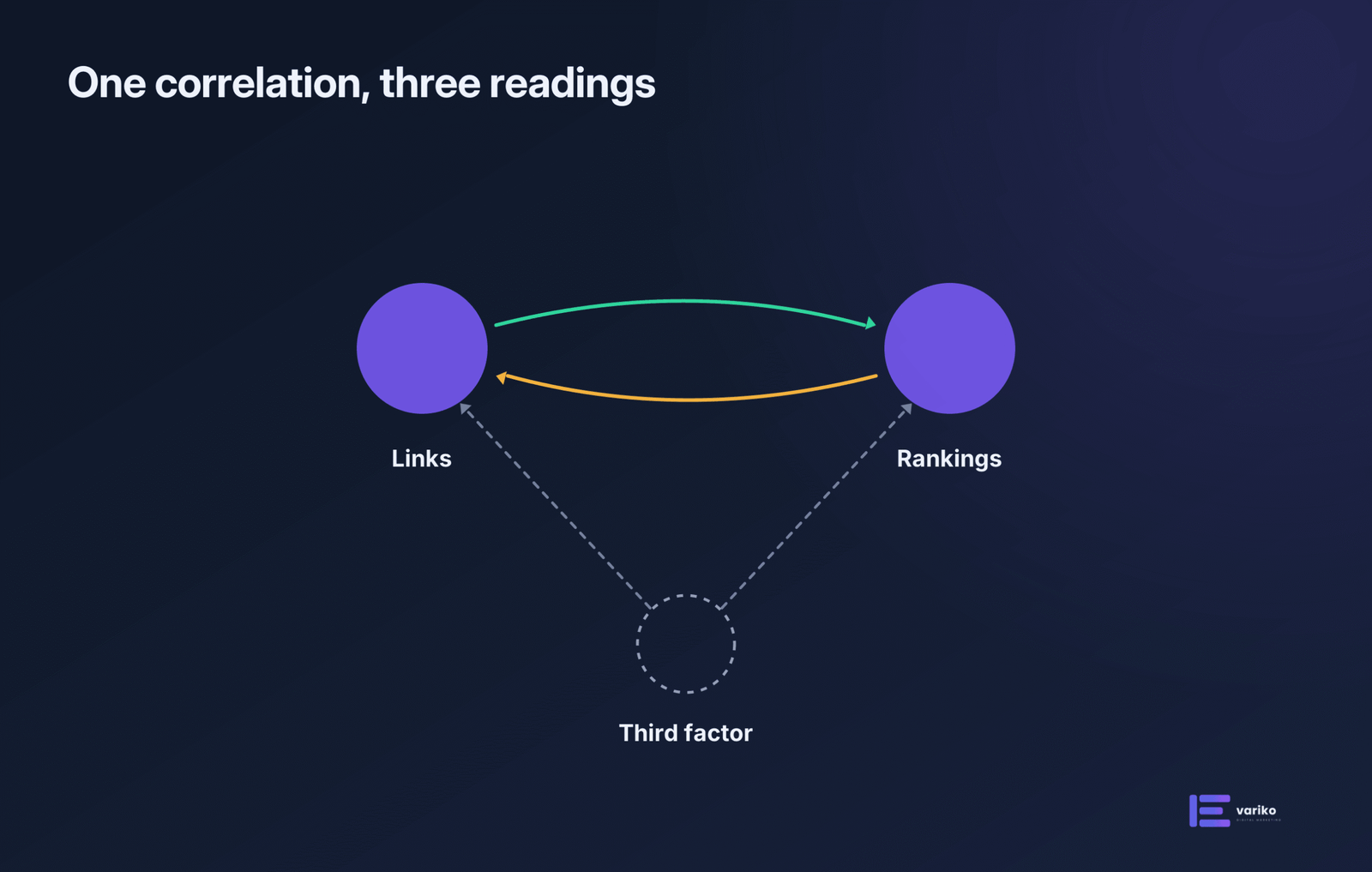
In the real world the arrow runs both ways. A correlation study cannot tell you which direction dominated in any given case.
So no correlation figure from any competing page appears in this article. Not the 12th-most-influential ranking. Not the 90.6% prevalence figure. Not the word-count averages. Not the referring-domain charts.
Where a correlation is the only evidence available, the verdict here is Likely and the word correlation sits next to it.
Apply this to the next list you read. One question does it.
Does the page tell you a study found an association, or does it tell you a factor has influence? The second is a claim the evidence underneath it cannot support.
AI Overviews and AI Mode: what decides citation rather than position
Google documents how your page becomes eligible for AI Overviews and AI Mode. It also says no special optimisation is required.
What Google has not published is how a source gets picked from among the eligible ones.
Both halves need saying. The first half is inconvenient for the way most agencies sell this work, mine included.
Eligibility is simple and documented. Your page must be indexed and eligible to appear in Google Search with a snippet.
Google’s AI features documentation puts it plainly:
There are no additional technical requirements.
There are no additional requirements to appear in AI Overviews or AI Mode, nor other special optimizations necessary.
There’s also no special schema.org structured data that you need to add.
The advice that follows is ordinary search advice. Crawlability, internal links, page experience, and structured data matching the visible page.
Two mechanics are documented and worth knowing.
AI Overviews and AI Mode may use query fan-out, which Google describes as issuing “multiple related searches across subtopics and data sources” to surface a wider set of links.
And AI Overviews appear only when, in Google’s phrasing, “our systems determine that it is additive to classic Search.”
So your page can be perfectly eligible and never meet an AI Overview. No overview was generated for that query.
Selection is the part that stays unpublished. Among thousands of eligible pages, Google has not described what decides which three or four get cited.
The useful shift is from position to citation. An AI answer does not rank ten results. It assembles one answer and attributes parts of it.

That favours content a system can pull a clean, attributable statement out of. Which is a writing property, not a technical one.
It is also inference, not documentation, and row 36 marks it that way.
Four of the five highest-ranking pages for this query have nothing on this subject. There is no secondary material to lean on either.
So this is the least-documented area on the page. Anyone selling a distinct technical discipline for it is selling judgement and execution. That includes AEO, GEO, and the version Evariko sells.
AI Overviews has its own page for what is known about triggering.
What is the most important Google ranking factor in 2026?
It depends on your site.
The dependency is predictable enough to put in a table. Any page answering this with a single factor is guessing or selling.
Relevance and content quality are the floor everywhere, so they are useless as an answer.
The useful answer is which factor is most likely to be the thing holding your particular site back.
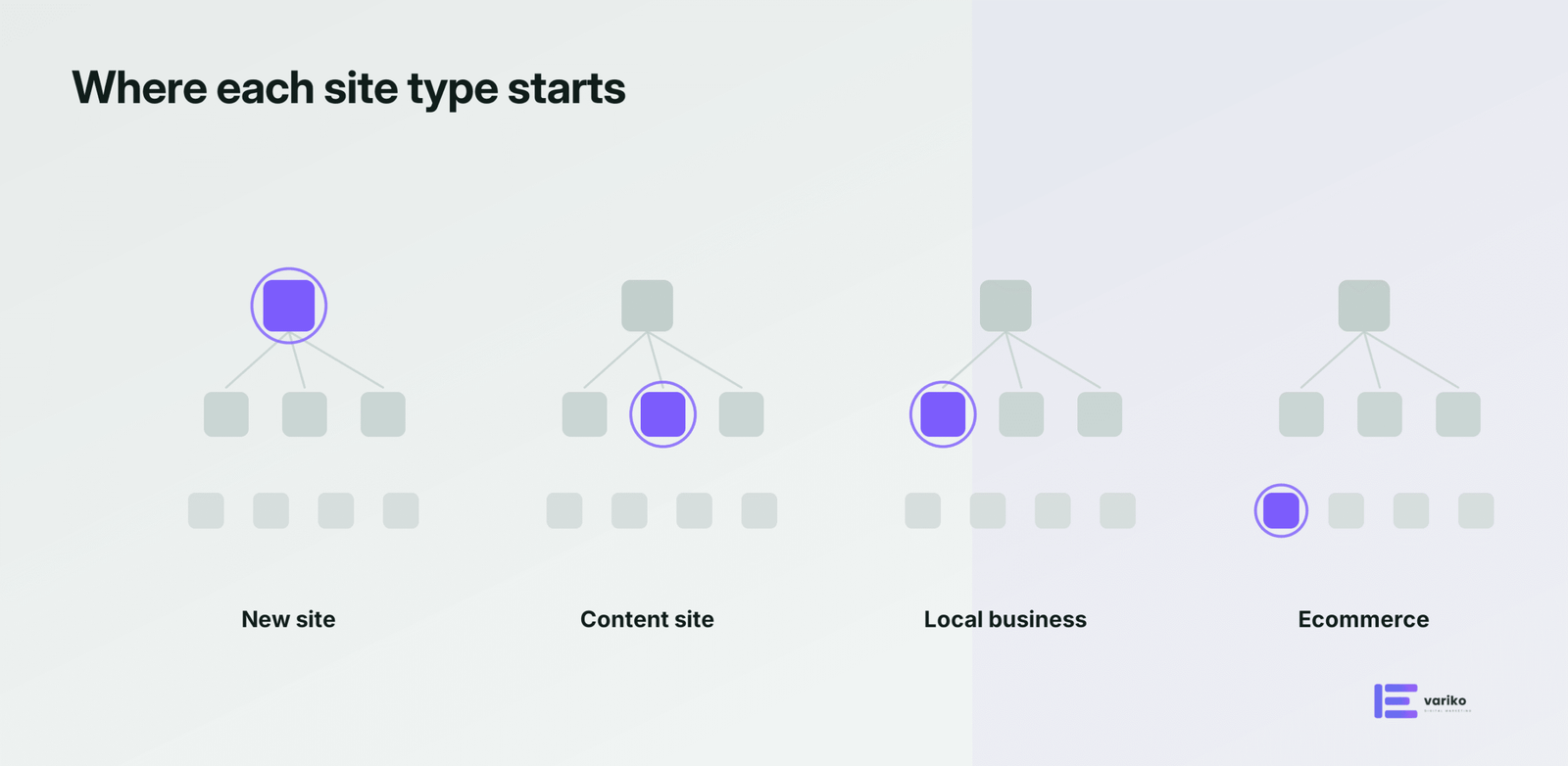
That changes with age, competition and model.
| Site type | Work on first | Then | Evidence weight of that first priority | Why |
|---|---|---|---|---|
| New site, under a year | Relevance and topical coverage. Pick one narrow subject and cover it completely | Indexing and crawlability, then links | First priority is Confirmed (relevance) plus Likely (coverage) | A new site has no historical data. Partial coverage of a broad subject loses to complete coverage of a narrow one, and there is nothing else to compete on |
| Established content site | Content quality against the core ranking systems, section by section | Site-level quality, then internal link distribution | Confirmed, with the March 2024 change behind it | Thin sections appear to drag the whole domain. Pruning and improving beats publishing more |
| Local service business | Google Business Profile completeness, primary category, genuine reviews | Location relevance on the site, then links | Confirmed, documented as relevance, distance and prominence | Distance cannot be changed and relevance and prominence can. Most local underperformance is an incomplete profile |
| Ecommerce catalogue | Crawlability and index control across filtered pages | Core Web Vitals, then category-page relevance | Prerequisite first, then Confirmed | Large catalogues fail at indexing before they fail at ranking. A product page that is not indexed has no ranking problem to fix |
I have worked that table backwards from client accounts since 2019, and the local row is the one people fight me on most.
They want the website fixed. The profile is what is costing them the calls.
Two things hold across all four rows.
search intent decides whether your page format can win at all, before any factor applies.
And the evidence standard from section three tells you whether the next thing someone recommends belongs on this list. Google’s documentation beats a Googler’s remark. A remark beats the leaked schema. The schema beats a correlation study. A correlation study beats a blog post.
Use it on the next ranking-factor article you read. The article will tell you how much of it to trust.
Every verdict on this page is checkable. Several of the pages outranking it are four years out of date behind a 2026 title.
That is worth understanding, because the reason is historical, not evidentiary.
Why the old factor lists still outrank the accurate ones
The best-known ranking-factor list on the web went up in 2013. It has more links than almost any other SEO page. It still ranks first.
Its content reflects nothing after mid-2022.
It writes E-A-T instead of E-E-A-T. It gives latent semantic indexing two numbered entries. It lists accelerated mobile pages as a news-carousel requirement, three years after that stopped being true. It has nothing on the 2024 API leak and nothing on AI Overviews.
Its own introduction says some factors are proven, some controversial, some speculation. Then it presents 206 of them in one undifferentiated sequence.
Nothing in the body is marked. One entry out of 206 carries the word “speculative.”
Eight of them go further. The entry quotes Google denying the factor, and the factor stays numbered in the list.
Domain age is factor 1, with Mueller quoted saying it helps nothing. Analytics and Search Console is factor 81, described in the entry as a myth Google has denied. External links as a signal is factor 57, denied. Publishing frequency is factor 70, denied. Links from .edu and .gov domains is factor 90, with Cutts quoted saying the domain ending does not count. Wikipedia links is factor 116, denied. Accelerated mobile pages is factor 21, listed despite not being a direct factor.
Seven more entries cite no source at all.

Links and brand recall are doing that work. Not accuracy.
Every myth below has a date and a source. The sources are mostly tools and remarks.
Where each myth came from
Domain authority started honestly. Moz built it to estimate how a domain might perform, and estimates are useful.
It became a myth when the shorthand outgrew the caveat. It hardened when articles started numbering it among Google’s factors.
Two of the five pages ranking for this query do that today. Both sell or link to an authority checker.
domain authority is a term readers actually use for site strength, so here it is plainly. The number is a vendor’s opinion.
E-E-A-T came from a document people read as something it is not.
The Quality Rater Guidelines tell human raters how to score sample results. Google uses those scores to test changes. The guidelines do not describe the ranking systems.
Read them as algorithm documentation and E-E-A-T stops being a description of what Google aims at. It becomes a lever you think you can pull.
The page ranking first cites the rater guidelines as factor evidence four times. That is the myth being manufactured, in public, on the page most people read first.
E-E-A-T is worth working on. It is still not a direct ranking factor.
LSI keywords came from a real technique. Latent semantic indexing is a 1980s information-retrieval method and it works on the problem it was built for.
Someone applied it to Google by analogy. Google said it does not use it. The term survived because tools were already selling it.
Word count and content length came from correlation studies reporting the average length of ranking pages.
The studies were accurate about their own measurement. The rule people derived was never in the data.
Bounce rate came from Google Analytics. The metric was visible and the story was plausible.
Nobody checked whether Google reads data it has no reason to read.
The confusion sticks because a genuinely similar claim about click behaviour inside the results page turned out to be well supported. That makes the wrong version sound half right.
off-page SEO budgets get misdirected by this one more than by anything else on the list.
Algorithm updates that are now history
Three of the most-cited algorithm names are listed by Google itself as retired.
Panda became part of the core ranking systems in 2015. Penguin was integrated in 2016. The helpful content system became part of the core ranking systems in March 2024.
Hummingbird is listed as retired, with a note that ranking systems have continued to evolve since.
Retired does not mean reversed. The work those systems did is now inseparable from ranking.
Which is exactly why treating them as separate things to optimise for stopped making sense.
A list presenting Panda, Penguin and Fred as current mechanics is describing a Google that has not existed for a decade.
Terms that no longer describe anything
The Google sandbox is the belief that new domains get held back for a fixed probationary period. Google has denied a sandbox as described.
New sites do rank slowly. The reason is no accumulated historical data, not a timer running.
The symptom is real. The mechanism is not. That difference changes what you do about it.
The Google dance comes from the era of monthly index refreshes, when rankings visibly reshuffled on a schedule.
Continuous indexing ended that. The term now describes nothing, and it still appears on a currently ranking list beside confirmed signals.
That same list counts search features and recovery tools among its factors.
Shopping results, image results and an easter egg are things Google displays. The disavow file and the reconsideration request are what you use after a problem.
Neither category is an input to ranking. Roughly twenty entries of a 206-item list belong to one of them.
Counting them is how a list reaches two hundred.
Does Google use my Analytics data to rank my site?
No. Google does not read your Analytics, bounce rate included.
Install Analytics and Search Console because you need the measurement. Expect no ranking effect from either.
Is a higher Domain Authority score worth paying for?
No, because Google does not read it.
Domain Authority is a third-party estimate. Useful for comparing sites in a tool. Meaningless as a target.
Anything sold specifically to raise a DA score is sold against a number nobody at Google sees.
Do I need special schema for AI Overviews?
No. Google’s AI features documentation says there is no special structured data required for AI Overviews or AI Mode.
There are no additional technical requirements beyond being indexed and eligible for a snippet.
Can anyone guarantee a Google ranking?
No. An agency offering you a guarantee is telling you something useful about itself.
Nobody outside Google controls the ranking systems. The weighting is unpublished. Competitors change what is achievable week to week.
One of the pages ranking for this query guarantees a major improvement in rankings. Nobody can keep that promise.
When does running this in-house stop making sense?
The adjudication above is most of the skill, and you can do it yourself.
Someone on your team reads Google’s documentation, applies the evidence standard, and stops acting on claims that fail it.
That alone kills most wasted effort. It needs no agency.
Where it stops working is volume and sequencing.
Knowing topical coverage comes first for a new site does not tell you which subject to close first, what order the pages go in, or how to keep a hundred of them consistent on entities and internal links.
Knowing Core Web Vitals are confirmed does not tell you which of two hundred technical findings to fix before the others.
Those are scheduling and judgement problems. They scale badly across a small team with other work to do.
I have been doing this since 2019, and Evariko runs it for clients in the UK, United States, Canada and Europe.
The method is the one on this page. Audit against a stated standard (212 checks across four layers). Map the subject before writing anything. Publish in sequence. Let coverage compound.
Two things we will not do, and this page has spent five thousand words earning the right to say them.
We do not sell a metric. That is why domain authority gets the verdict it gets above.
And we do not guarantee rankings, because nobody can.
technical SEO and our SEO services describe what the work actually consists of.