
What Is SEO? Search Engine Optimization Best Practices in 2026


Search engine optimization is the practice of improving your website’s content, structure and authority so that search engines and AI modals choose your website as a source to serve their user queries.
It is not a set of tricks applied to a finished website instead it is the work of making your site the most complete, most clearly stated answer available for the questions your customers are already asking.
So what changed in 2026 then?
What changed by 2026 is the shape of the answer your are getting from search engines or AI modals.
Google now generates answers as well as listing links, through AI Overviews and AI Mode, and a reader can finish with a question without ever visiting a page.
That has changed everything on how much traffic a given ranking produces. It has not changed the process about how a source being selected, because generated answers are built from pages already in Google’s index.
Google explicitly said about this. Its own documentation on AI features states: “There are no additional requirements to appear in AI Overviews or AI Mode.” A page needs to be indexed and eligible to appear with a snippet.
That is the whole requirement you need to make your brand visible in online.
This guide walks you through
- What SEO is,
- How search and AI systems decide what to show,
- Whether the channel suits your business at all,
- The four types of SEO work,
- How to find what people search for,
- How topical coverage compounds,
- What makes content worth choosing,
- Which page-level and site-level elements matter,
- Where structured data still earns something,
- How authority is earned off the page,
- Where AEO and GEO genuinely differ from SEO, and
- How to tell whether any of it is working.
Lets dive in….
What is SEO?
SEO also known as Search engine optimization is the practice of improving a website’s content, structure and authority so that search engines and AI modals choose it as a source for queries that matter to the business. Through you can earn ranking without giving a penny to google and this is what seperate SEO from paid advertising.
SEO acts on three things:
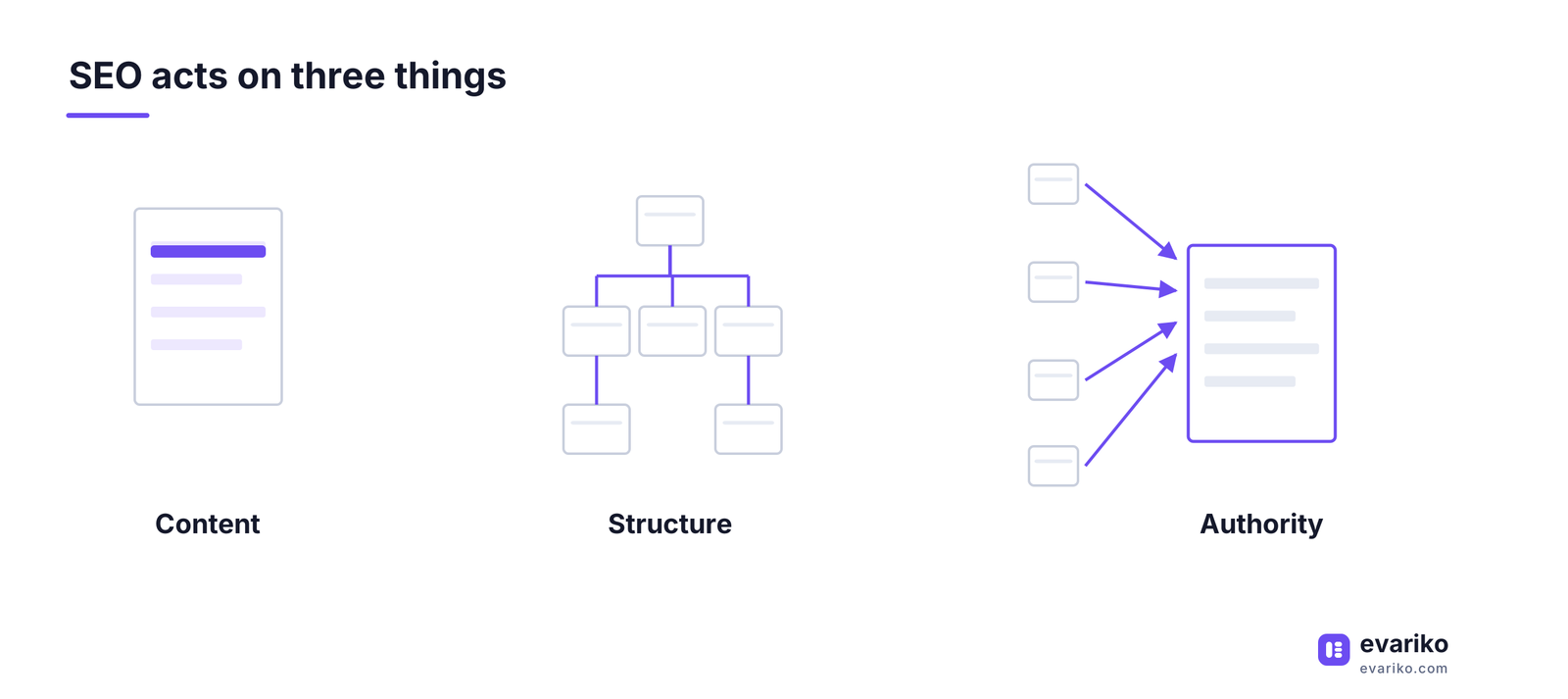
- Content: What the page says, how completely it answers the question it was written for, and how directly it states the answer.
- Structure: How the page and the site are organized, so that both a crawler and a reader can reach and interpret every part of them.
- Authority: What other sites and other people say about the source, and whether that reference pattern reads as editorial rather than manufactured.
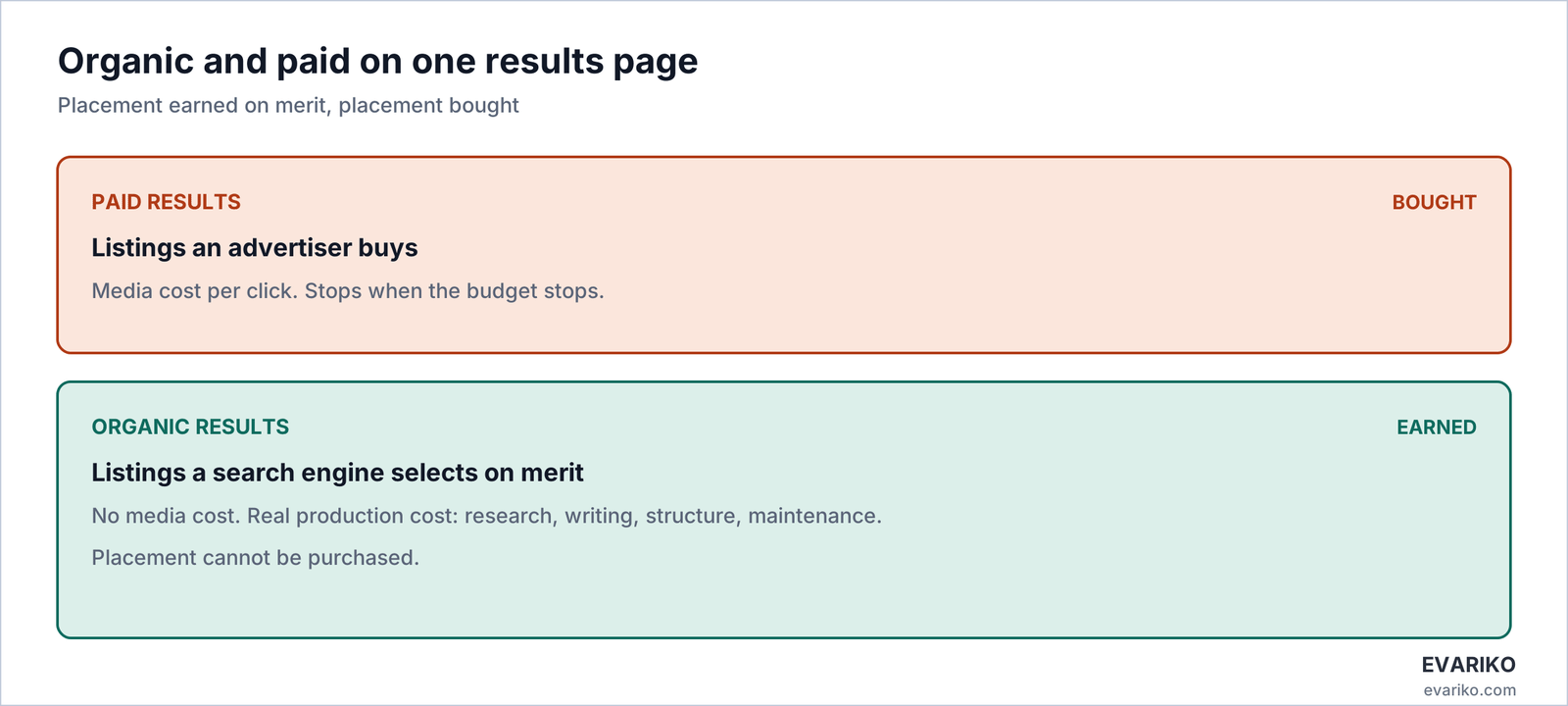
Organic results are the listings a search engine selects on RPP (aka Relevance, Prominance and Popularity).
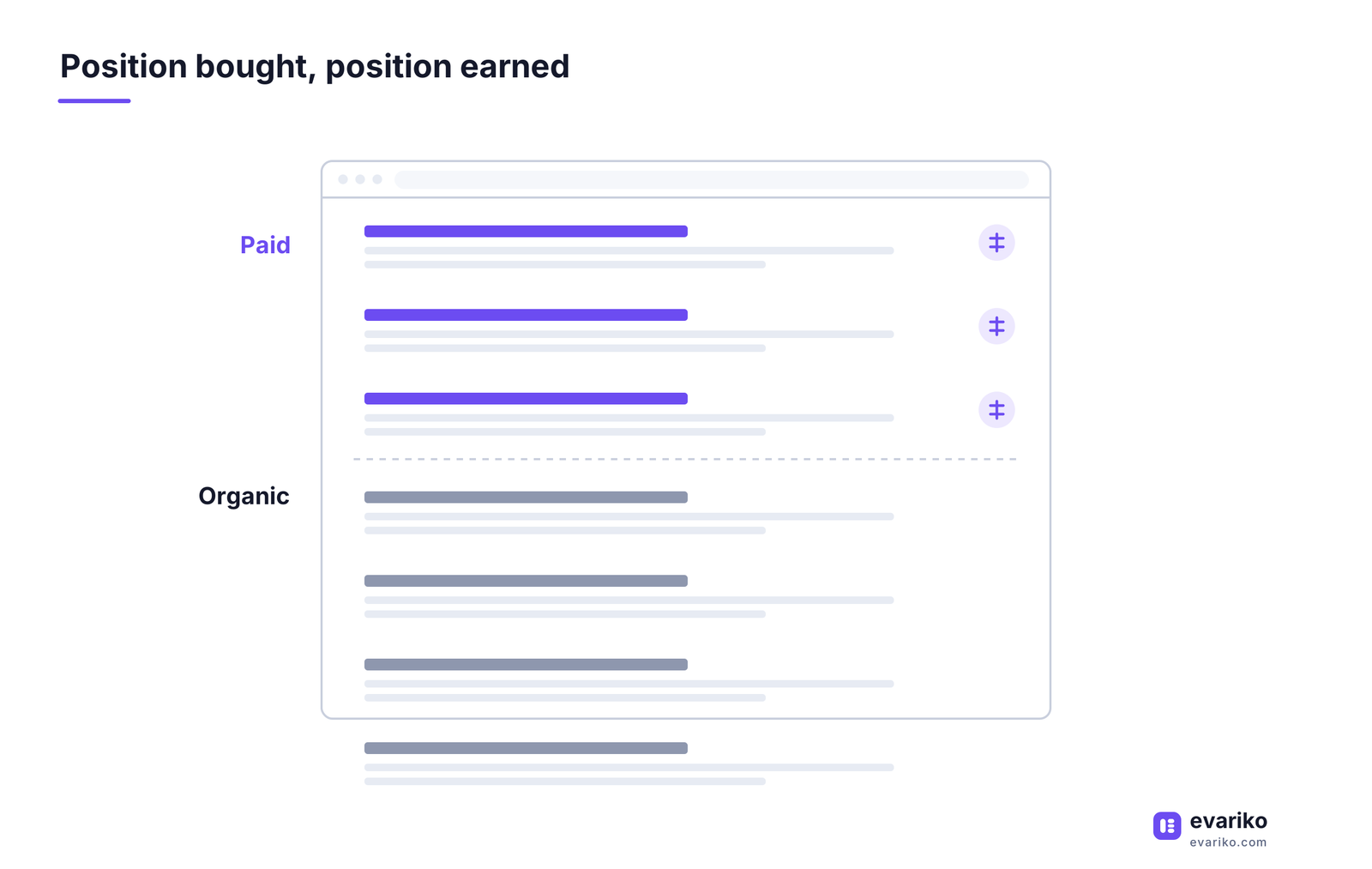
On the other hand, paid results are the listings spots you can buy.
What is SEO in simple words?
SEO is the work of making your website the best answer to the questions your customers type, so that Google shows it to them without you paying for the ranking.
How do search engines and AI systems decide what to show?
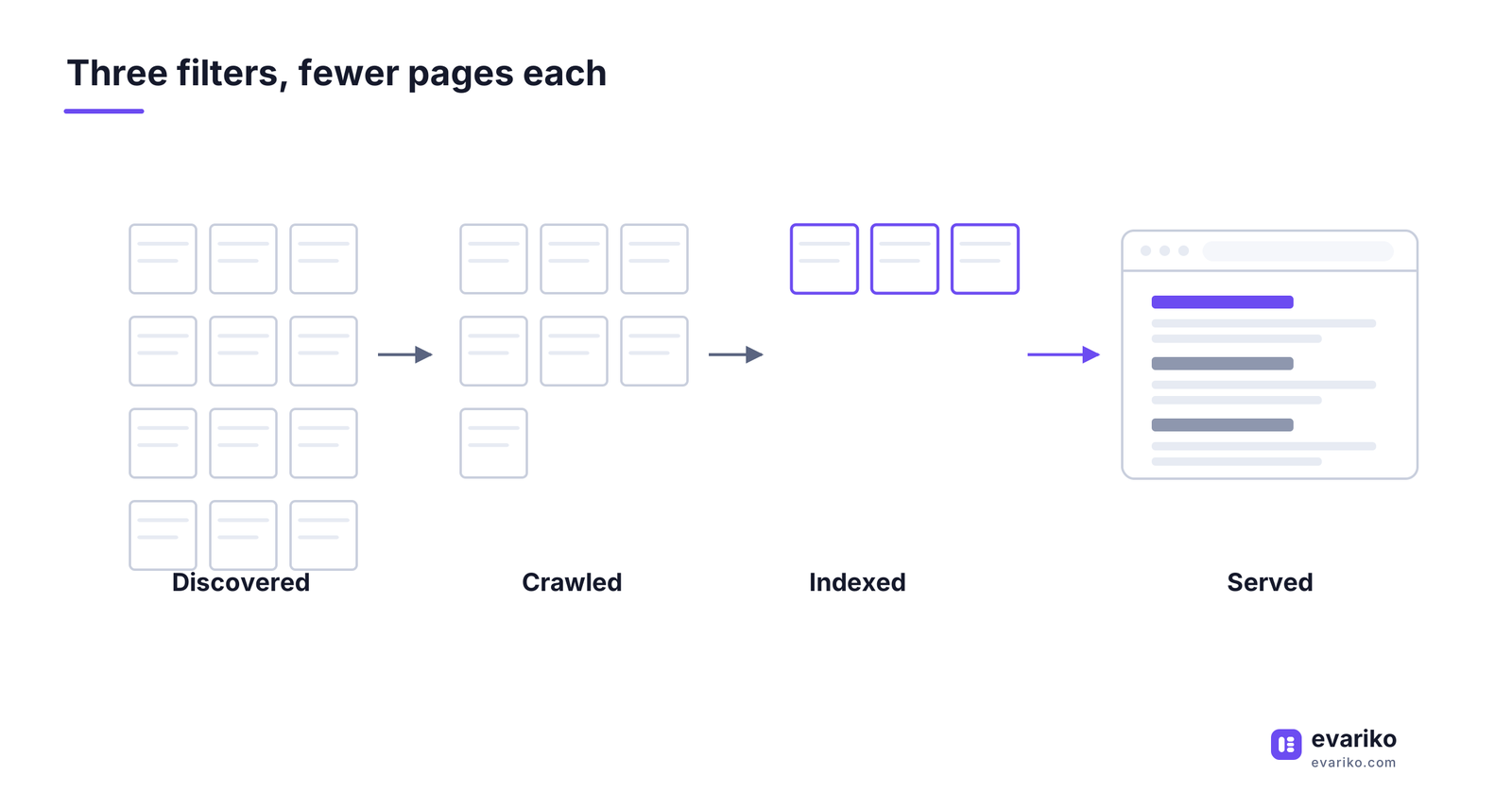
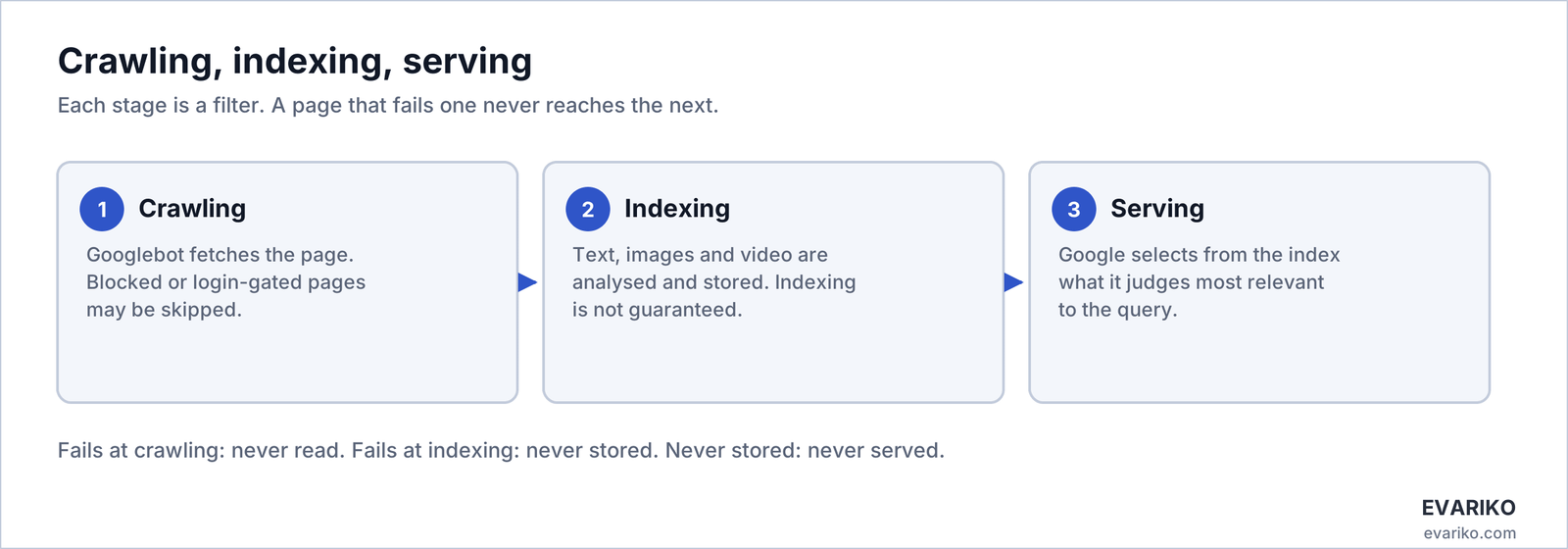
You may already know that search engine like google works in three stages: crawling, indexing, and serving search results (aka ranking). Right?
Well, You’re partially right, I wouldn’t disagree with it but if you want to learn the whole process about how a search engine actually works you’re welcome to read our guide on it.
Because each stage inside the process is a filter, and a page that fails one never reaches the next stage.
Google states plainly that indexing is not guaranteed (Google Search Central, In-depth guide to how Google Search works, updated 18 December 2025).
A SERP, or search engine results pages, is the page of results you get after submitting any queries/questions on search engines.
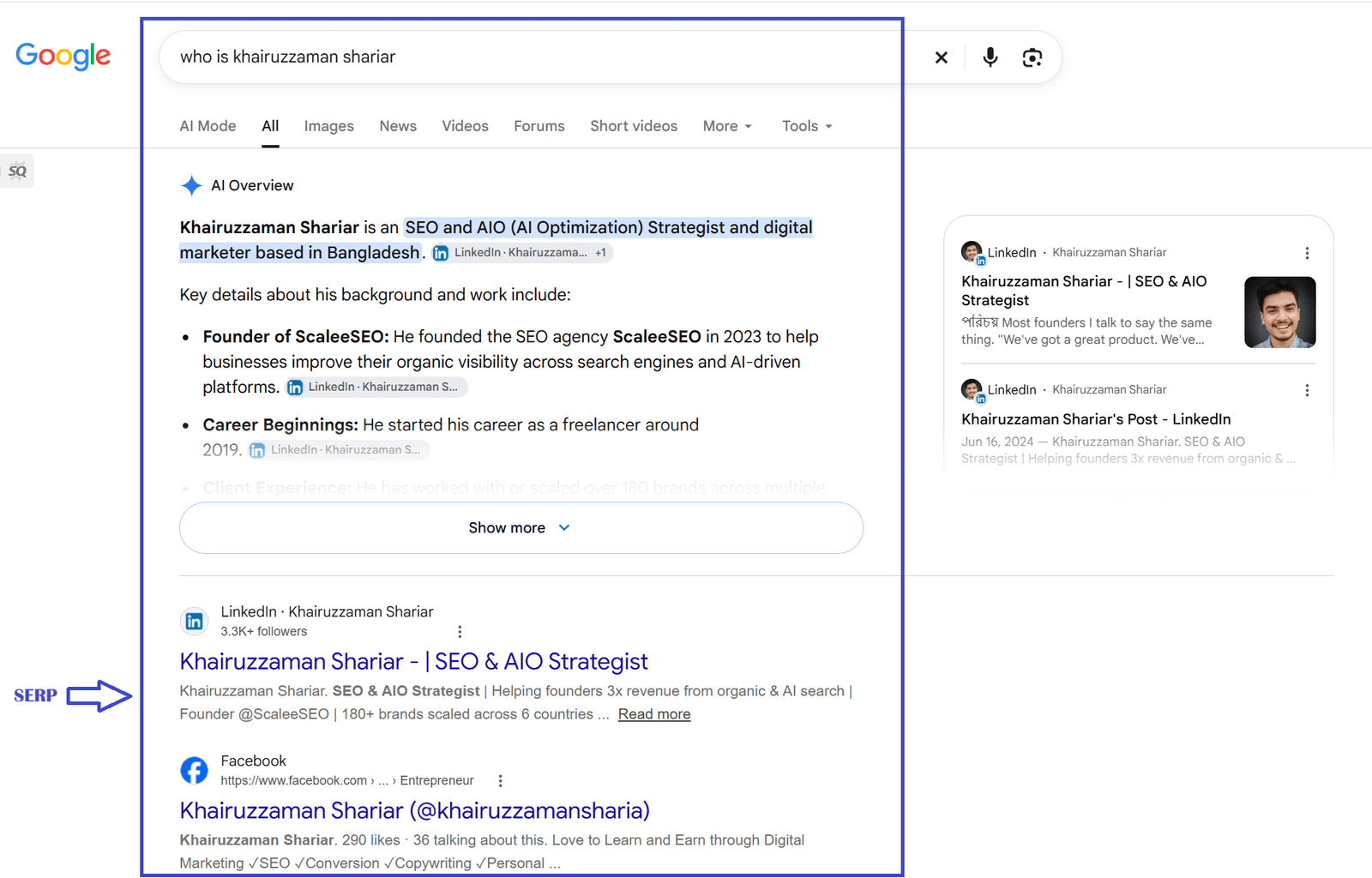
In 2026 a SERP can contain classic blue links, an AI Overview, People Also Ask boxes, local results, images, video and shopping listings, and which of these appear varies by query.
How does Google find and index pages?
Google finds pages through links, downloads their content, and stores what it understands of them in an index. These three steps run in order:
- Discovery: Google learns that a URL exists, usually through a link from a page it already knows or through a submitted sitemap.
- Crawling: Googlebot fetches the page. Google notes that it may skip pages that site owners block or that require a login.
- Indexing: Google analyses the text, images and video on the page and stores the information in the Google index.
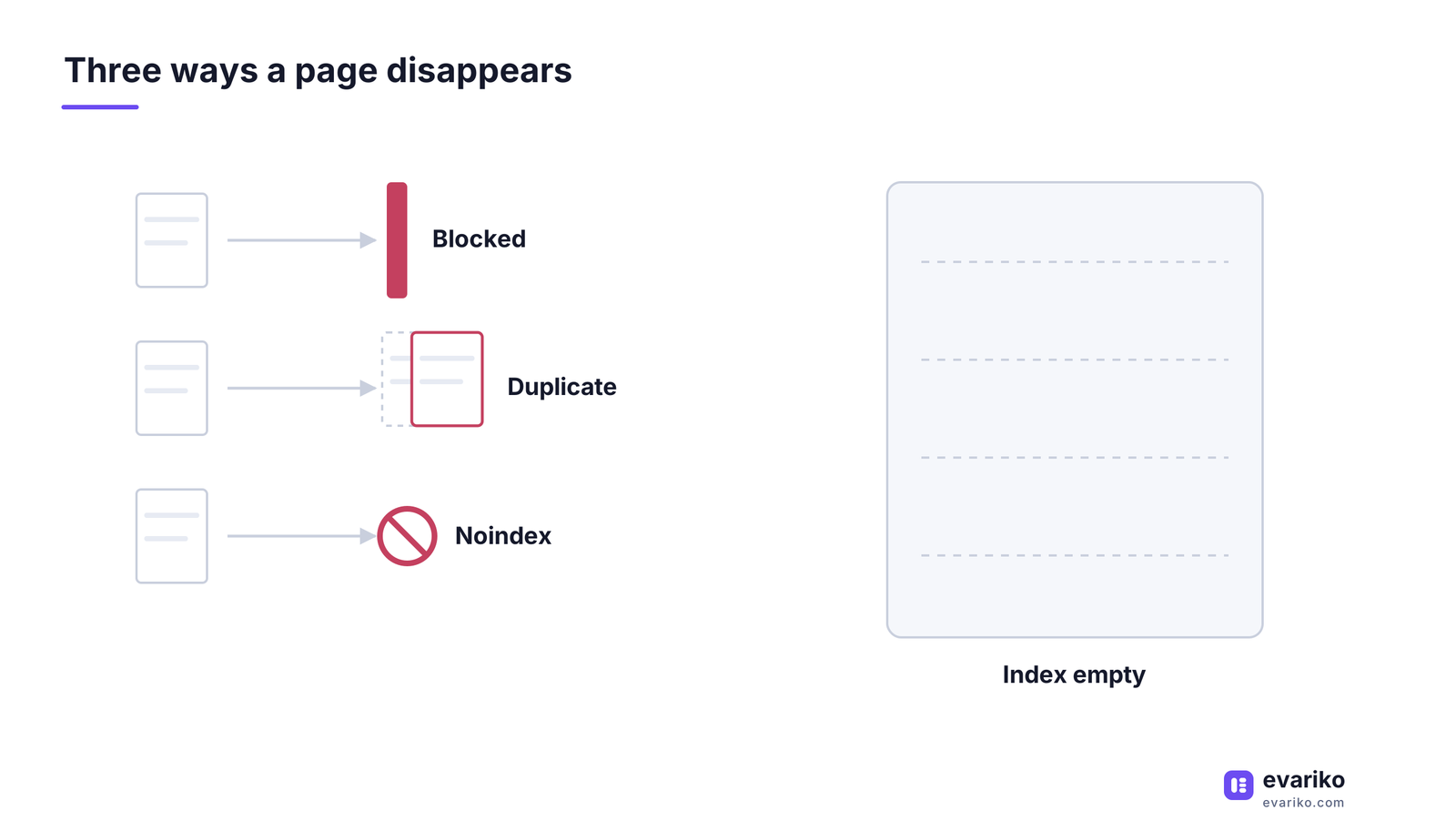
A page blocked in robots.txt is never fetched.
A page fetched but consider duplicate is never indexed.
Most embarrasing part is, Neither failure gives you a warning, which is why Google Search Console and its URL Inspection tool exist, and why the first diagnostic question for any underperforming page is whether it is indexed at all.
If you want to learn more about tech SEO. Then feel free to read our comprehensive guide Technical SEO 101: Complete guide for 2026
How does Google choose which pages to serve?
Google selects from its index the results it believes are the highest quality and most relevant to the query. Relevance is not absolute: Google states that it depends on factors including the searcher’s location, language and device, so two people entering identical words can receive different results.
No complete public list of the signals or their weights exists. What is known is the shape of the judgement.
Google is matching a query to documents, and the documents that win are the ones that answer the query most completely, state the answer most clearly, and come from a source with a history of doing both.
How do AI Overviews and AI Mode choose sources?
AI Overviews and AI Mode are generated from pages already in Google’s index, which is why the entry requirement for both is the same as for classic results.
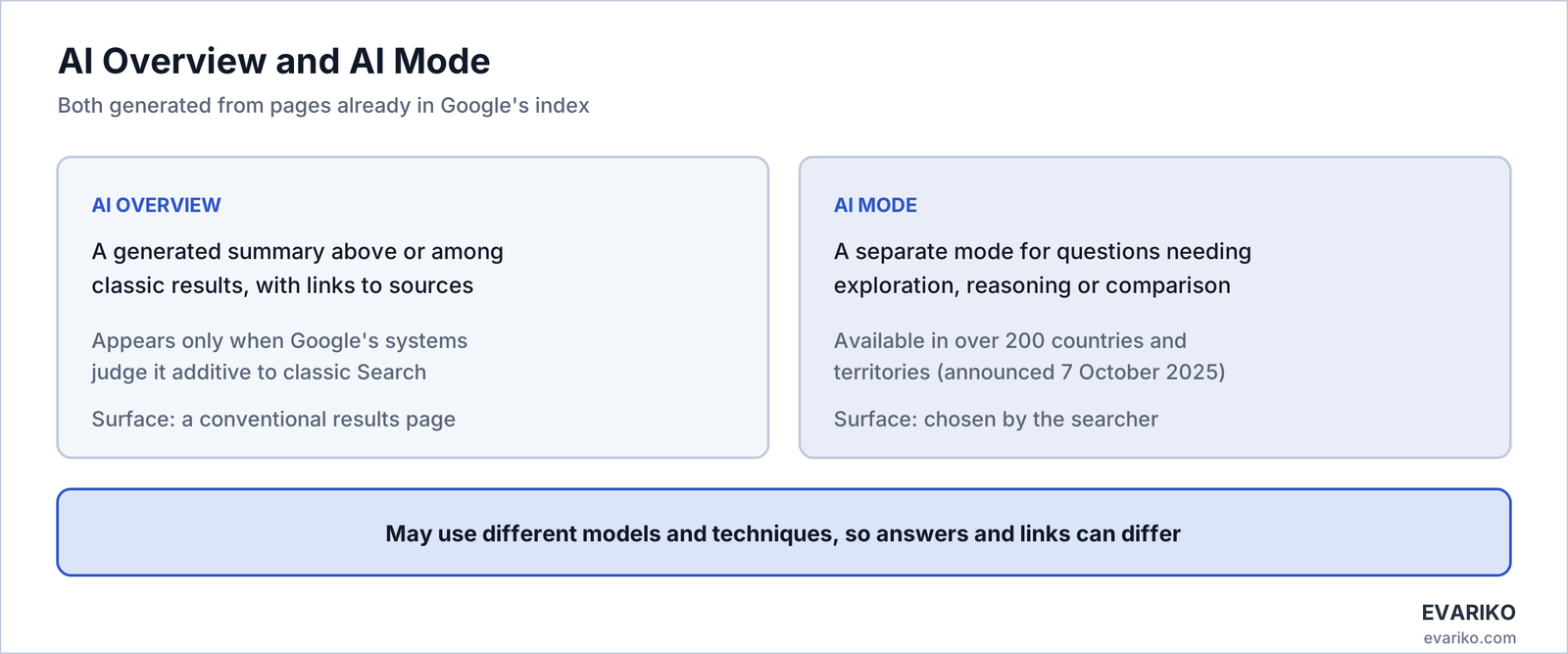
They differ from each other in purpose and in mechanism.
| Feature | What it is | When it appears |
|---|---|---|
| AI Overview | A generated summary placed above or among classic results, with links to supporting sites. Google states it is shown “only when our systems determine that it is additive to classic Search,” so on many queries it does not appear at all. | Alongside a conventional results page |
| AI Mode | A separate mode for questions that need further exploration, reasoning or comparison, returning a generated response with links to supporting sites. Google announced on 7 October 2025 that AI Mode would be available in over 200 countries and territories, after an expansion adding more than 40 countries and 35 languages. | When the searcher chooses it |
Both may use query fan-out, which means running several related searches and building a response from the combined results rather than from one query’s results.

Google also notes that the two features may use different models and techniques, so their responses and the links they carry can differ for the same question.
Measurement is where the practical difficulty sits. Google reports sites appearing in AI Overviews and AI Mode inside the Search Console Performance report under the “Web” search type.
There is no separate AI breakout, so impressions earned in a generated answer are mixed with impressions earned in classic results and cannot be isolated.

The mechanics and the current limits are covered in Google AI Overviews: How They Work and How to Appear In Them.
Is SEO still relevant in 2026 with AI search?
SEO is still relevant in 2026, because AI answers are generated from indexed pages and a page that is not indexed cannot be cited. The index is the gate for both surfaces.
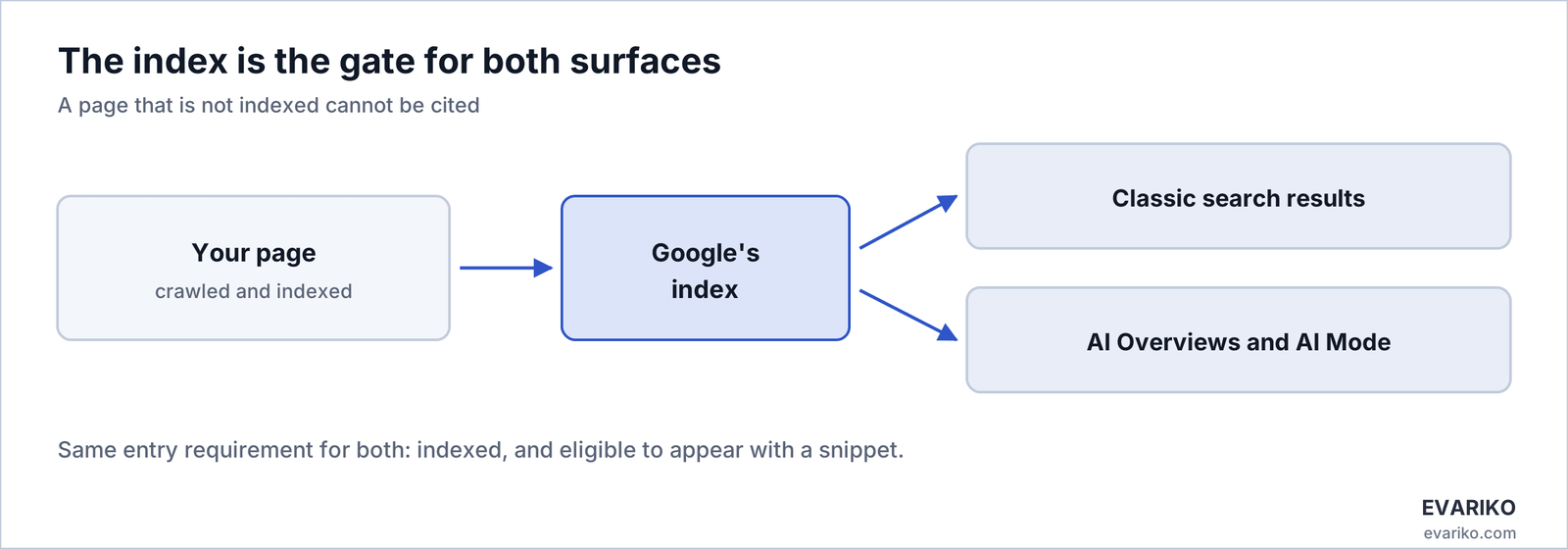
Work that gets a page indexed, understood and judged worth citing serves the generated answer and the classic result at the same time.
What has changed is the yield per impression, and it has changed unevenly. Question-shaped queries with short factual answers now resolve more often inside the answer itself, so a page ranking for one of those earns fewer clicks than it did.
Queries with commercial depth, where the searcher needs to compare, verify or buy, still produce clicks, and those clicks now arrive from readers who have already had the basics answered elsewhere, which tends to make them better qualified.
The magnitude of the shift is where caution is warranted. Several vendors publish click-through-loss figures for AI Overviews and they disagree with each other substantially, each measured on that vendor’s own sample with its own method.
No vendor-independent figure was found in researching this guide, so none is quoted here. The mechanism is clear and the size is contested, and a guide that gives you a precise percentage is giving you one vendor’s sample dressed as a fact.
Is SEO the right channel for your business?
SEO is the right channel when people are already searching for what you sell and you can wait for compounding returns.
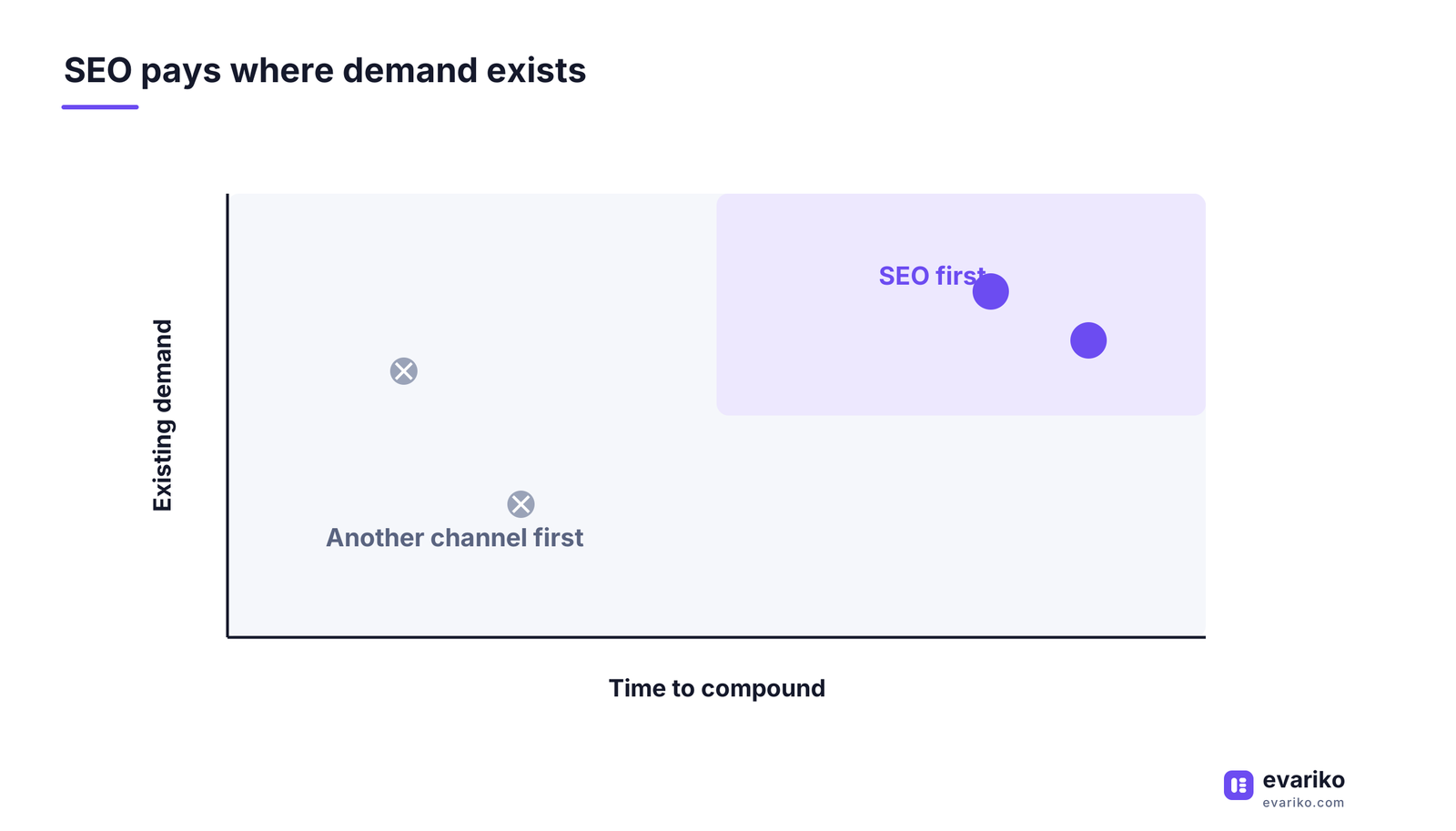
It is the wrong channel when neither condition holds, and no amount of good execution fixes that. Every guide on this subject assumes the answer is yes and moves straight to method. The table below compares four business profiles on whether SEO should be the first channel they fund.
| Business profile | Right first channel? | Why | What to do instead |
|---|---|---|---|
| Established service business, steady search demand, no visibility | Yes | The demand exists and competitors are capturing it. Coverage work converts existing demand into enquiries. | Nothing instead. This is the clearest case for SEO. |
| Ecommerce catalogue, many products, recognisable category terms | Yes | Category and product queries are high in volume and explicit in intent, and the catalogue gives natural page structure. | Pair it with paid search on the highest-margin terms while coverage builds. |
| New product in a category that does not exist yet | No | Nobody is searching for it, so there is no demand to capture. SEO cannot create a query that nobody types. | Paid social and direct outreach to build category awareness first. Return to SEO once search volume appears. |
| Local service business, under a few hundred monthly searches in its area, needs work this quarter | Not first | The total available search volume is too small to produce the volume needed in the timeframe. | A Google Business Profile, local directories and paid search. Treat broader SEO as the second phase. |
The honest summary is that SEO pays when there is existing demand and time to compound, and that it is a poor fit for urgent revenue problems in thin markets. An agency that sells search, paid search and social can give that answer without losing the engagement, which is why it is worth asking for.
When paid search is the better first channel
Paid search is the better first channel under three conditions: a deadline inside the next quarter, an offer that has not yet been validated with real buyers, and a query set with high commercial intent but low volume.
In the first case SEO is too slow. In the second, building twenty pages around an offer that may change is wasted production. In the third, the total organic upside is smaller than the cost of earning it, while paid captures the same searches immediately at a predictable cost per enquiry.
What are the 4 types of SEO?
SEO divides into four types, grouped by what each one acts on.
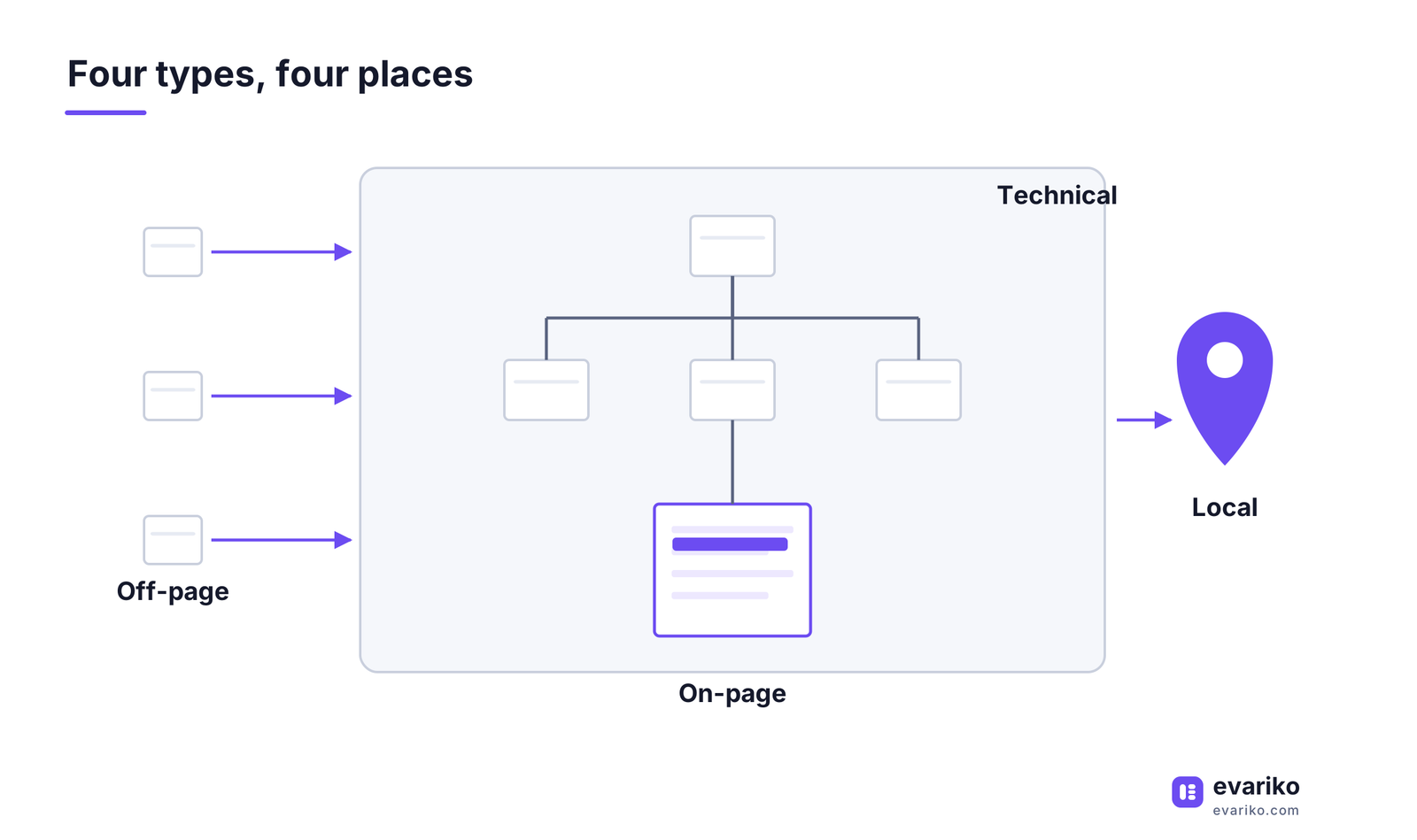
On-page SEO covers everything in the page itself. Technical SEO covers everything about the site that governs whether pages can be reached and interpreted. Off-page SEO covers signals from outside the site. Local SEO covers visibility for queries tied to a place. The table compares them on scope, control and measurement.
| Type | What it covers | Who controls it | How it is measured |
|---|---|---|---|
| On-page SEO | Title tag, headings, the first sentence under each heading, body content, URL, internal links, image alt text | You, entirely | Impressions and average position for the queries the page targets |
| Technical SEO | Crawlability, indexability, canonicals, redirects, site architecture, rendering, page performance, HTTPS | You, with developer access | Indexed page count, crawl statistics, Core Web Vitals field data |
| Off-page SEO | Backlinks, referring domains, brand mentions, branded search volume | Other people, influenced by you | Referring domains, branded query volume |
| Local SEO | Google Business Profile, citations, directory listings, location and service-area pages | You, within the platform’s rules | Local pack visibility, profile actions, calls and direction requests |
Answer engine optimization and generative engine optimization are not a fifth type. They describe a surface where visibility is earned, not a category of work with its own mechanics, and the distinction is worth being precise about. It is covered in full further down.
How do you find what people are searching for?
Keyword research is the practice of finding the queries real people type, then judging which ones a page can realistically answer better than the pages currently answering them. A query is the actual string entered.
Search volume is how often it is entered in a given period. Keyword difficulty is a tool’s estimate of how hard the current results would be to displace, and it is an estimate, not a measurement.
The sequence that works:
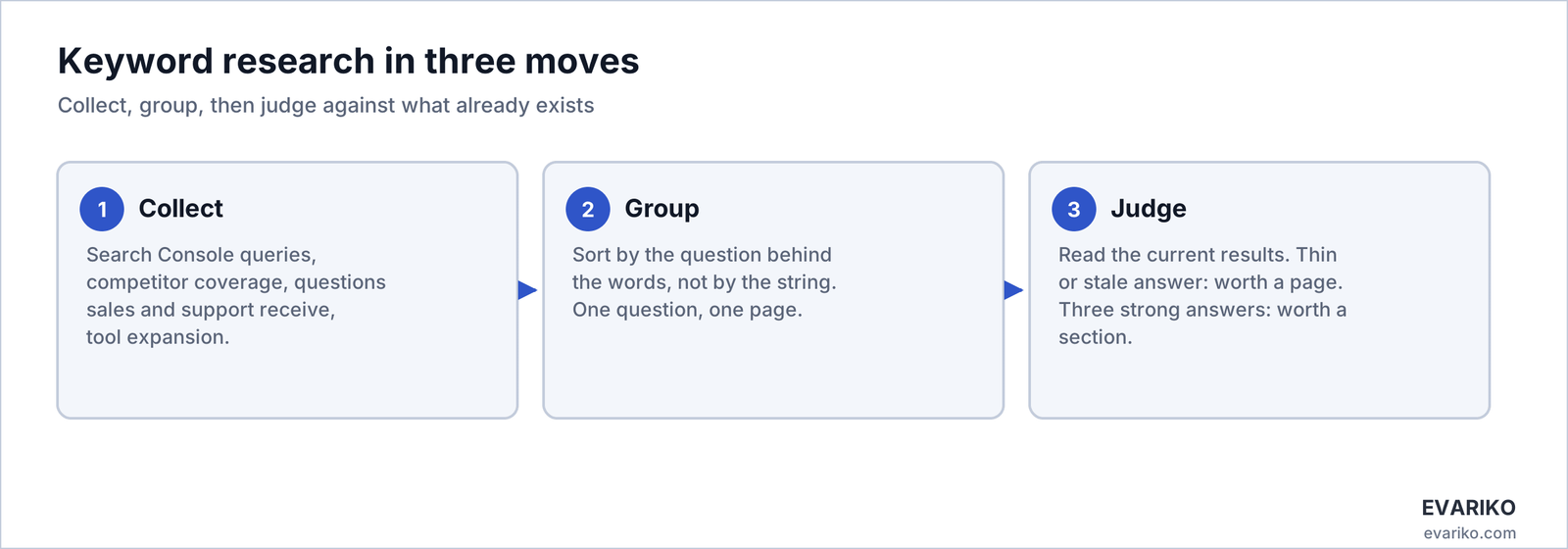
- Collect the queries. Start from what the business already ranks for in Search Console, add competitor coverage, add the questions sales and support actually receive, then expand each with a keyword tool.
- Group by the question behind the words. “SEO cost”, “how much does SEO cost” and “SEO pricing” are three strings and one question, so they belong to one page. “SEO cost” and “SEO timeline” are two questions and need two.
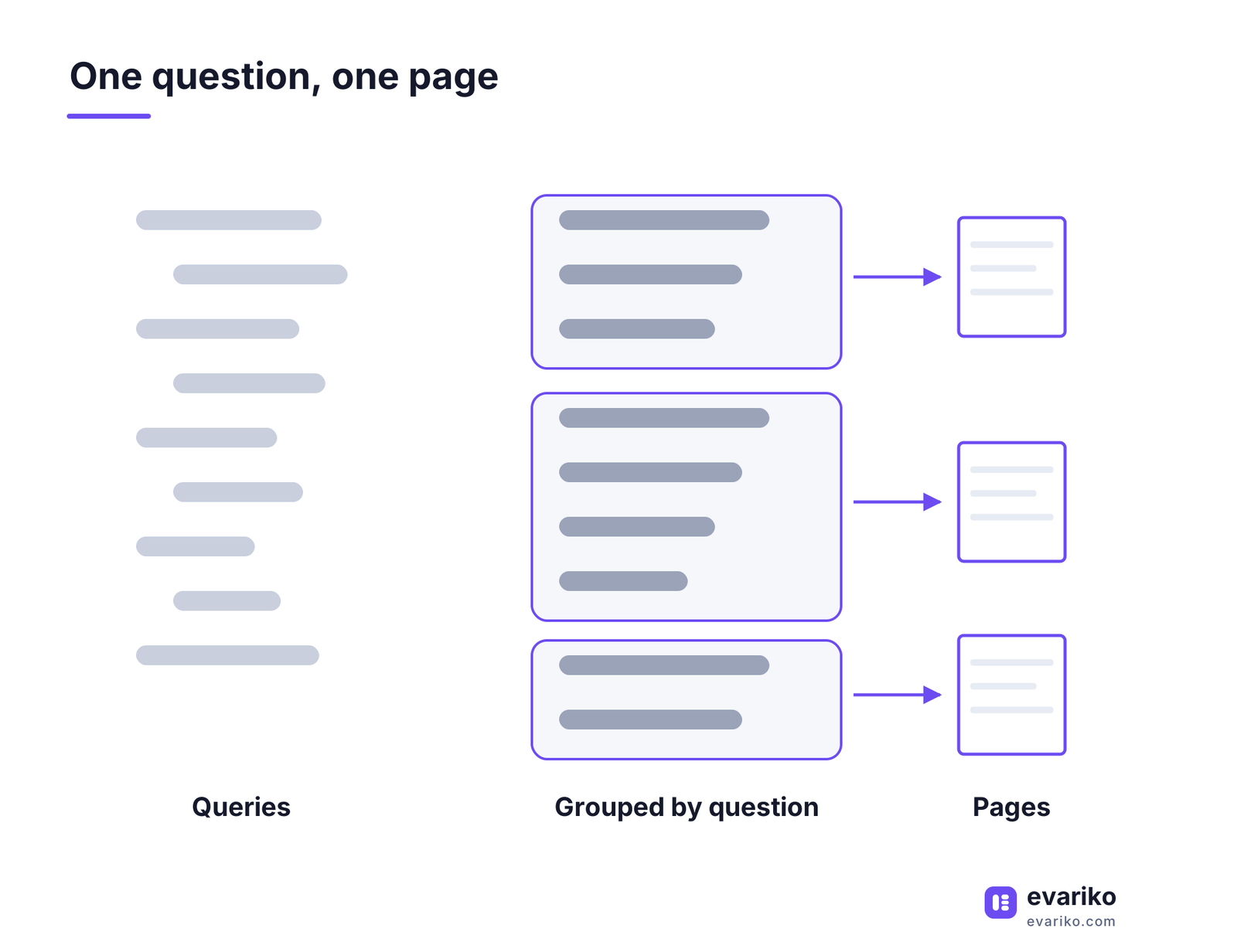
- Judge each group against what exists. Read the current results. If the best page answering a question is thin, stale or does not answer it at all, that group is worth a page. If three strong pages already answer it completely, that group is worth a section inside a broader page instead.
A worked example runs through the rest of this guide. Take a single query a reader can follow: a UK training provider wants to rank for a mid-volume commercial question in its sector.
Step one finds the query already producing impressions but no clicks.
Step two groups it with four phrasings of the same question.
Step three reads the current results and finds the strongest page answers the question in its fifth section rather than its first.
Want to learn more about keyword research?
Here is the full Keyword Research method: How to Find Queries/Keyword Worth Targeting.
Do keywords still matter for SEO in 2026?
Keywords still matter in 2026, as evidence of what people want rather than as strings to place in a page. Matching the words is not what gets a page chosen. Covering the question those words represent, completely and in plain statements, is.
A page that repeats a phrase thirty times and answers the question once will lose to a page that states the phrase twice and answers the question fully.
What are the four types of search intent?
Search intent is what the person entering a query is trying to accomplish, and it falls into four types. Each needs a different kind of page, and serving the wrong one is the most common reason a well-written page fails.
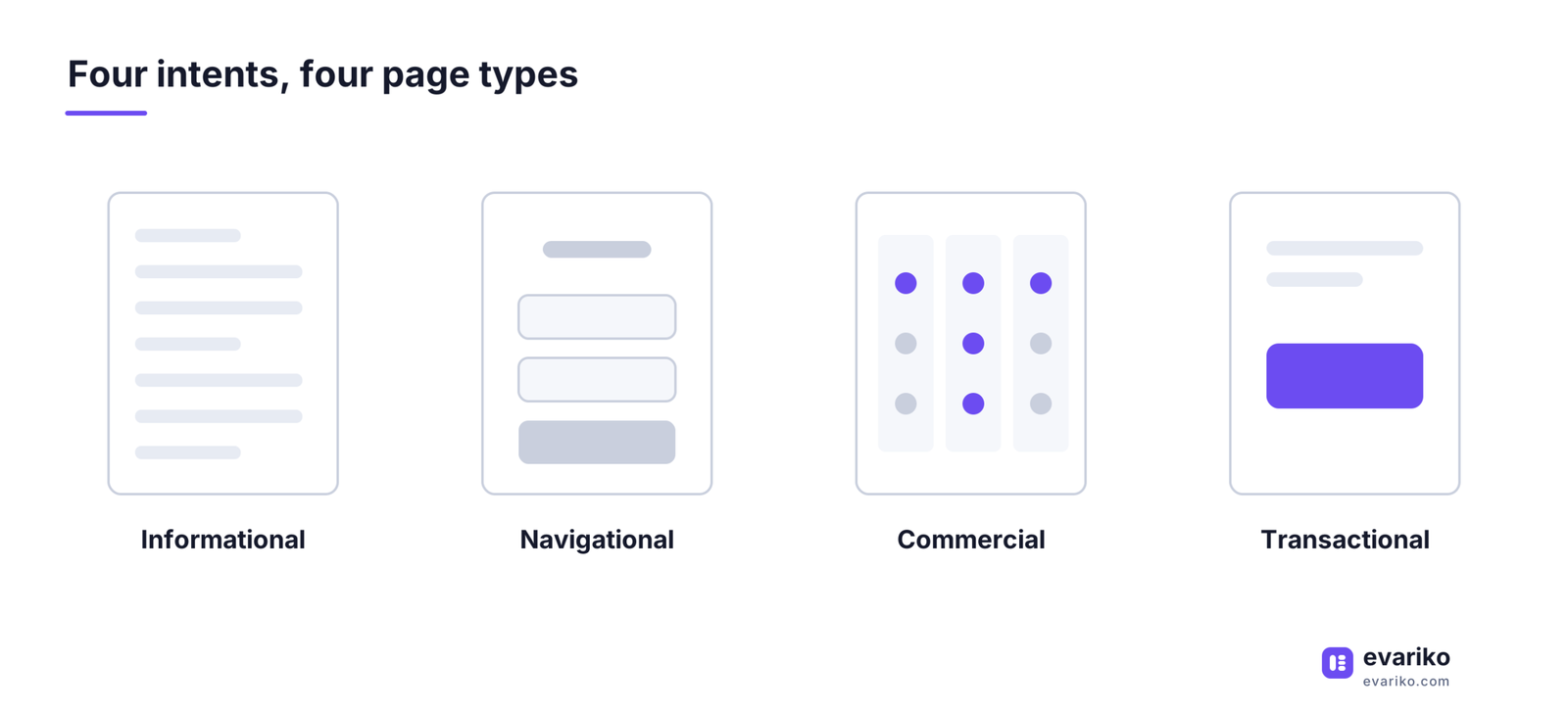
- Informational. The searcher wants to understand something. Example: how search engines index pages.
- Navigational. The searcher wants a specific site or page. Example: a brand name plus “login”.
- Commercial. The searcher is comparing options before buying. Example: best project management software for small teams.
- Transactional. The searcher is ready to act. Example: book a safety training course.
Matching the page type to the intent matters more than matching the words. A product page cannot win an informational query and a guide cannot win a transactional one.
The four types and how to match a page to each are covered in Search Intent: The Four Types and How to Match Them.
Topical authority is the state of covering a subject so completely that a search engine retrieves your site for most of the questions inside it, rather than for one query at a time. It is earned by coverage and accumulated engagement, not by site age and not by publishing volume on its own.
The mechanism is retrieval economics. A search engine incurs a cost to crawl, evaluate and serve every document it considers. When one source answers forty related questions accurately, the engine can satisfy forty queries from one place it already trusts, instead of evaluating forty separate sources of unknown quality.
A source that reliably lowers that cost gets retrieved more often, and gets retrieved for questions it has not specifically targeted.

The structure that produces it has three levels:
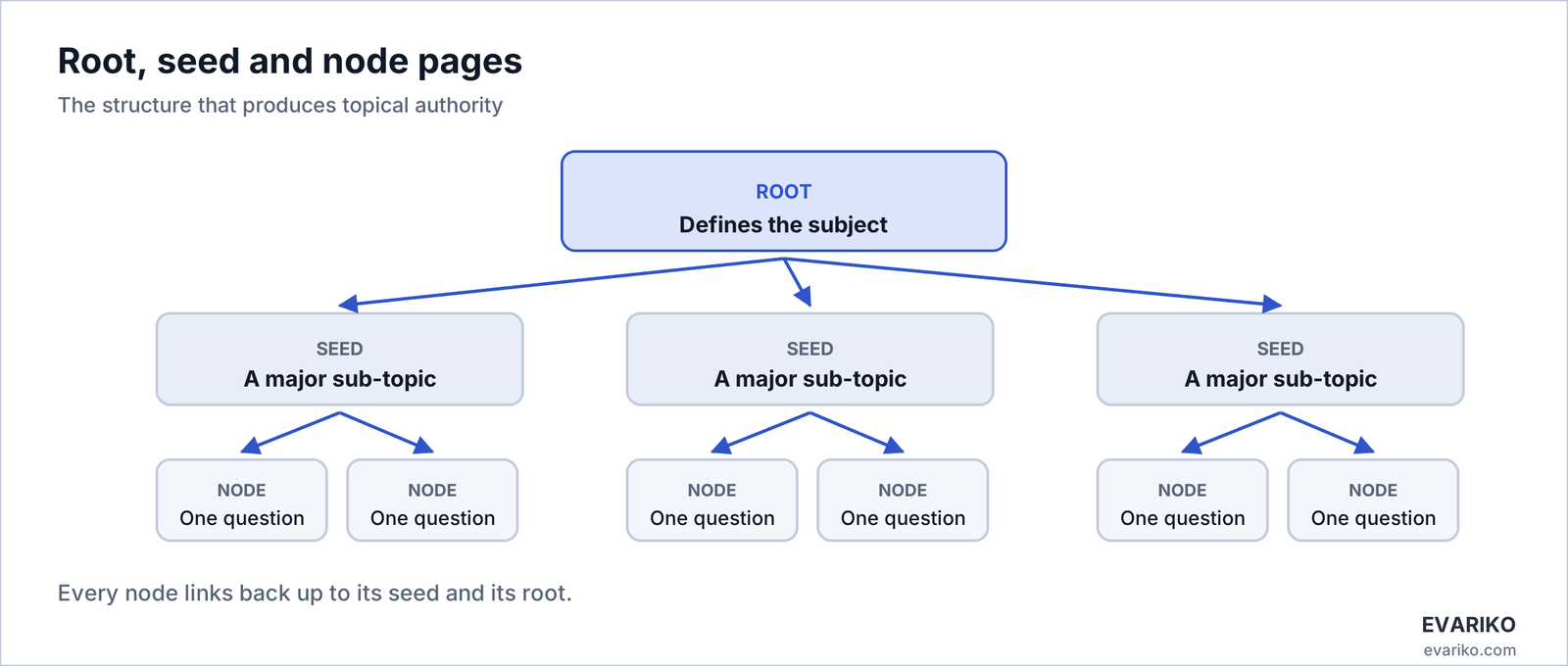
- A root page that defines the subject and links to everything inside it. This page is one.
- Seed pages for each major sub-topic, which group the questions beneath them.
- Node pages for individual questions, each linking back up to its seed and its root.
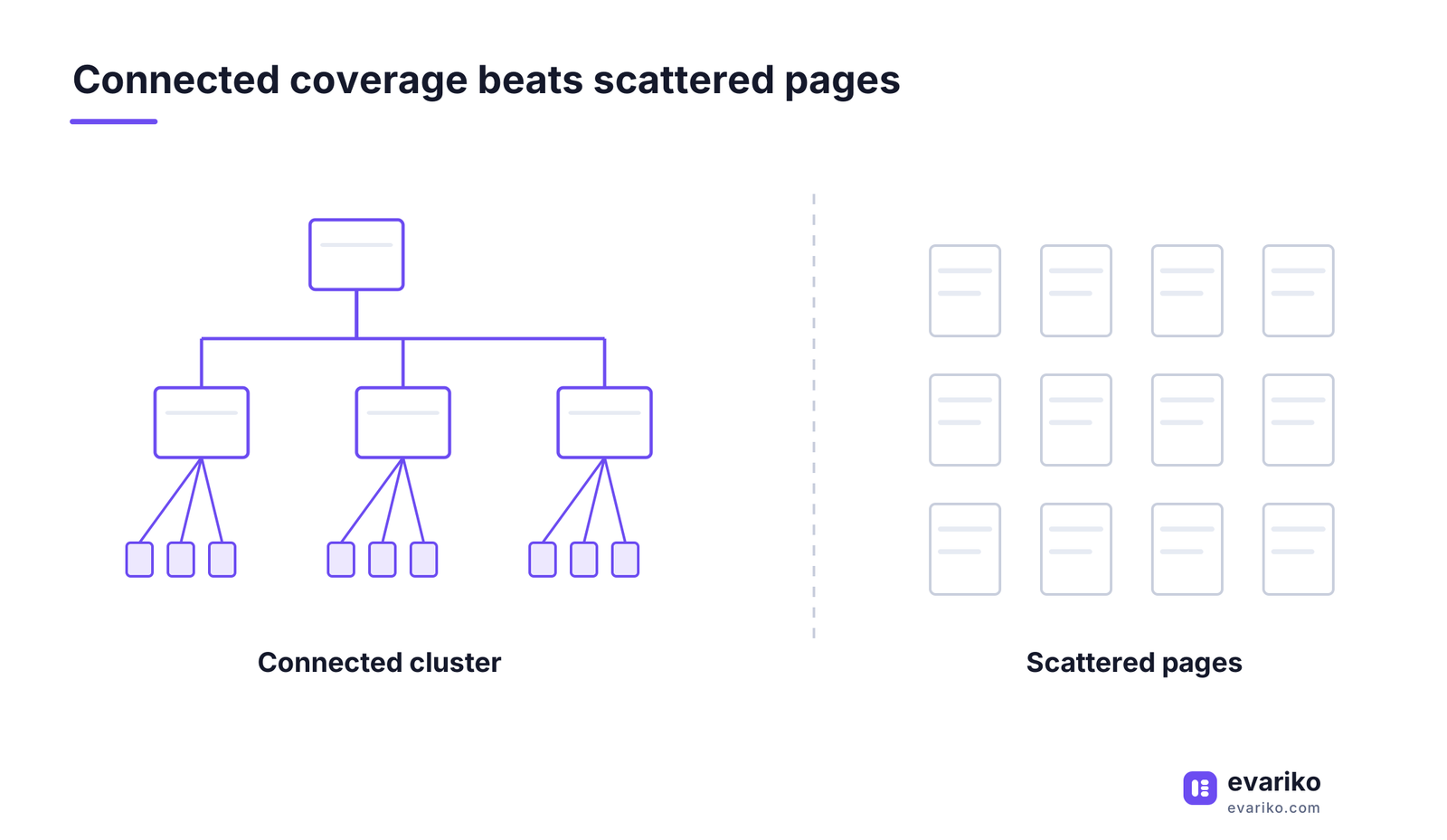
Every bolded phrase in this guide is a node or seed page in exactly that structure. The practical consequence for anyone planning content is that a cluster of twelve connected pages covering one subject completely will usually outperform forty disconnected pages covering forty subjects partially, because the forty never accumulate enough coverage in any one subject for the engine to treat the source as the place that answers it.
How to plan and sequence a cluster is covered in Topical Authority: How to Build It With Topic Clusters.
What makes content good enough to be shown?
Content is good enough to be shown when it answers the question it was written for more completely and more clearly than the pages currently answering it.
Google’s guidance on this is written in terms of people-first content, which it describes as content created primarily for people rather than to manipulate rankings.
The qualities that guidance asks for, reduced to what they mean on the page:
- Original information. Something in the page cannot be found in the pages it competes with. Research, measurement, a worked case, direct experience.
- A complete answer. The reader finishes the page without needing another one for the same question.
- Clear sourcing. Facts are attributable, and claims that are contested are described as contested.
- Evident experience. The writing shows the subject has actually been done, through the detail that only doing it produces.
Is E-E-A-T a ranking factor?
E-E-A-T is not a ranking factor.
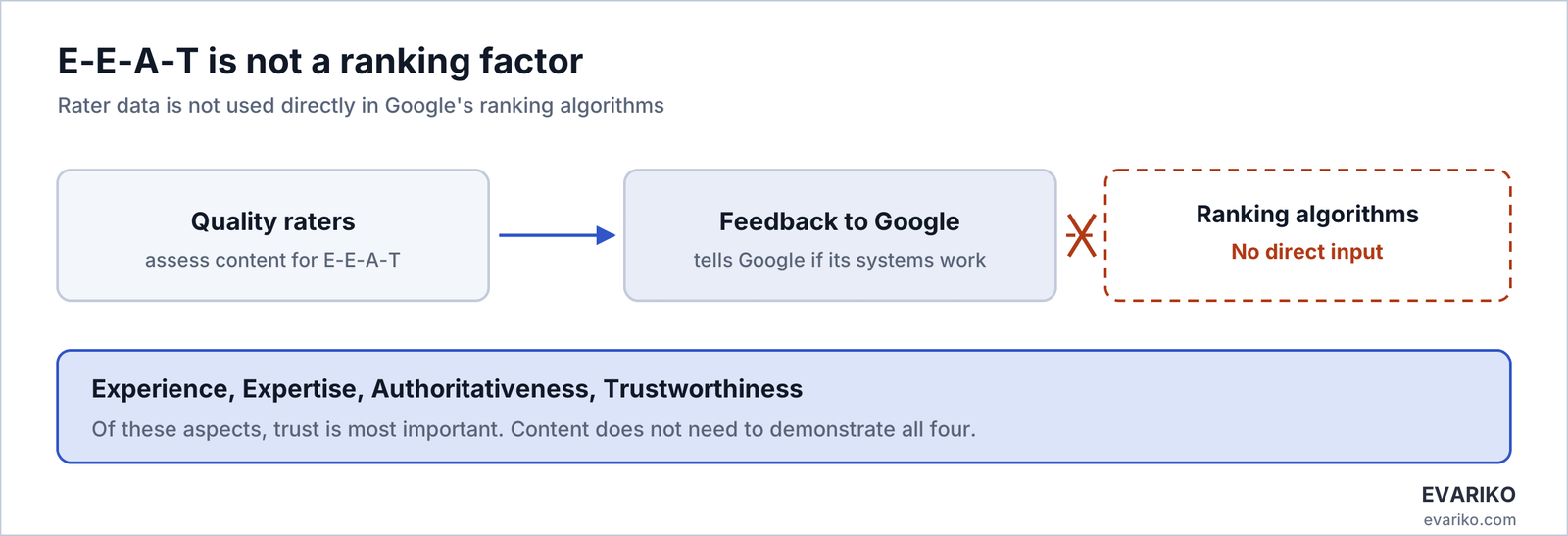
Google’s own words are that “E-E-A-T itself isn’t a specific ranking factor,” though it adds that using a mix of factors which identify content with good E-E-A-T is useful (Google Search Central, Creating helpful, reliable, people-first content, updated 5 October 2026).
E-E-A-T stands for experience, expertise, authoritativeness and trustworthiness, and it is a set of criteria used in Google’s quality rater guidelines.
Google states that raters “are trained to understand if content has strong E-E-A-T,” and then states something the SEO industry routinely omits: “Rater data is not used directly in our ranking algorithms.” Raters have no influence over the rankings of the pages they assess.
Their feedback tells Google whether its systems are working. Google also gives the four aspects a hierarchy: “Of these aspects, trust is most important,” and notes that content does not need to demonstrate all of them.
What that means operationally is narrow and useful. The signals that genuinely accompany a trustworthy source are worth building: a named author with verifiable involvement in the field, dated and attributed facts, clear ownership and contact information, and claims that hold up when checked.
The acronym is not a checklist and optimising for it as a score is optimising for something that does not exist. What Google publishes and what the industry claims about it are separated in E-E-A-T: What Google’s Quality Rater Guidelines Actually Say.
Which on-page elements actually matter?
Six on-page elements carry real weight: the title tag, the heading structure, the first sentence under each heading, the URL, the internal links and the image alt text.
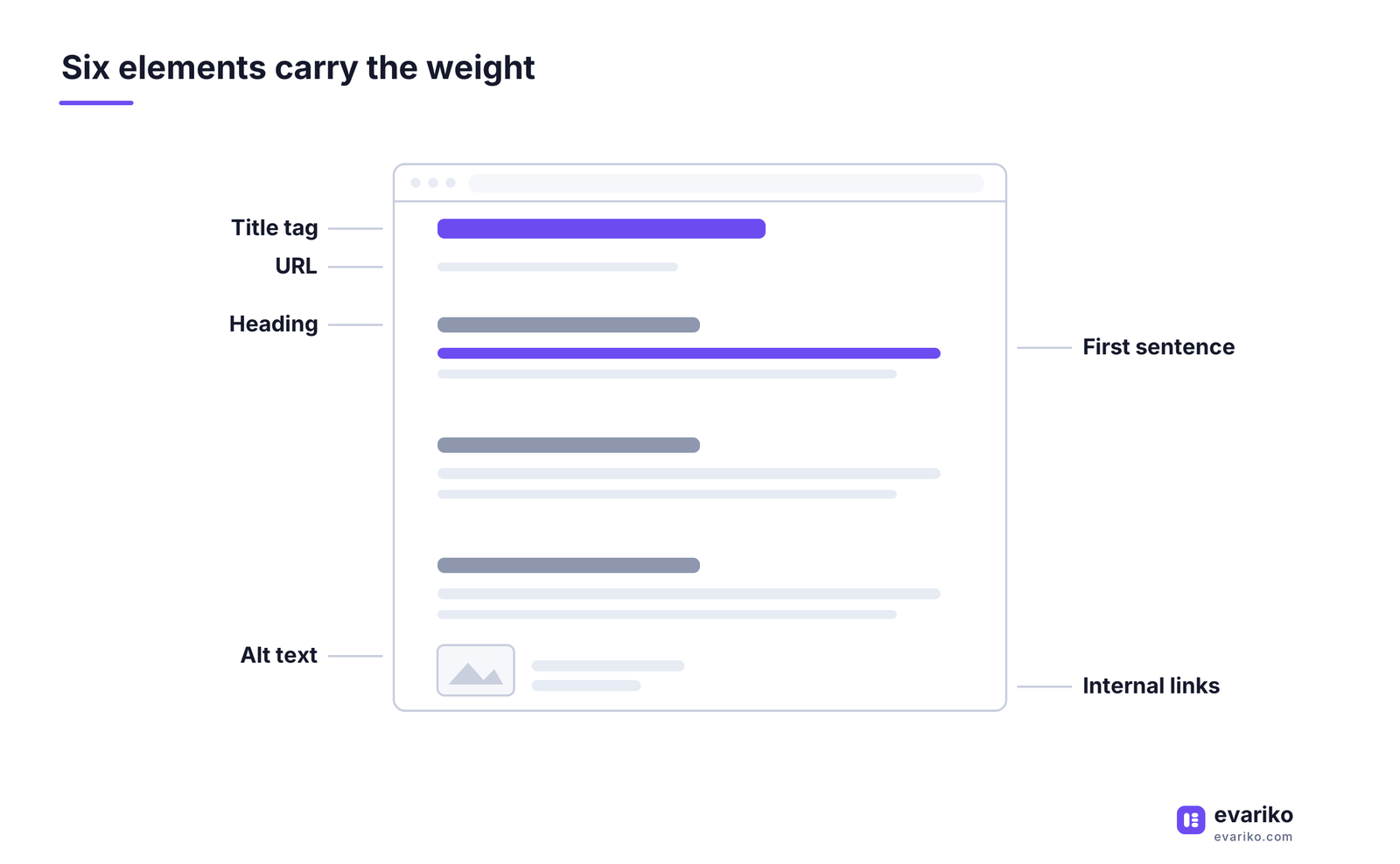
Each is defined in the table before it is compared, and the third column names the failure that is most common in practice.
| Element | What it does | What gets it wrong |
|---|---|---|
| Title tag | Tells the search engine and the reader what the single topic of the page is | Covering two topics, so the page is strongly relevant to neither |
| Heading structure | Breaks the page into questions and signals which are primary and which are subordinate | Headings written as labels rather than as the questions readers ask |
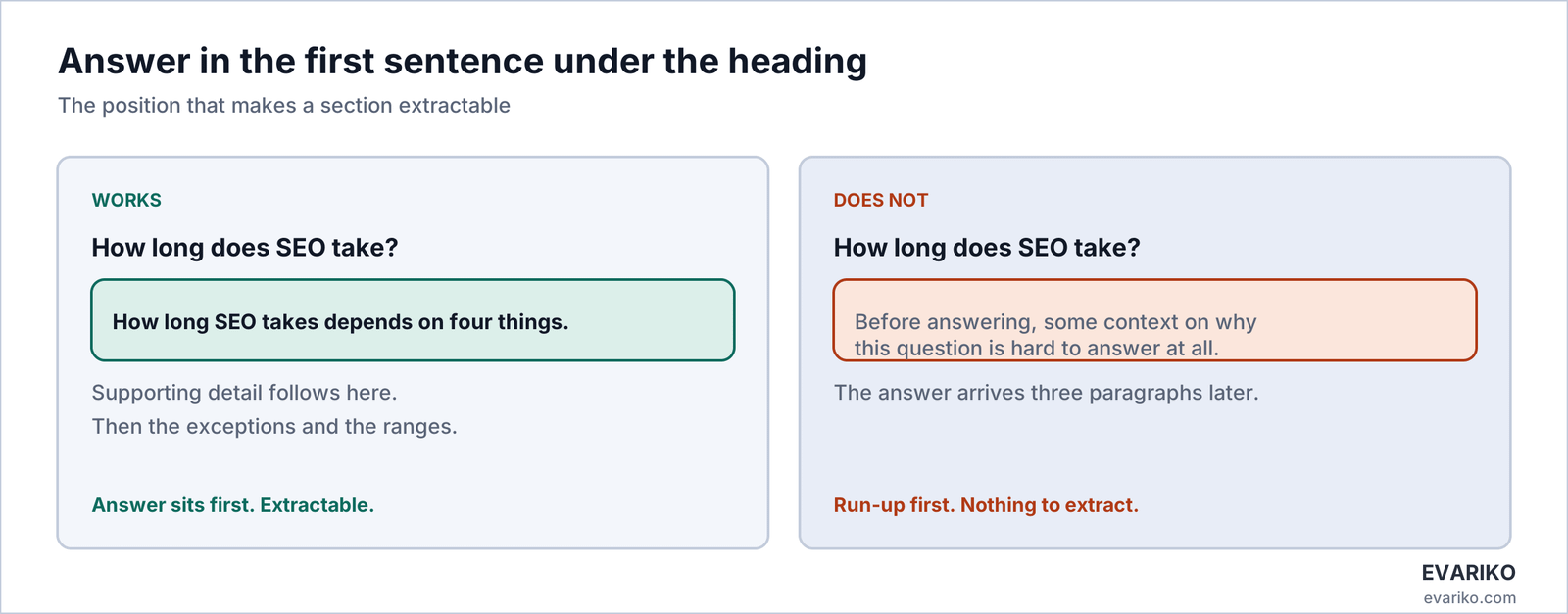
| First sentence under each heading | Answers the heading immediately, which is what makes a section extractable | Opening with context or a restatement instead of the answer |
| URL | Tells the crawler the page’s subject and position before the page is read | Length, repeated words, and dates that make the URL stale |
| Internal links | Pass relevance between related pages and let a crawler reach every page | Boilerplate links repeated site-wide, which pass almost nothing |
| Image alt text | States what the image conveys, for readers using screen readers and for image search | Naming the format rather than the content |
The meta description is not a ranking factor. It is the text Google may show beneath the title in results, so it affects whether a listing earns the click, and it still reflects the page’s overall topicality to anyone reading it.
In the worked example, the gap found in keyword research was that the strongest existing page answered the question in its fifth section.
The response is structural, not stylistic: the new page carries the question in the title tag, repeats it as the first H2, and answers it in the first sentence underneath, which is the position that makes a section eligible to be extracted as a featured snippet or quoted in a generated answer.
What technical problems stop a site being found?
Five technical problems account for most cases of a site not being found, and all five are failures of access or interpretation rather than failures of writing.
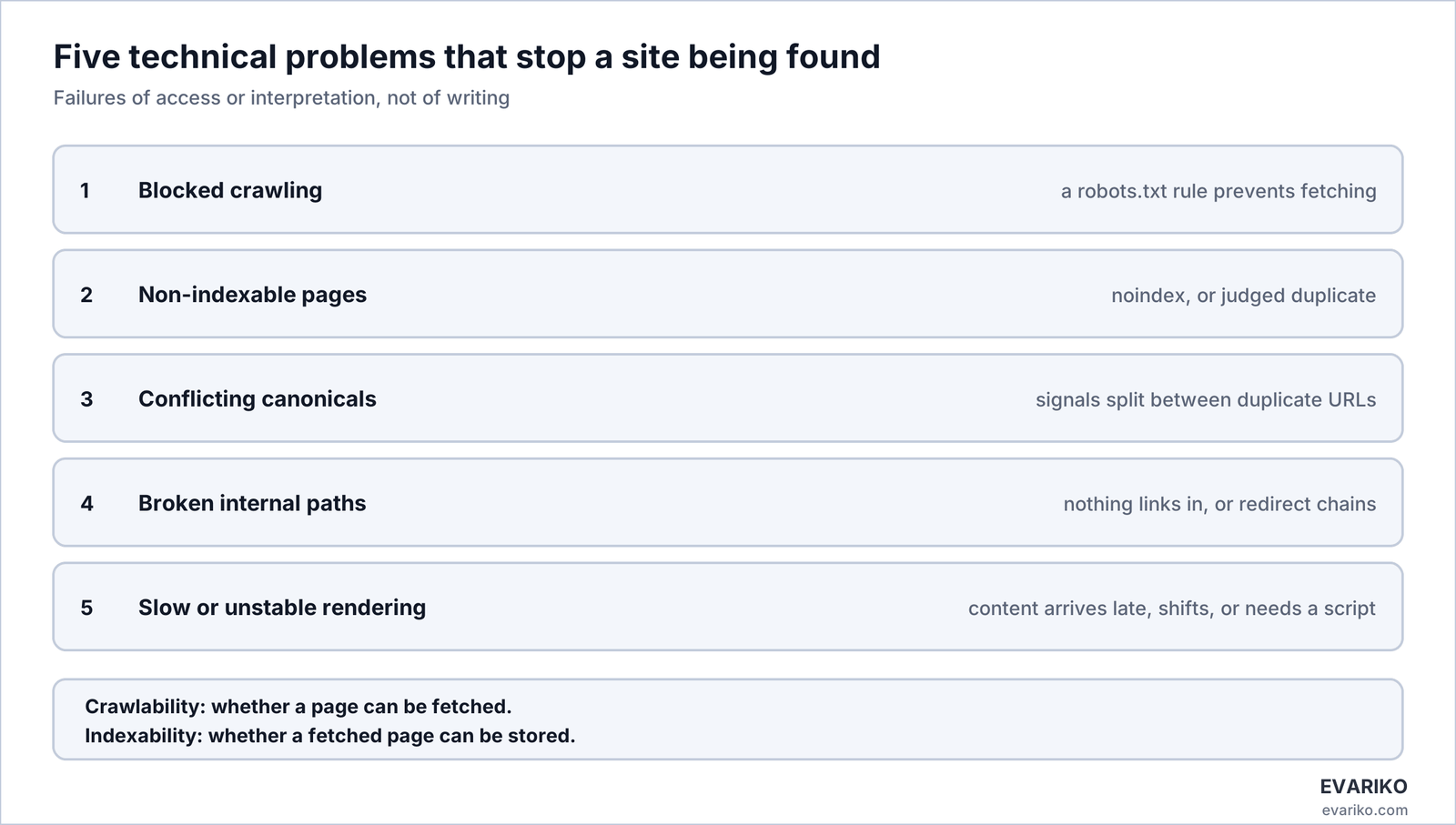
- Blocked crawling. A robots.txt rule prevents fetching, so the page is never read. This is more common than it sounds and it is not always deliberate. Researching this guide involved attempting to fetch a live agency website and being refused at the robots layer, which means nothing that respects robots.txt can read it, Googlebot included. A site in that state cannot rank for anything regardless of how good its content is.
- Non-indexable pages. The page is crawled but carries a noindex directive, or is judged duplicate, so it is never stored.
- Conflicting canonicals. Two or more URLs serve the same content and the canonical tags disagree about which is authoritative, so the signals split between them.
- Broken internal paths. Pages exist but nothing links to them, or the links pass through redirect chains, so crawlers reach them late or not at all.
- Slow or unstable rendering. The content is there but arrives too slowly, or the page shifts under the reader as it loads, or the main content is injected by a script the crawler does not execute.
Crawlability is whether a page can be fetched. Indexability is whether a fetched page can be stored. A canonical is the declaration of which URL is authoritative among duplicates.
A redirect is an instruction that a URL has moved. The first four problems are binary and either hold or do not. The fifth has published numbers.
What are the current Core Web Vitals thresholds?
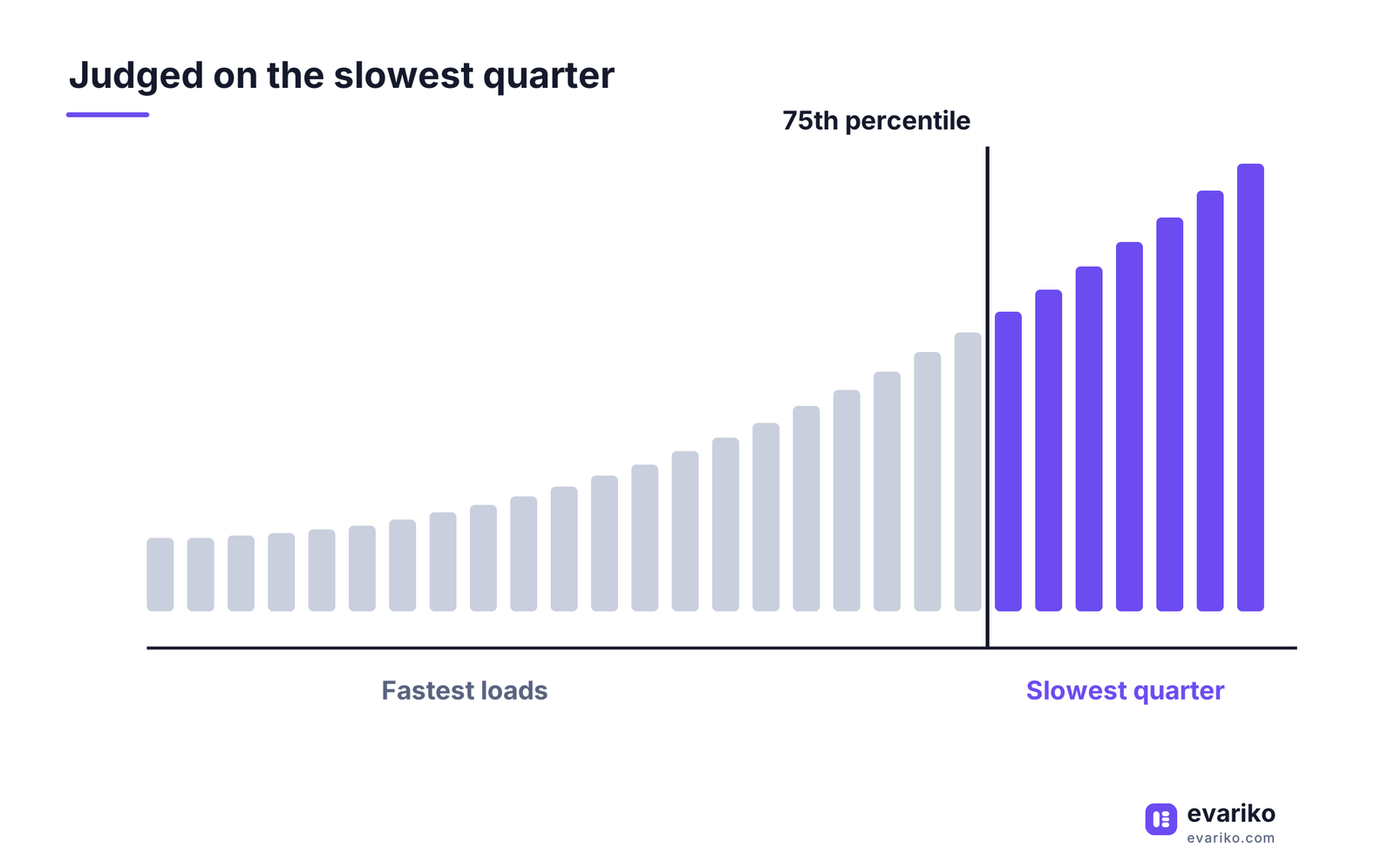
Core Web Vitals are three metrics with published thresholds, each assessed at the 75th percentile of page loads and segmented separately for mobile and desktop.
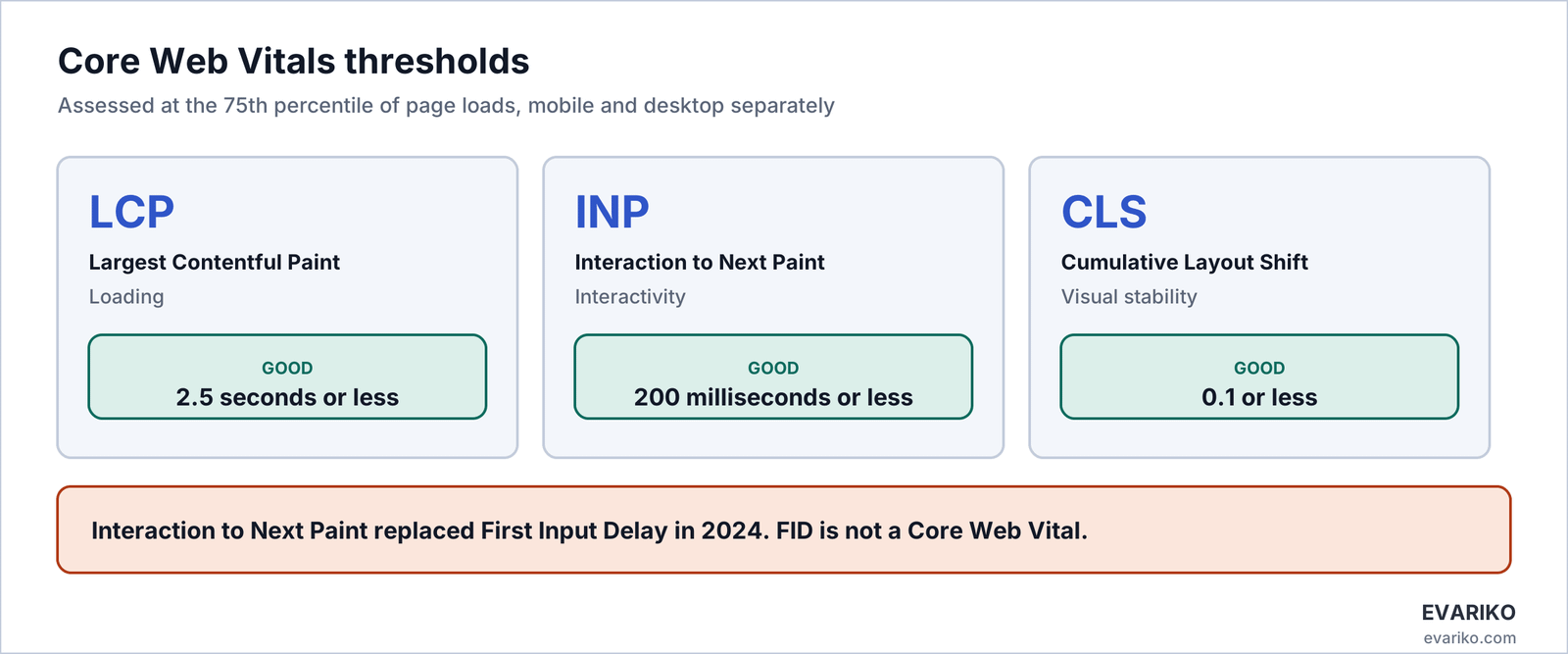
The table gives the current metric set and the value each must reach to be judged good.
| Metric | What it measures | Good threshold |
|---|---|---|
| Largest Contentful Paint (LCP) | Loading. How long until the largest visible element has rendered | 2.5 seconds or less (2,500 milliseconds) |
| Interaction to Next Paint (INP) | Interactivity. How long the page takes to respond visibly to an interaction | 200 milliseconds or less (0.2 seconds) |
| Cumulative Layout Shift (CLS) | Visual stability. How much visible content moves unexpectedly during loading | 0.1 or less |
One correction matters here, because a large amount of SEO writing still gets it wrong. Interaction to Next Paint replaced First Input Delay, becoming a stable Core Web Vital in 2024 (web.dev, Web Vitals, updated 31 October 2024).
Any guide still naming FID as a Core Web Vital, or still giving its threshold, was written before that change and has not been revised.
The 75th percentile matters too: a site passes on the experience of the slowest quarter of its visits, not on an average, which is why a fast desktop test can coexist with a failing assessment.
The three metrics and what actually moves them are covered in Core Web Vitals: LCP, INP and CLS Explained.
Does structured data still help in 2026?
Structured data still helps in 2026, for the rich result features Google still supports, and that set is smaller than it was. Structured data is machine-readable markup describing what a page’s content means.
Schema markup is the vocabulary most commonly used for it. A rich result is the enhanced appearance a supported type can earn in search results.
Google currently lists 25 structured data features eligible for rich results, including Article, Breadcrumb, Product, Local business, Organization, Event, Job posting, Recipe, Review snippet, Video and Course list (Google Search Central, structured data markup gallery, updated 15 June 2026). Two widely deployed types are no longer among them.
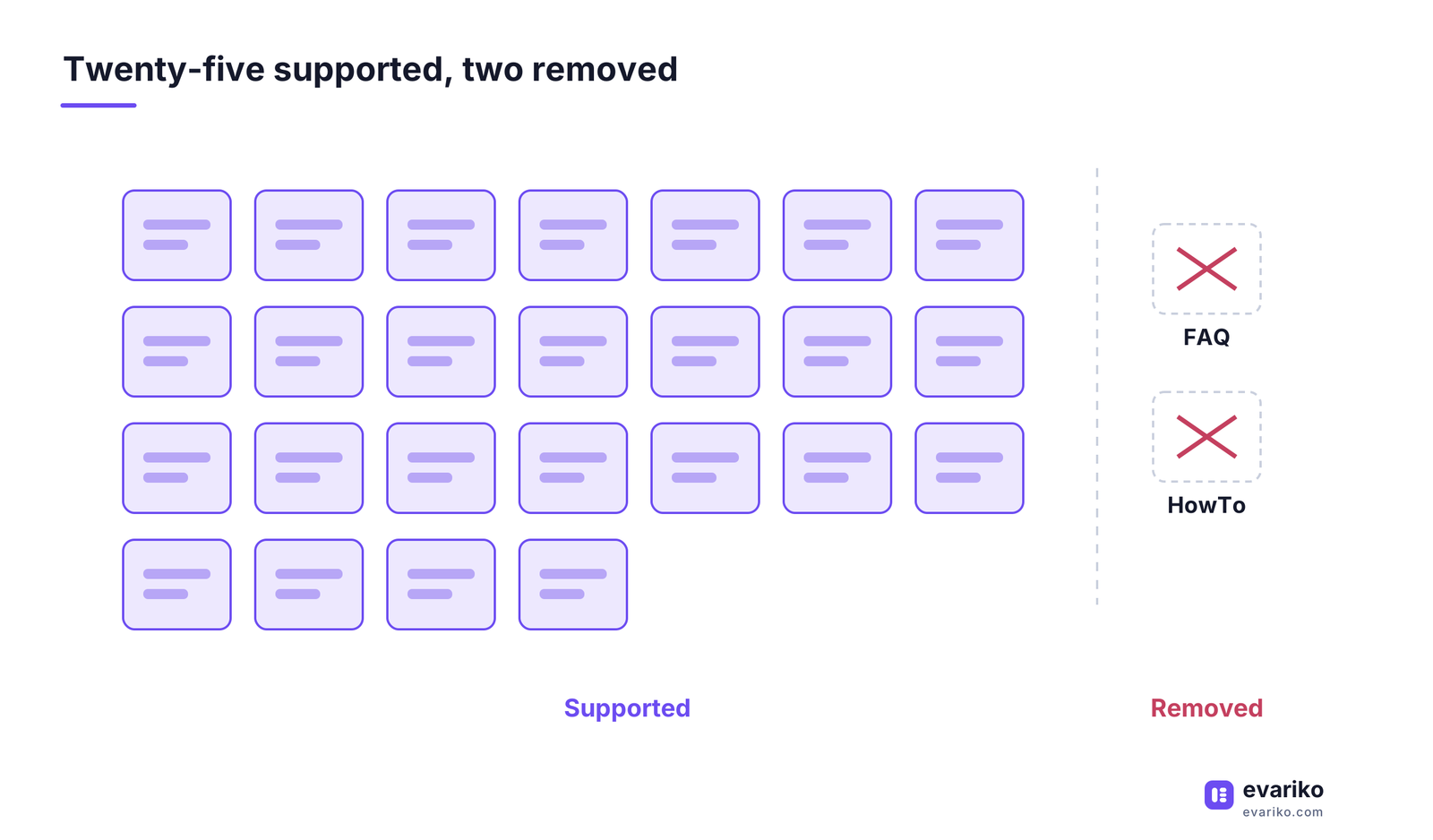
The FAQ rich result was removed from Google Search on 7 May 2026, announced in Google’s changelog on 8 May 2026, with the documentation removed on 15 June 2026. The HowTo rich result no longer appears in the current gallery either, and the practice problem type has also been deprecated.
The markup on pages that still carry FAQ or HowTo schema does no harm. It simply no longer produces the result it was added for, and any guide still recommending it as a visibility tactic is recommending something that stopped existing.
For AI features the position is clearer than most commentary suggests. Google states: “There’s also no special schema.org structured data that you need to add” to appear in AI Overviews or AI Mode.
The one rule worth following is that structured data should stay consistent with what is visible on the page, because markup describing content a reader cannot see is treated as a quality problem rather than a signal.
Which types are supported and what each one earns is covered in Structured Data and Schema Markup: What Google Still Supports.
Authority is earned off the page when other sites and other people reference yours in ways their own audiences act on. A backlink is a link from another site to yours.
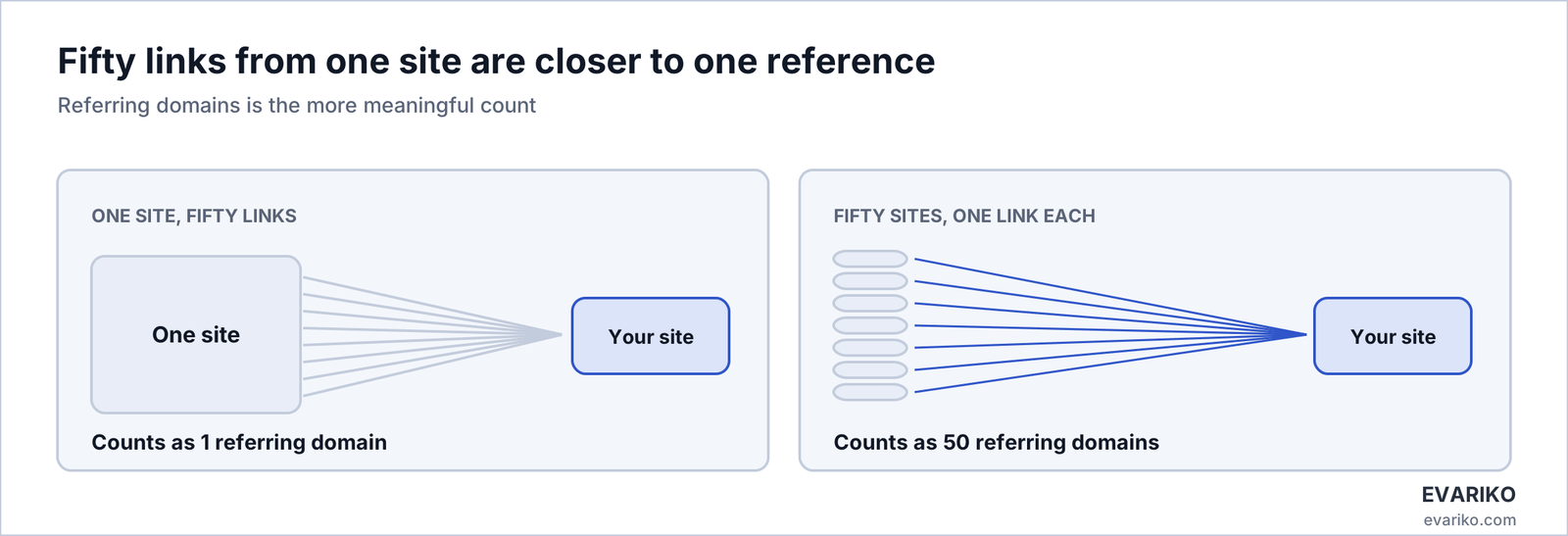
A referring domain is a distinct site that links to you at least once, which is the more meaningful count because fifty links from one site are closer to one reference than to fifty.
A brand mention is a reference to the business without a link, which still contributes to how recognisable the source is.
The mechanism is editorial. A link from a relevant page is a decision by someone else that your page was worth sending a reader to, and that decision is expensive enough to be hard to manufacture at scale.
Pages with more relevant referring domains tend to be retrieved more often, which is a tendency measured across many sites rather than a rule that holds for any particular one.
No public list of weights exists, and treating link counts as a target rather than a by-product is how sites acquire the kind of link profile that costs them visibility.
What earns references reliably is narrow:
- Original data. Something measured that nobody else has measured.
- A resource other people need to cite. A calculator, a dataset, a reference table.
- Genuine expertise placed where its audience already is. Contributed writing, interviews, conference material.
- Being the business people name. Branded search volume rises when the brand is worth naming, and it is among the hardest signals to fake.
One caution on tactics. Specific link-building services and platforms come and go, and SEO guides routinely recommend ones that have shut down or changed beyond recognition.
Before investing in any named tactic, confirm it currently operates. The methods that hold up, and the ones that stopped working, are covered in Link Building: How to Earn Backlinks That Count.
What is the difference between SEO, AEO, and GEO?
SEO earns visibility in search results, AEO earns the direct answer position, and GEO earns a citation inside a generated answer.
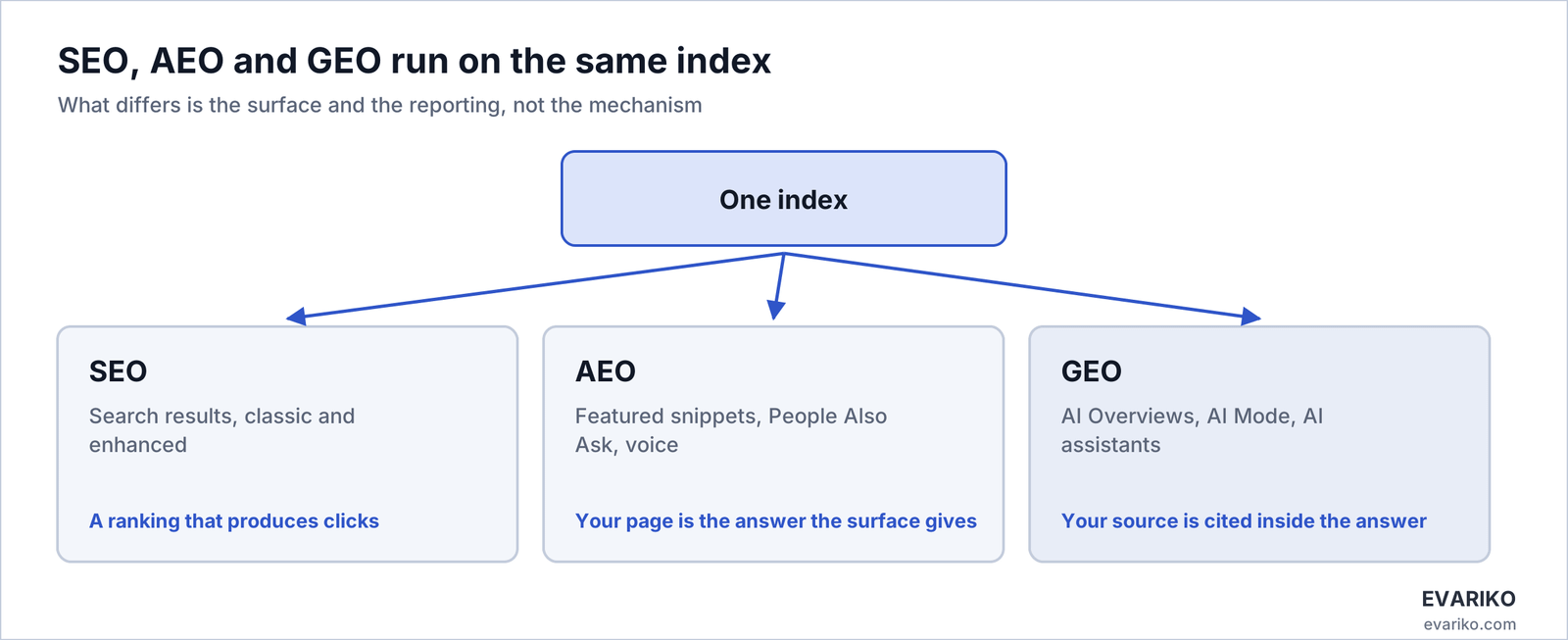
All three run on the same index, which is why most of the underlying work is identical and why the distinction is narrower than the marketing around it suggests.
| Term | What it targets | What success looks like |
|---|---|---|
| SEO | Search results, classic and enhanced | A ranking that produces clicks |
| AEO | The answer position: featured snippets, People Also Ask, voice responses | Your page is the answer the surface reads out or displays |
| GEO | Generated answers in AI Overviews, AI Mode and other AI assistants | Your source is cited inside the answer, with or without a click |
Three things genuinely differ in practice. The unit of success changes: a citation inside an answer may produce brand exposure and no visit, which is a real outcome that existing reporting was not built to count.
The measurement changes, and not for the better: Google reports AI Overview and AI Mode appearances inside the Performance report’s “Web” search type with no separate breakout, so the surface that matters most to GEO is the one you can least isolate.
The volatility changes: generated answers vary between sessions and between models, so a position held one week may not be held the next, for reasons the publisher cannot observe.
Everything else is SEO. Being crawlable, being indexed, answering the question in the first sentence under the heading that asks it, keeping the answer in text rather than in an image, covering a subject completely enough to be the obvious source.
Those were good practice before generated answers existed and they are what gets a source cited inside one. An honest reading is that AEO is a specialisation of SEO focused on extractable answers, and that most of what is sold as GEO is the same retrieval work with a different reporting surface.
The part that is genuinely new is the measurement problem, not the method. Each term is examined, with what it does and does not add, in Answer Engine Optimization (AEO): A Practical Definition.
How do I optimize my content for Google AI Overviews?
Google’s own position is the starting point: “There are no additional requirements to appear in AI Overviews or AI Mode.” A page must be indexed and eligible to appear in Search with a snippet. From that, four things follow, and all four are mechanical rather than speculative:
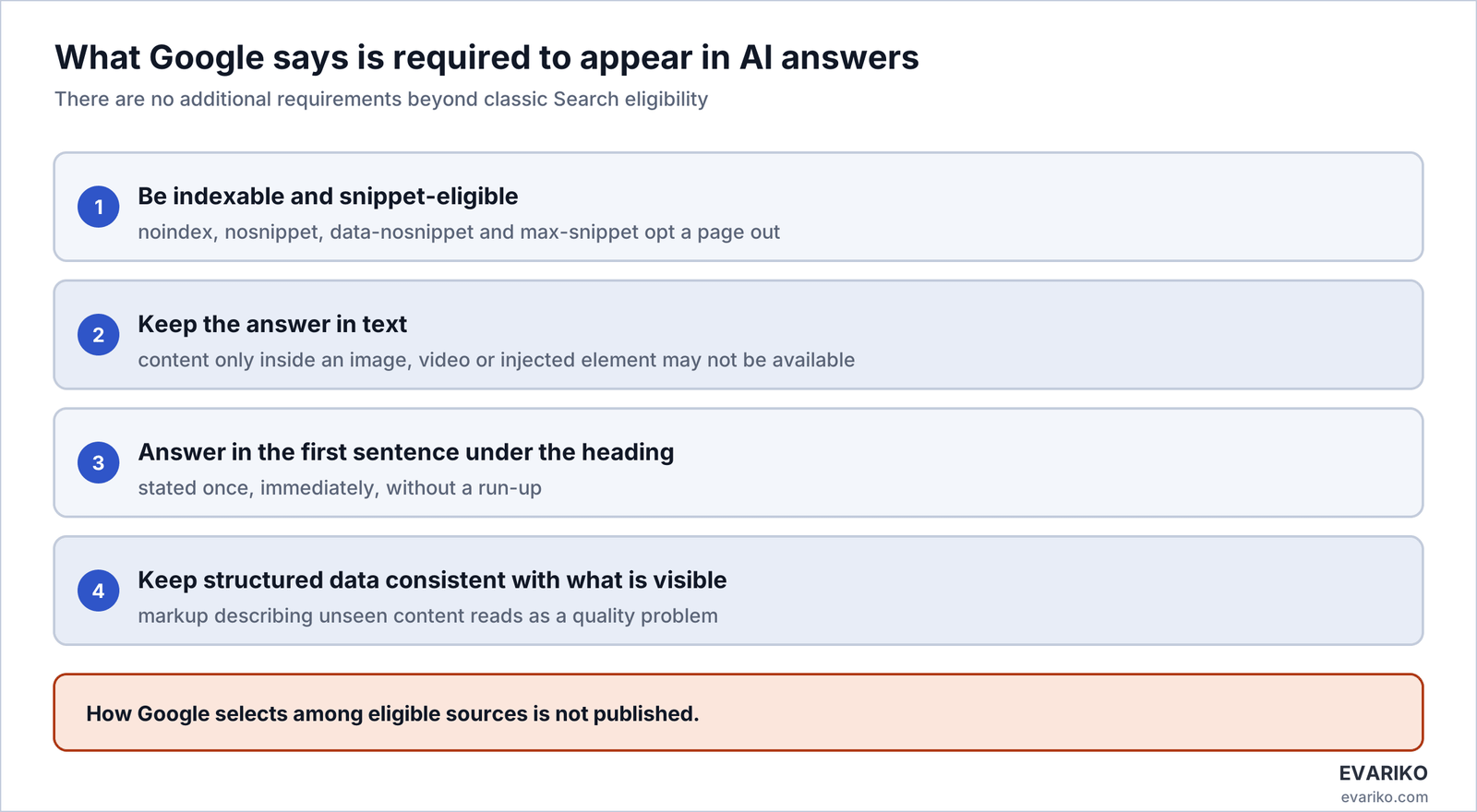
- Be indexable and snippet-eligible. A noindex or nosnippet directive removes the page from consideration. Google names nosnippet, data-nosnippet, max-snippet and noindex as the controls that limit appearance in Search including AI features, so a page using them is opting out.
- Keep the answer in text. Content that exists only inside an image, a video, or an element injected by a script may not be available to the systems building the answer.
- Answer in the first sentence under the heading that asks the question. An extractable answer is one that sits immediately after the question, stated once, without a run-up.
- Keep structured data consistent with visible content. Google names this among the standard practices that apply, alongside allowing crawling, using internal links and providing a good page experience.
What Google does not publish is how it selects among the many eligible sources for a given answer. That part is not known, and no technique on offer changes it reliably.
Where the boundary is genuinely unclear
Three things about AI search are not settled, and a guide that claims otherwise will age badly. Source selection inside generated answers is not documented: Google says what makes a page eligible, not what makes it chosen, and the vendor studies attempting to reverse-engineer it disagree and are each measured on a single sample.
Whether GEO is meaningfully distinct from SEO is genuinely contested, and the position taken here is a judgement rather than a fact: the mechanics overlap almost entirely while the measurement does not, which makes it a reporting discipline more than a technical one.
The magnitude of click loss on question-shaped queries is reported very differently by different vendors, and no vendor-independent measurement was found while researching this guide.
Where this guide gives a figure, it carries a source and a date. Where it does not, no figure was available that met that standard, and the gap is deliberate. What this means for GEO specifically is examined in Generative Engine Optimization (GEO): What It Is and What It Is Not.
How do you know whether SEO is working?
SEO is working when the chain from impression to enquiry is getting longer at the top and wider at each step.
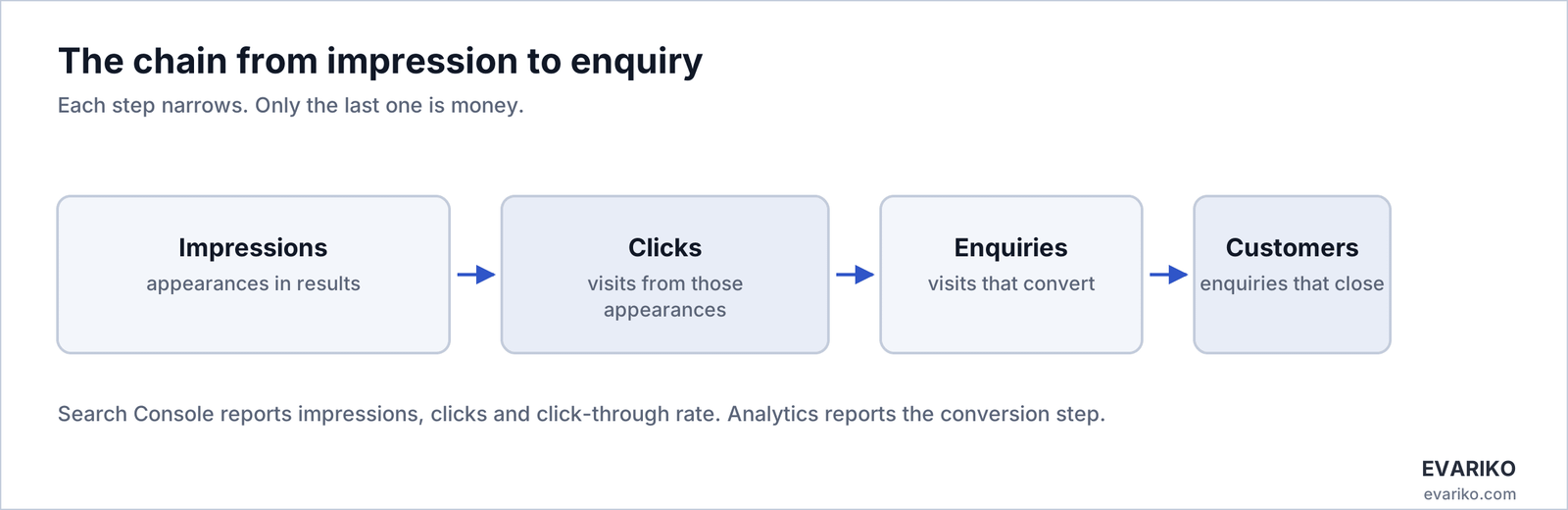
An impression is one appearance of your page in results for a query. A click is one visit from that appearance. Click-through rate is clicks divided by impressions. Conversion rate is the share of visits that become enquiries. Google Search Console reports the first three; Google Analytics 4 reports the fourth.
Running the arithmetic turns a list of metrics into a decision. The figures below are illustrative, chosen to show the chain rather than to report an account:
- Impressions: 12,000 per month for the query group
- Average position: 8, producing a click-through rate of roughly 2 per cent
- Clicks: 240 per month
- Enquiry conversion rate: 3 per cent
- Enquiries: 7 per month
- Enquiry to customer rate: 25 per cent, giving fewer than 2 customers per month
Now move the average position from 8 to 3, which typically lifts click-through rate into the 8 to 10 per cent band. The same 12,000 impressions produce roughly 1,000 clicks, 30 enquiries and 7 or 8 customers.
Nothing about the page’s conversion rate changed.
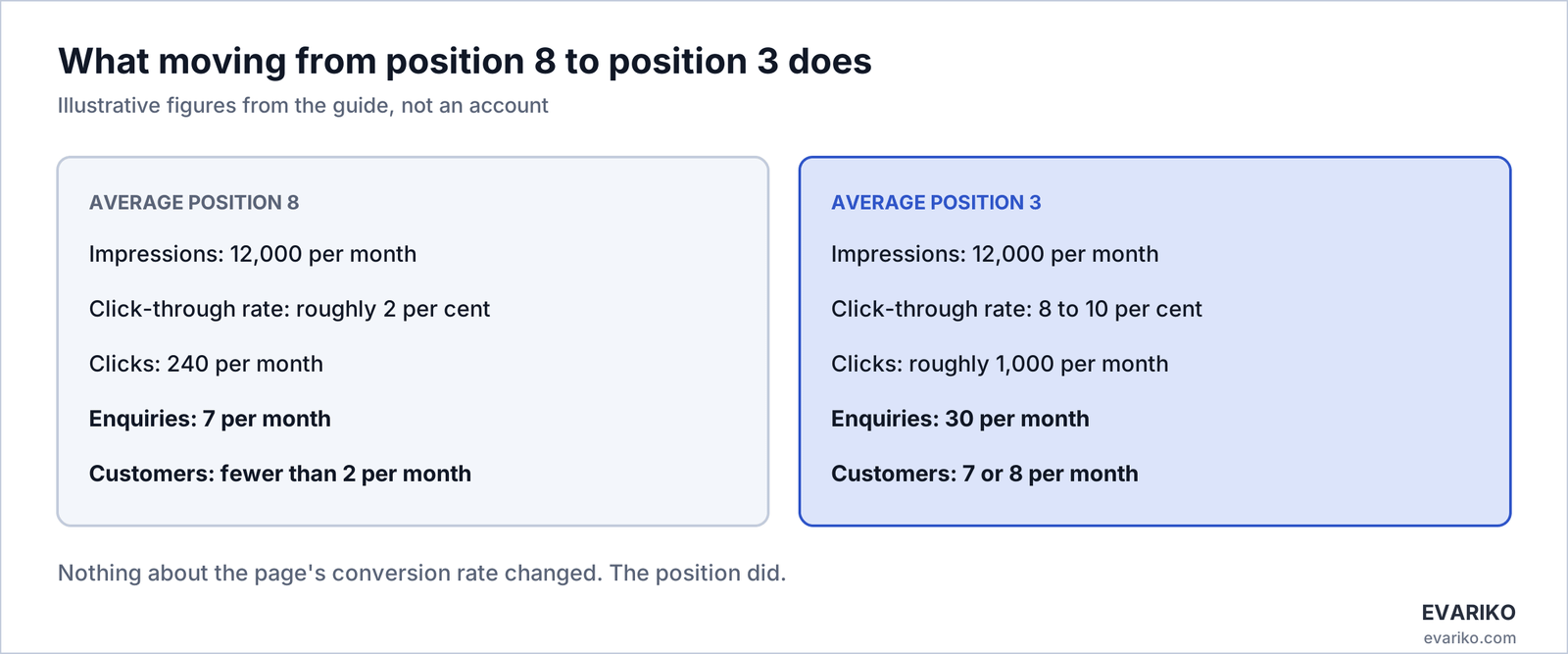
The position did, and the chain multiplied it.
That calculation is also what tells you when SEO is not the answer: if the query group only generates 300 impressions a month, no position improvement produces a meaningful number at the bottom of the chain, and the honest recommendation is a different channel.
What to watch, in order of how early it moves:
- Indexed page count, which moves first and tells you whether anything is eligible
- Impressions on new queries, which is the earliest genuine signal that coverage is being recognised
- Average position on the query groups the pages target
- Clicks and click-through rate, which lag position
- Enquiries, which lag clicks and are the only number the business actually spends
Search Console is where the first four of those metrics live, and the order listed above is the order to read them in.
How long does SEO take to show results?
How long SEO takes depends on four things, and a single figure for all sites does not exist.
The figure most often quoted traces to one undated vendor survey and is repeated across the major SEO publications without a date or a sample attached, which is reason enough not to repeat it again.
The four variables that drive the variance are existing index coverage, existing referring domains, competition in the target query set, and publication rate.
The table gives ranged expectations by site profile for the first genuine signal, which is impressions appearing on queries the site did not previously register for.
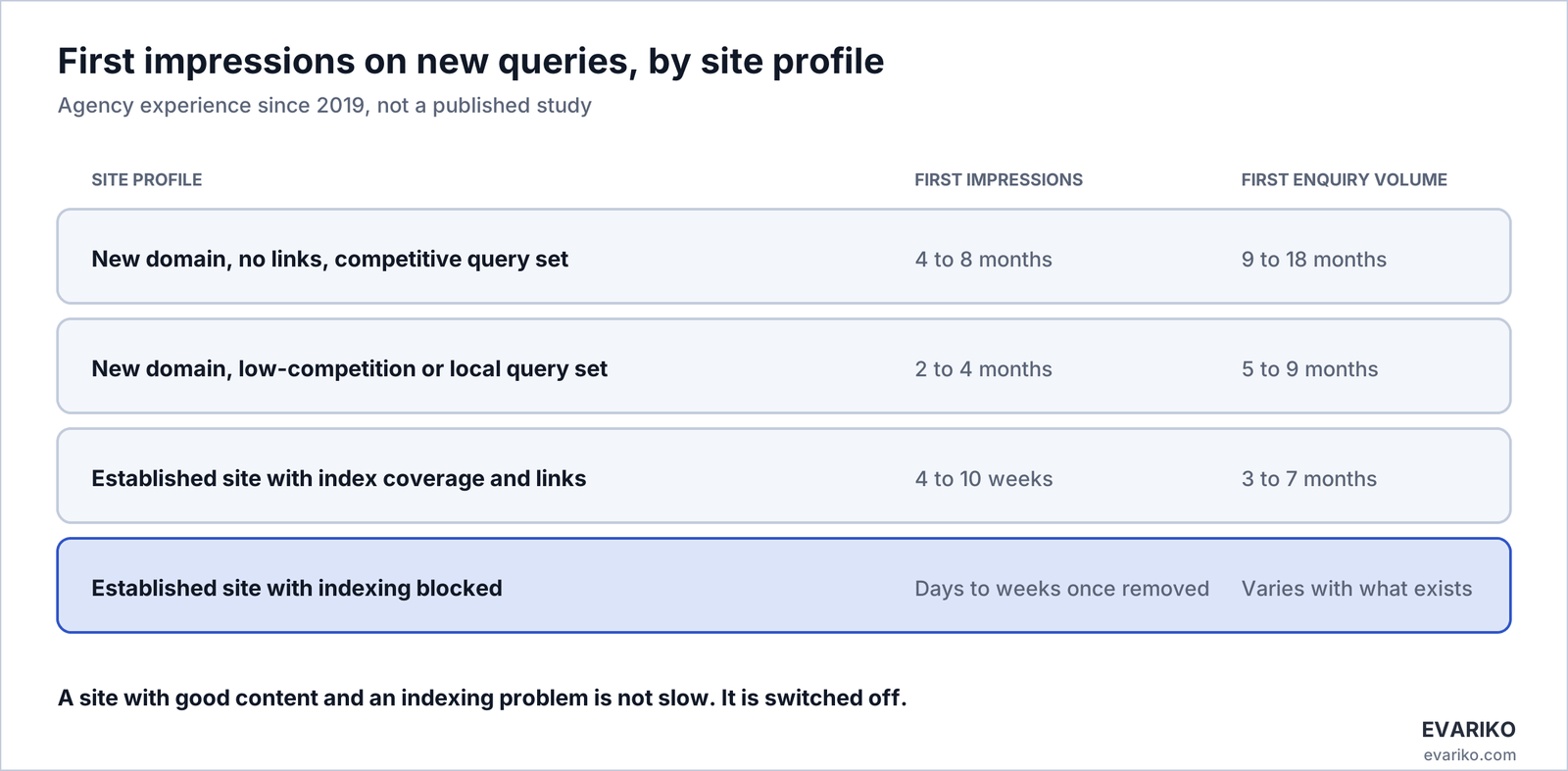
These ranges are drawn from agency experience across UK, US, Canadian and Australian clients since 2019, not from a published study, and they are stated as experience rather than as data.
| Site profile | First impressions on new queries | First meaningful enquiry volume |
|---|---|---|
| New domain, no links, competitive query set | 4 to 8 months | 9 to 18 months |
| New domain, low-competition or local query set | 2 to 4 months | 5 to 9 months |
| Established site with existing index coverage and links | 4 to 10 weeks | 3 to 7 months |
| Established site with a technical problem blocking indexing | Days to weeks once the block is removed | Varies with what was already written |
The fourth row is the one worth noting, because it is the most common pleasant surprise in this work. A site with good content and a crawling or indexing problem is not slow.
It is switched off, and switching it on produces results on a timescale nothing else in SEO matches.
Most of what makes SEO slow is not the work. It is the advice.
What SEO advice should you ignore in 2026?
Seven pieces of advice still circulating in 2026 cost businesses time and money, and each is wrong for a checkable reason rather than as a matter of opinion.
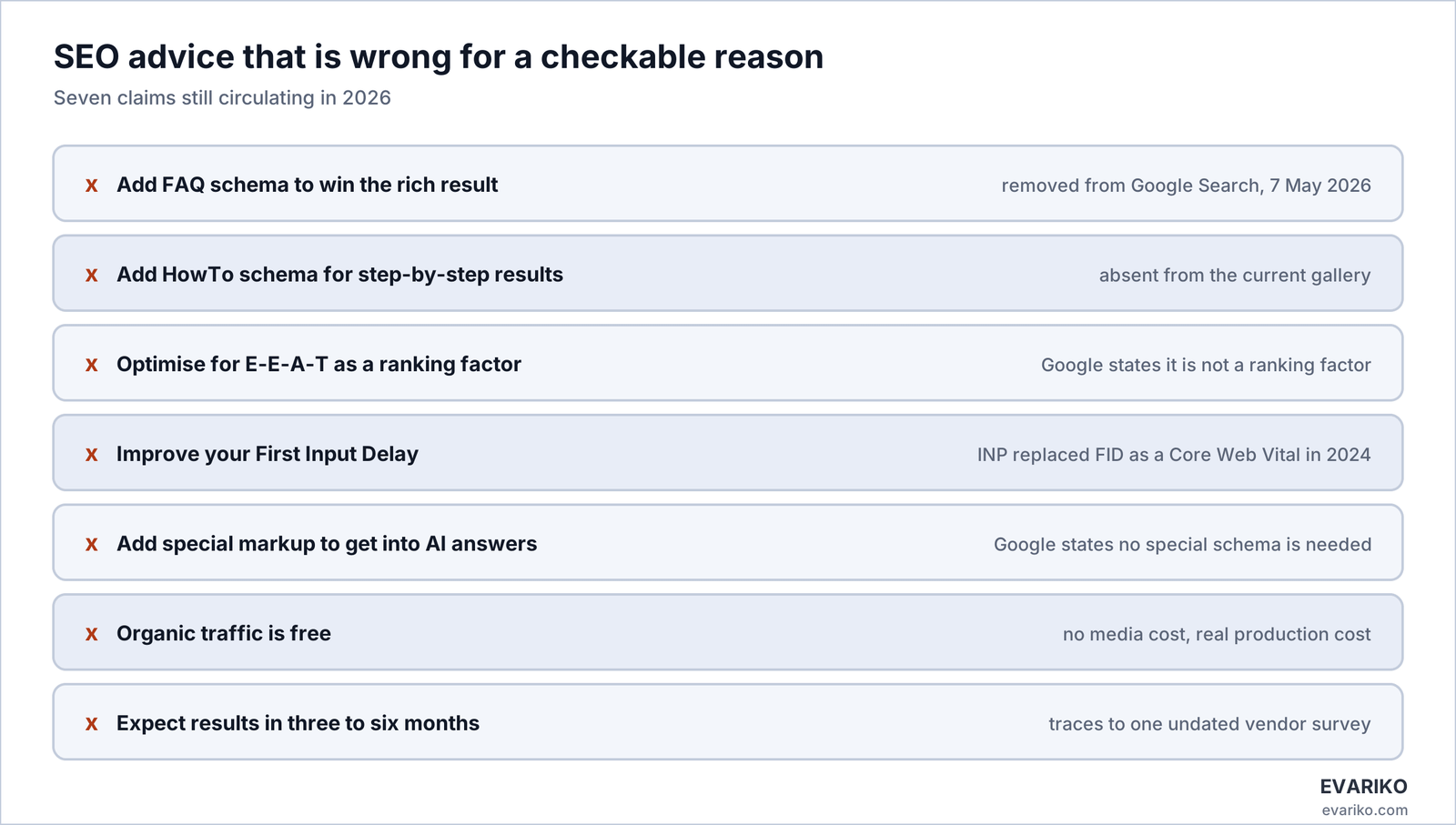
- “Add FAQ schema to win the rich result.” The FAQ rich result was removed from Google Search on 7 May 2026. The markup is harmless. The result it was added for no longer exists.
- “Add HowTo schema for step-by-step rich results.” HowTo no longer appears in Google’s current rich results gallery.
- “Optimise for E-E-A-T as a ranking factor.” Google states E-E-A-T is not a ranking factor and that rater data is not used directly in its ranking algorithms. Build the signals that accompany trust, not a score.
- “Improve your First Input Delay.” Interaction to Next Paint replaced FID and became a stable Core Web Vital in 2024. FID is not a Core Web Vital.
- “Add special files or markup to get into AI answers.” Google states there are no additional requirements, and no special schema.org structured data, to appear in AI Overviews or AI Mode.
- “Organic traffic is free.” It has no media cost and a real production cost. Businesses that believe the first half under-resource the work and then conclude SEO does not work.
- “Expect results in three to six months.” That figure comes from a single undated vendor survey. The variables that actually determine the timeline are listed above.
More of these, with what to do instead of each, are collected in 7 SEO Myths That Still Cost Businesses Money.
Which kind of SEO does your business need?
Which kind of SEO a business needs follows from where its customers search, not from which service sounds most comprehensive. A business serving customers who come to a physical location needs its Google Business Profile, its citations and its location pages working before anything else, because the local pack resolves those queries before organic results are read.
A business selling a catalogue online needs category and product page structure first, because that is where commercial queries land.
A business selling a service nationally or across borders needs depth on the questions buyers ask before they enquire, and a business operating in several countries needs its market targeting correct before any of that work compounds.
A practical starting point for most sites is the on-page work, because it is entirely within the business’s control and it is where the gap between what a page says and what a query asks is usually widest. The element-by-element version is in On-Page SEO Checklist: Every On-Page Element That Matters in 2026.
Can I do SEO myself or should I hire an agency?
Some businesses should do their own SEO, and saying so is more useful than the alternative. If you have one site, a narrow service area, time to learn, and someone who writes well about the subject already, the on-page and local work is learnable and the results are real.
Free checklists cover most of it, and a business that does its own keyword research and writes its own pages usually produces better content than an outsourced writer with no operational knowledge, because the detail that signals experience cannot be briefed in.
Hiring makes sense at three points. When the technical work exceeds what is safe to attempt without developer experience, because a mistaken robots.txt rule or canonical change can remove a site from results.
When the volume of content required exceeds what one person can produce alongside running a business. And when the query set is competitive enough that competing requires research depth, not just effort.
If you reach that point, the questions worth asking are in How to Choose an SEO Agency: Questions That Separate Good From Bad.
The short version: ask what the first ninety days produce, ask who writes the content and what they know about your field, ask to see a page they are proud of, and treat any guarantee of a specific ranking as a reason to end the conversation.
How much does SEO cost per month?
SEO cost is driven by scope, competition and content volume, and no single monthly figure is standard for the market.
Published rate studies circulate widely and most carry no date, no sample description and no market segmentation, which makes them unsuitable to quote.
What can be stated honestly is the shape of the market and what moves a quote within it.
| Engagement shape | What it typically includes | What drives the price |
|---|---|---|
| One-off project | Technical audit, keyword research, on-page fixes to an existing site | Site size and the number of pages requiring work |
| Monthly retainer, content-led | Ongoing publication, on-page work, internal linking, reporting | Pages produced per month and the research depth each needs |
| Monthly retainer, full scope | The above plus technical work, off-page activity, local or international targeting | Market competition and the number of markets or locations |
Three things move a quote more than anything else. Content volume, because research and writing are the largest cost in any serious engagement. Competition in the query set, because displacing strong incumbents requires depth that thin markets do not.
Market and language count, because each additional market multiplies the content, not just the configuration. A quote that does not change when you describe these has not been priced against your situation.
Anyone comparing proposals should be asking what is produced each month, who produces it, and what the first report will contain.
Pricing structures and what each one suits are set out in SEO Pricing: What Agencies Charge and Why. If you would rather have the work done than learn it, that is what this agency does, across the UK, United States, Canada and Australia.
Is SEO free?
No. Organic placement is not bought, and the research, writing and technical work that earns it has a real cost.
Can anyone guarantee a number one ranking?
No. Nobody controls search results, and a provider offering a guaranteed position is describing something outside their control.
Does SEO still work if AI answers the question?
Yes. AI Overviews and AI Mode are generated from pages in Google’s index, so being indexed and clearly written is still the entry requirement.
Do you need to publish every week to rank?
No. Publication rate affects how quickly coverage accumulates, not whether an individual page can rank.